
End-to-end test automation
TestSprite can build test plans, write code, execute tests, debug failures, and generate reports with minimal input from the user.

TestSprite is an AI testing agent and automation platform for software teams to plan, generate, run, debug, and report tests with minimal input.
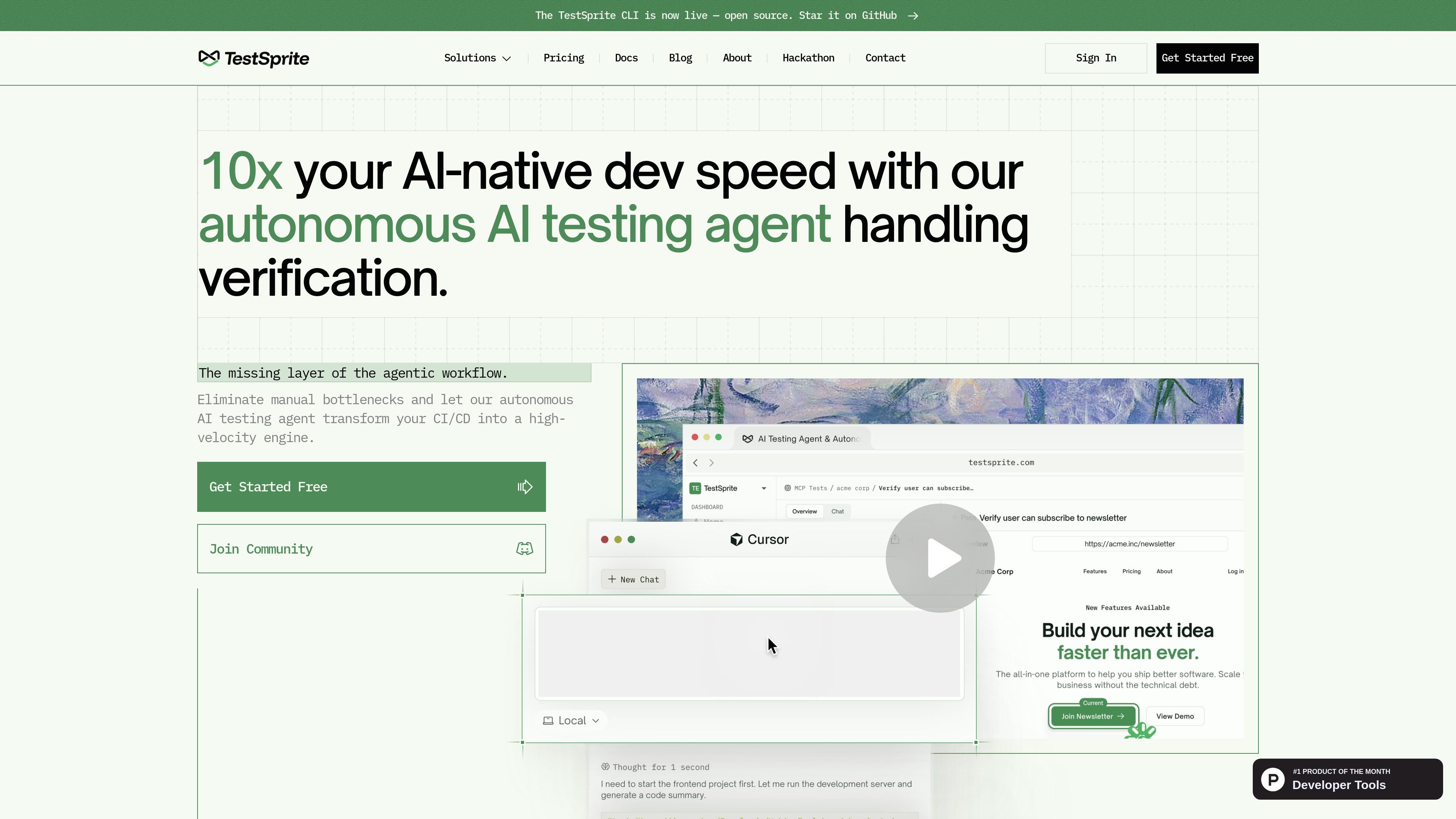
TestSprite is an AI testing agent and automation platform for software teams that need verification alongside code generation. It is positioned as an autonomous layer that can help turn AI-generated code into production-ready software by planning tests, generating code, running tests, diagnosing failures, and reporting results.
Across the homepage, pricing page, and MCP solution page, TestSprite presents a workflow that starts from requirements or codebase context, creates tests and test plans, runs them in cloud environments, and sends feedback back to the coding agent or development workflow. The product is aimed at AI-native development stacks, dev teams, and users working with tools such as Cursor and Claude Code.
TestSprite can build test plans, write code, execute tests, debug failures, and generate reports with minimal input from the user.
The MCP page says TestSprite can parse product specification documents or natural language intent, then generate a standardized PRD document, test plans, test cases, and test code.
The product describes ephemeral cloud sandboxes for validating UI flows, API logic, and edge cases before code reaches a human reviewer.
The pricing page lists backend integration test chains, automatic frontend and backend workflows, and auto-healing reruns for failed tests.
The MCP workflow sends structured feedback and precise suggestions back to coding agents such as Cursor and Claude Code to close the loop on failures.
The pricing page includes test scheduling, GitHub Action / CI integration, and an IDE plugin via MCP for tools such as Claude Code and Codex.
Use TestSprite when you want an AI coding agent to verify its own output instead of leaving final QA to a manual pass. The product is designed to provide the feedback loop that helps generated code converge on working behavior.
Use the MCP workflow when you have a PRD or other product intent and want tests derived from that input. TestSprite can parse the document or intent, create a standardized PRD, and generate test plans and test cases from it.
Use the platform for UI, API, and edge-case validation in cloud sandboxes before a human reviewer sees the changes. The source specifically mentions validating UI flows, API logic, and complex edge cases.
Use the scheduling and CI features when you want repeated regression checks over time. The pricing page calls out test scheduling and GitHub Action / CI integration for ongoing verification.
Use the IDE plugin or MCP integration when you are working inside tools such as Cursor, Claude Code, or Codex and want testing feedback returned to the coding agent in the same workflow.
TestSprite is designed to take minimal input and then build test plans, write code, execute tests, debug failures, and report results. The MCP page also describes a workflow that parses product specifications or natural language intent, generates standardized PRD documents, creates test plans and test cases, runs tests in remote cloud environments, and sends structured feedback back to the coding agent.
The source describes TestSprite as a fit for AI-native development stacks, coding agents, and dev teams that want self-serve testing across multiple scenarios. The MCP page specifically highlights use with tools such as Cursor and Claude Code, and the pricing page lists an IDE plugin via MCP along with GitHub Action / CI integration.
The pricing page shows Free, Starter, Standard, and Enterprise plans. Free includes 150 credits per month, Starter is listed with a first-month discount and then $19 from the second month, Standard is $69 per month, and Enterprise uses custom pricing.
The pricing page lists automatic frontend and backend workflows, backend integration test chains, auto-healing rerun, test file uploads, test scheduling, and IDE plugin support via MCP. The solution pages also describe cloud-based execution and feedback loops back to the coding agent.
The source highlights remote cloud execution and ephemeral cloud sandboxes, but it does not provide a detailed list of supported frameworks, cloud providers, or deployment environments on the pages reviewed.

ByteAsk is a terminal-first AI coding agent for C and C++ that edits repos and verifies changes with compilers, debuggers, sanitizers, and tests.

Manta AI is an autonomous web app testing tool that maps app behavior, catches regressions, and generates tests from a URL, no scripts or selectors needed.

Lasso is an ecommerce product data platform for enriching catalog records, processing supplier files, generating product content, and tracking competitors. It includes a web app, REST API, SDK, and MCP server.

CreateOS Sandbox is an isolated compute environment for running code and agent workloads in Firecracker micro-VMs with private networking and SDK, CLI, or MCP control.

hob is an independent workspace for coding agents, with local control over sessions, terminals, history, routing, and follow-up work.

Ably Chat is a chat API platform for custom realtime chat apps, with rooms, typing indicators, presence, reactions, message updates and usage-based pricing.