

Universal Gas Framework (UGF)
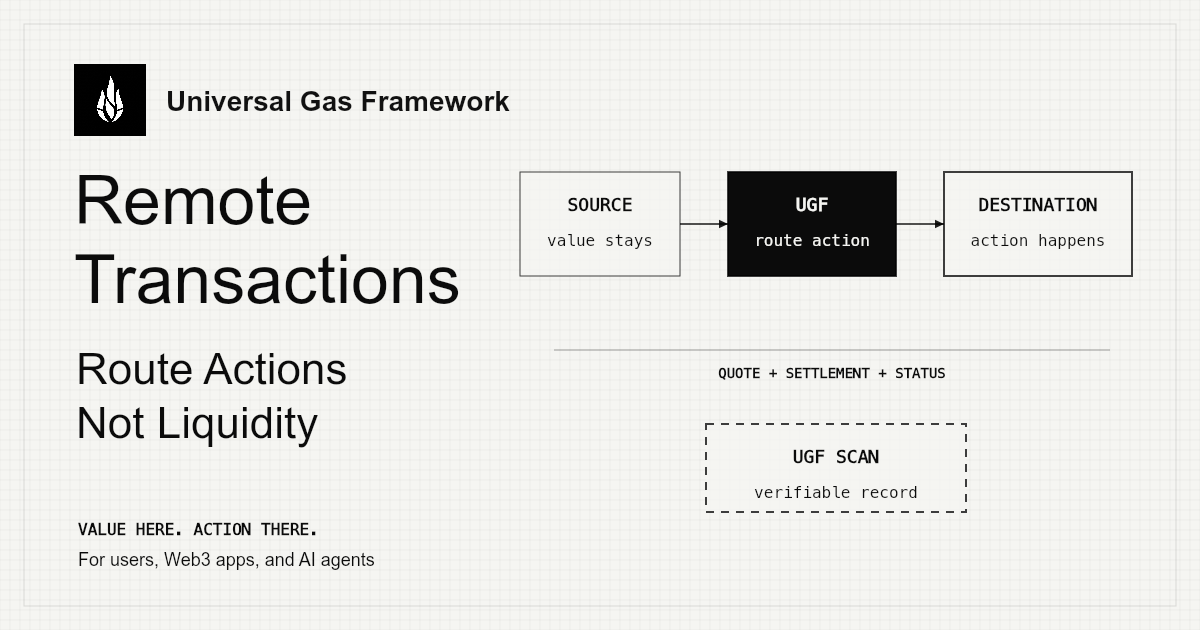
Universal Gas Framework (UGF) is a remote transaction framework that converts source-chain value into destination-chain actions for developers and agents.
What is Universal Gas Framework (UGF)?
Universal Gas Framework (UGF) is a remote transaction framework for developers and agents. Its core purpose is to let “source-chain” value be turned into “destination-chain” action, so users can trigger outcomes on a different chain than where the initial value originates.
Key Features
- Remote transactions: enables transaction execution in a remote manner, oriented toward developer and agent workflows.
- Cross-chain value to action: maps value available on a source chain into executable behavior on a destination chain.
- Developer- and agent-oriented design: positioned for integration into automated or programmatic systems rather than only manual interactions.
How to Use Universal Gas Framework (UGF)
- Identify the source chain where the relevant value originates.
- Define the destination chain action you want to execute.
- Use UGF from your application or agent to submit the remote transaction workflow that connects source-chain value to destination-chain execution.
Use Cases
- A developer builds an app where a user’s assets are on one chain, but the app’s outcome must be executed on another chain.
- An automated agent triggers actions on a destination chain based on value or state from a source chain.
- A system operator wants a standardized way to coordinate cross-chain “value-in, action-out” flows without manually managing multiple transaction steps.
- A team designing multi-chain user experiences uses UGF to align source-chain inputs with destination-chain effects.
FAQ
-
What does “remote transactions” mean in UGF? The product is described as enabling remote transaction execution for developers and agents, suggesting programmatic submission rather than manual wallet-only flows.
-
How does UGF relate to source-chain and destination-chain? UGF is described as turning source-chain value into destination-chain action, aligning a value origin on one chain with execution on another.
-
Who is UGF intended for? The site positions UGF for developers and agents.
-
Is UGF a general cross-chain bridge? The provided description emphasizes remote transactions and source-chain-to-destination-chain action. Without additional page details, it’s best understood as a framework for cross-chain execution rather than confirming support for all bridge scenarios.
-
What do I need to get started? Based on the description, you’ll need to specify a source chain and the destination-chain action your workflow should produce.
Alternatives
- Cross-chain messaging or bridging middleware: categories of tools that coordinate message passing or value transfer across chains; they typically focus on delivering payloads or assets to another chain.
- Multi-chain transaction orchestrators: solutions that coordinate multi-step transactions across networks; they differ by centering orchestration rather than explicit source-to-destination value mapping.
- Custom smart-contract-based cross-chain handlers: teams implement cross-chain behavior directly using contracts and off-chain relaying; this shifts responsibility from a framework to your own architecture.
Alternatives

AakarDev AI
AakarDev AI is a powerful platform that simplifies the development of AI applications with seamless vector database integration, enabling rapid deployment and scalability.

Arduino VENTUNO Q
Arduino VENTUNO Q is an edge AI computer for robotics, combining AI inference hardware and a microcontroller for deterministic control. Arduino App Lab-ready.

Devin
Devin is an AI coding agent that helps software teams complete code migrations and large refactoring by running subtasks in parallel.

OpenUI
OpenUI is the open standard for generative UI, helping AI apps respond with structured user interfaces built from registered components.

Codex Plugins
Use Codex Plugins to bundle skills, app integrations, and MCP servers into reusable workflows—extending Codex access to tools like Gmail, Drive, and Slack.

Ably Chat
Ably Chat is a chat API and SDKs for building custom realtime chat apps, with reactions, presence, and message edit/delete.