Web Speed
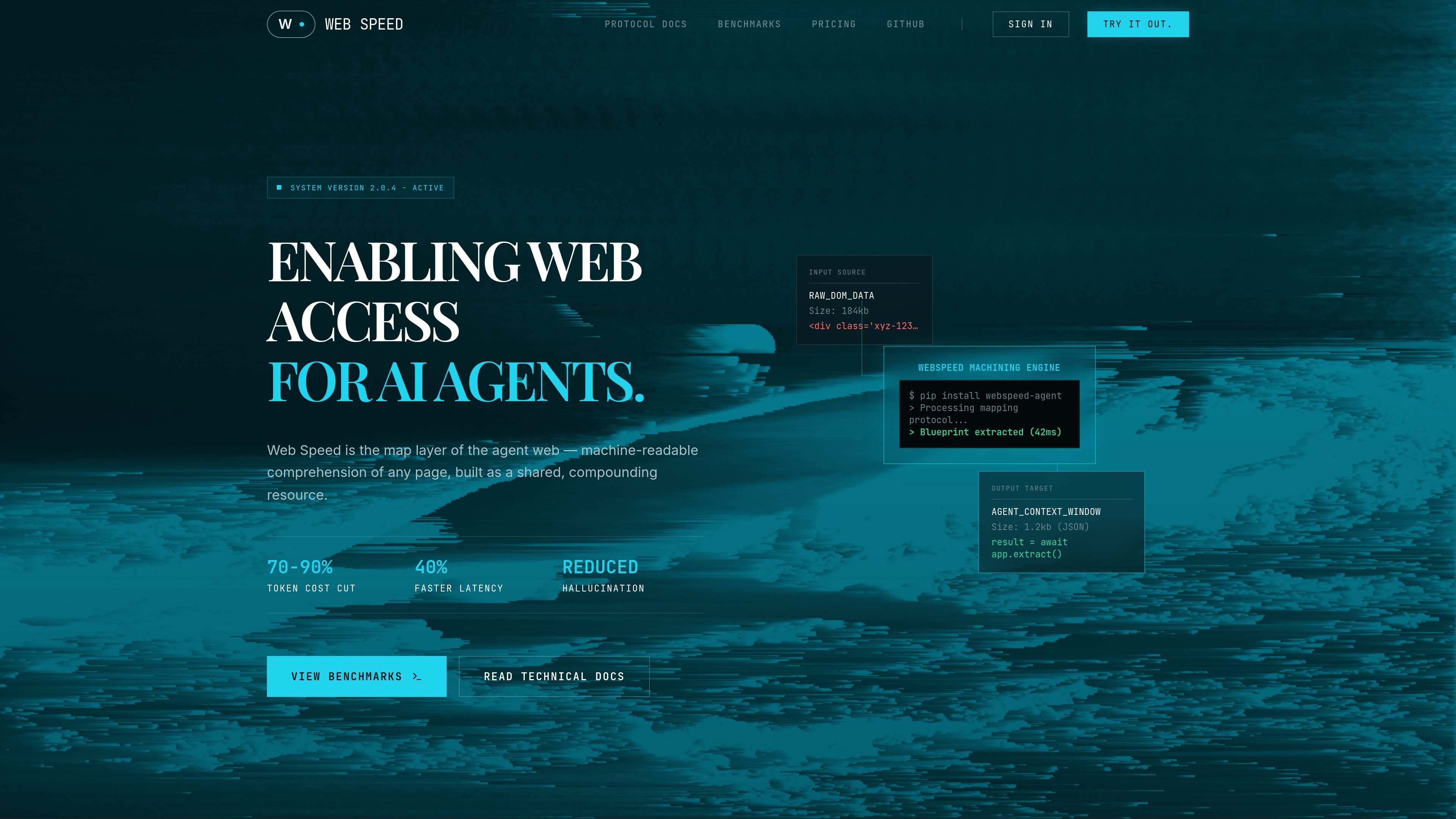
Web Speed translates websites into structured, token-efficient JSON for AI agents, with deterministic outputs built for reliable agent workflows.
What is Web Speed?
Web Speed is an “agentic web adaptation layer” that translates websites into structured JSON intended for AI agents. Its core purpose is to make web content more token-efficient and deterministic for downstream AI workflows.
Rather than sending raw pages directly to an agent, Web Speed produces a consistent, structured representation that agents can consume reliably.
Key Features
- Website-to-JSON translation for AI agents, turning web content into structured data rather than unstructured page text.
- Token-efficient output to reduce the amount of text agents need to process.
- Deterministic behavior, designed to produce consistent structured results across runs.
- An adaptation layer approach that focuses on preparing web content for agent workflows.
How to Use Web Speed
- Provide a target website (the page/content you want an agent to work with).
- Run Web Speed to translate the website into structured JSON.
- Feed the resulting JSON into your AI agent or agent pipeline as the agent’s input.
Use Cases
- Building agent workflows that need structured web inputs (e.g., turning page content into a format an agent can reason over step-by-step).
- Creating deterministic scraping/reading behavior for agent tasks where repeatability matters.
- Reducing token usage for agent prompts by supplying structured JSON instead of large volumes of raw page text.
- Preparing website-derived data for automation tasks such as information extraction and subsequent action planning by an agent.
- Standardizing how an agent “sees” different websites by converting them into a consistent JSON schema.
FAQ
What does Web Speed output?
Web Speed translates websites into structured JSON intended for AI agents.
Is Web Speed aimed at end users or developers?
Based on its focus on producing agent-ready JSON, Web Speed is best suited to developers and teams building agent workflows.
Does Web Speed help reduce token usage?
Yes—its output is described as token-efficient for AI agents.
Is the output consistent between runs?
Web Speed is described as deterministic, with the goal of consistent structured results.
What should I do with the JSON?
Use it as input to your AI agents or agent pipelines in place of raw website content.
Alternatives
- General-purpose web scrapers plus custom parsing: Instead of a dedicated agentic adaptation layer, you extract HTML and build your own structured JSON pipeline.
- RAG pipelines for web content: If your goal is retrieval-augmented answers, you may convert pages into documents/embeddings rather than agent-ready JSON.
- DOM/HTML-to-structured extraction tools: Tools that extract fields from pages can produce structured data, but may not be tailored to token efficiency and deterministic agent inputs.
- Agent-oriented browsing/scraping frameworks: Some frameworks provide higher-level agent web interaction, but may not specifically translate pages into the same structured JSON layer described here.
Alternatives
AakarDev AI
AakarDev AI is a powerful platform that simplifies the development of AI applications with seamless vector database integration, enabling rapid deployment and scalability.
BenchSpan
BenchSpan runs AI agent benchmarks in parallel, captures scores and failures in run history, and uses commit-tagged executions to improve reproducibility.
Edgee
Edgee is an edge-native AI gateway that compresses prompts before LLM providers, using one OpenAI-compatible API to route 200+ models.
Pioneer AI by Fastino Labs
Pioneer AI by Fastino Labs is an agentic fine-tuning platform that improves open-source language models with Adaptive Inference and continuous evaluation.
Codex Plugins
Use Codex Plugins to bundle skills, app integrations, and MCP servers into reusable workflows—extending Codex access to tools like Gmail, Drive, and Slack.
Whirr
Whirr is a quiet macOS menu bar app that mirrors Claude Code agent activity to your Mac’s notch—so you can glance without watching the screen.