

AGEN
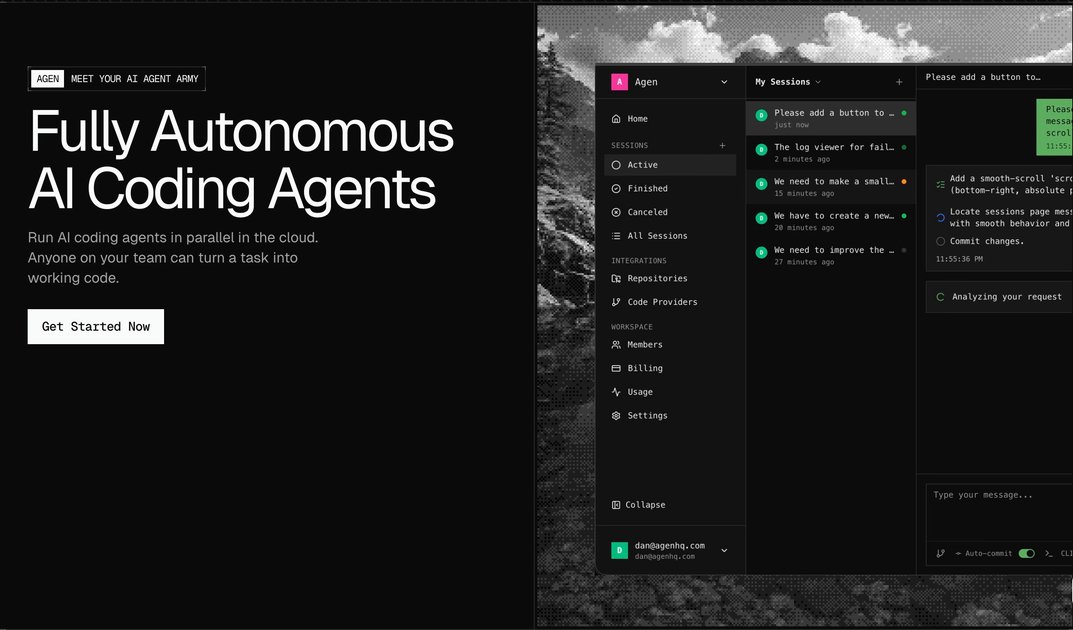
AGen fully autonomous AI coding agents in the cloud clone repos, inspect code, edit files, run commands and deliver passing pipelines as merge requests.
What is Agenhq?
Agenhq (AGEN) provides fully autonomous AI coding agents that take a software task from a prompt and work through it until the job is complete. The agents run in the cloud, clone repositories, inspect code, edit files, and execute commands in isolated sandboxes.
Its core purpose is end-to-end coding assistance: agents plan the work, fix build/test pipelines as needed, and produce working code in a Git-native workflow that can be reviewed and merged by technical users.
Key Features
- Fully autonomous agent workflow (prompt → work → completion): The agent plans steps, explores the codebase, edits files, and continues until the task is finished.
- Repository cloning and codebase inspection: Agents clone your repositories and inspect the codebase before making changes.
- Isolated cloud sandbox execution: Agents run commands inside isolated cloud sandboxes to support verification of changes.
- Self-fixing pipeline behavior: Agents can address issues in pipelines as part of completing the task, rather than stopping after a first attempt.
- Parallel execution for multiple agents: Multiple agents can run at once to tackle several software tasks simultaneously.
- Git-native workflow with merge requests: Changes are committed to branches and prepared as merge requests for review.
How to Use Agenhq
- Assign a task: Provide what you want done in a prompt.
- Let the agent plan and start: Agenhq creates a plan and begins work immediately.
- Review the output: The agent executes builds/tests and finishes the task by producing working code.
- Use the Git workflow for approval: Changes are prepared as merge requests on branches so technical users can review and merge.
Use Cases
- Fixing CI/CD pipeline failures: Ask the agent to diagnose and correct issues so pipelines pass, with the agent executing commands in isolated sandboxes to verify changes.
- Implementing feature tasks from a prompt: Provide a development request (e.g., add functionality or adjust behavior), and let the agent plan steps and modify the repository until it results in working code.
- Running multiple development efforts in parallel: Start several agents at the same time to complete separate tasks concurrently and then review each agent’s merge requests.
- Maintaining code across a team: Enable multiple team members to start agents and contribute to the same codebase while keeping changes aligned to a Git-native review flow.
- Validating changes via build/test execution: Use the agent to run builds, tests, and services during the task so the final output is ready for pipeline completion.
FAQ
-
Does Agenhq require local setup to run the agents? The agents are described as running in isolated cloud sandboxes, with the product including the cloud environment they run in.
-
What does the agent produce when it finishes? The end result is described as working code, with changes committed to branches and prepared as merge requests for review.
-
Can multiple tasks run at the same time? Yes. The platform supports running many agents in parallel.
-
Who can start an agent and contribute to the codebase? The page states that anyone on your team can start an agent and contribute to the codebase.
-
Are pipelines checked during the task? The description indicates agents can run and fix pipelines and verify changes by executing builds/tests/services before finishing.
Alternatives
- General-purpose AI coding assistants (IDE chat/code completion): These tools typically help generate or edit code locally or in an editor workflow, but they may not provide end-to-end autonomous execution in cloud sandboxes or a Git-native agent workflow.
- Workflow automation for CI/CD debugging (scripted bots): Instead of autonomous agents that inspect and edit repositories step by step, these solutions use predefined scripts or rules to respond to pipeline failures.
- Repository-scoped code review and change generation tools: Some tools focus on proposing changes or generating diffs for review, but may not perform full prompt-to-verified pipeline execution.
- Cloud-based developer sandboxes with manual agent control: This approach can provide isolated execution environments, but requires users to orchestrate or drive the steps more directly than fully autonomous agents.
Alternatives

Devin
Devin is an AI coding agent that helps software teams complete code migrations and large refactoring by running subtasks in parallel.

Claude Opus 4.5
Introducing the best model in the world for coding, agents, computer use, and enterprise workflows.

Codex Plugins
Use Codex Plugins to bundle skills, app integrations, and MCP servers into reusable workflows—extending Codex access to tools like Gmail, Drive, and Slack.

Falconer
Falconer is a self-updating knowledge platform for high-speed teams to write, share, and find reliable internal documentation and code context in one place.
OpenFlags
OpenFlags is an open source, self-hosted feature flag system with a control plane and typed SDKs for progressive delivery and safe rollouts.

AakarDev AI
AakarDev AI is a powerful platform that simplifies the development of AI applications with seamless vector database integration, enabling rapid deployment and scalability.