
Platform plus publishing house
Presents itself as both a platform and a publishing house, indicating it supports entrepreneurs through a combination of software and publishing-oriented services.

Audos is a platform and publishing house for everyday entrepreneurs launching AI-native companies, with product and publishing support.
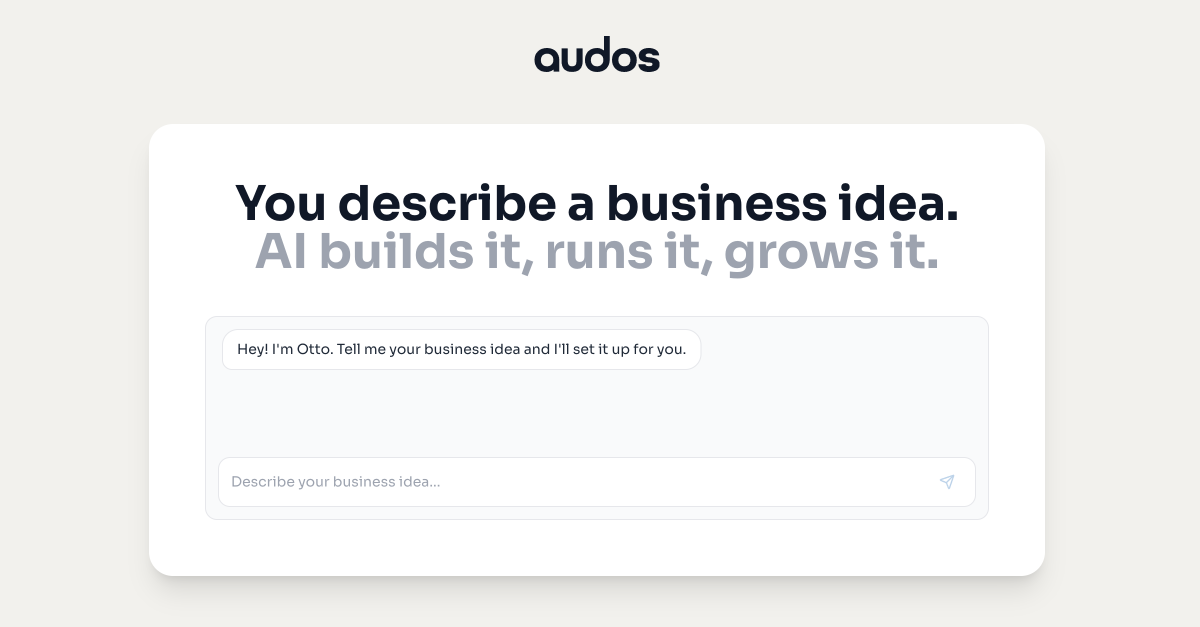
Audos is a platform and publishing house for everyday entrepreneurs starting AI-native companies. The site positions it around helping people launch businesses built with AI at the center, rather than retrofitting AI into an existing model.
Based on the available source, Audos appears to combine product and publishing-oriented support in one offering. The provided pages do not describe the full workflow, but they do show that the company publicly presents a product with its own pricing page and a distinct brand identity.
Presents itself as both a platform and a publishing house, indicating it supports entrepreneurs through a combination of software and publishing-oriented services.
Focuses on everyday entrepreneurs rather than a narrow technical audience, which suggests the product is intended for people building businesses with limited specialization.
Centers on AI-native companies, making the product relevant for founders who are starting businesses designed around AI from the outset.
Includes a dedicated pricing page, which indicates the product is packaged as a marketable offering rather than an informal service.
Has a separate `/nocap` page on the site, but the provided source does not explain what the page does or how it fits into the product.
A founder who wants to start an AI-native company can use Audos as the product framing for that kind of venture.
An everyday entrepreneur looking for a platform-oriented starting point can use Audos as a branded place to begin exploring company formation.
A reader evaluating whether a product includes commercial packaging can use the pricing page to confirm that Audos is publicly offered as a product.
Someone comparing positioning across startup tools can use Audos to understand a platform that combines software framing with publishing-house language.
Audos describes itself as a platform and publishing house for everyday entrepreneurs starting AI-native companies.
The source does not describe a sign-up flow or onboarding process, so setup details are not available from the page content provided.
The provided pricing page text only confirms that a pricing page exists; it does not show plan names, prices, or limits.
The available source content does not list integrations, supported tools, or product limits.

Skills Janitor is a GitHub-hosted set of slash commands for auditing, tracking, and cleaning up Claude Code and OpenAI Codex skills.

Grok 4.7 is an xAI model for coding and knowledge work, available via Grok Build, Cursor, the Grok API and more, from $2 per million input tokens.

ClawTick is an AI agent automation platform for scheduling jobs from the CLI, dashboard, or REST API. Built for developers and teams using LangChain, CrewAI, webhooks, or custom workflows with monitoring, alerts, and logs.

Falconer is an AI-powered company brain that keeps internal docs accurate, searchable, and up to date by syncing with GitHub, Slack, and Linear.

OpenFlags is an open-source, self-hosted feature flag platform for JavaScript teams, with local evaluation, targeted rollouts, and controlled launches.

AakarDev AI helps teams manage AI provider access, project setup, logs, and analytics in one dashboard. BYOK support included.