
Dedicated PostgreSQL database
Each project has a dedicated PostgreSQL database with an isolated schema, versioned migrations, native RLS, and automatic TypeScript type regeneration whenever the schema changes.

Aurabase is an all-in-one backend platform with dedicated PostgreSQL, authentication, S3 storage, realtime, Edge Functions, and AI services for open-standard development in Europe.
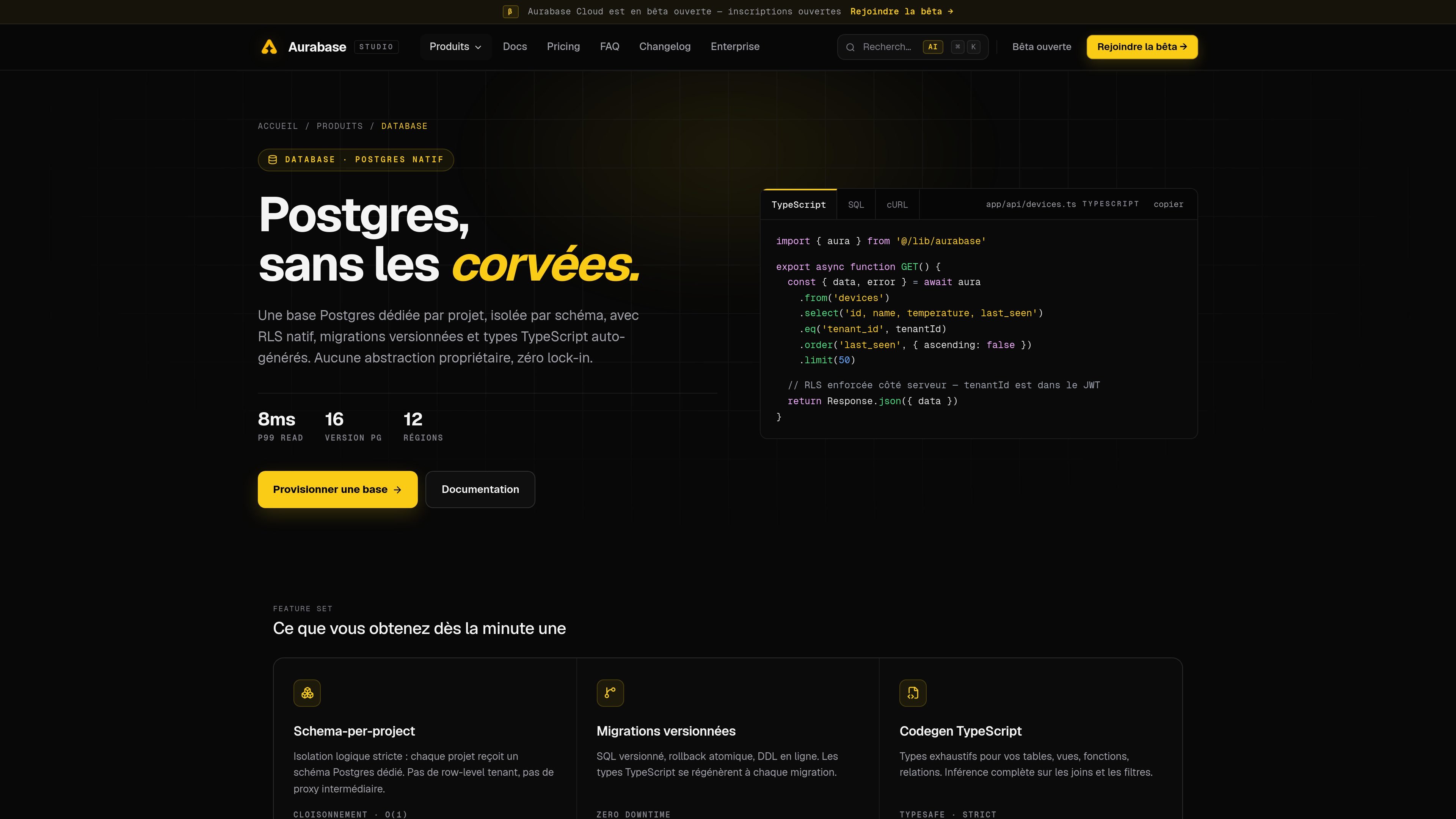
Aurabase is an all-in-one backend platform designed to bring together, in a single product, the building blocks most modern applications commonly use: a PostgreSQL database, authentication, file storage, realtime, server functions, and observability. The site positions it as a sovereign alternative to Supabase and Firebase, with hosting in Europe and an emphasis on GDPR, project isolation, and the absence of proprietary lock-in.
The documentation and product page show a developer-oriented approach: a typed JavaScript SDK, REST references, TypeScript codegen, versioned migrations, and built-in primitives to reduce the amount of infrastructure developers need to assemble themselves. The stated target audience also includes teams that want to standardize on Postgres and open standards, as well as teams building AI agent use cases through the AI gateway and Edge Functions.
Each project has a dedicated PostgreSQL database with an isolated schema, versioned migrations, native RLS, and automatic TypeScript type regeneration whenever the schema changes.
Aurabase combines users, OAuth providers, TOTP MFA, magic links, and enterprise SSO in a single identity service, with granular RBAC according to the documentation.
The realtime engine relies on WebSockets, SSE, and NATS, with presence, broadcast, replay, and data change capture to synchronize interfaces.
Storage is S3-compatible and adds signed URLs, image transformations, a global CDN, and automated antivirus scanning for files and media.
Edge Functions are described as multi-runtime, with Deno and WASM, as well as use cases for cron, DLQ, preview deployments, and AI Gateway.
The platform also provides a unified AI gateway, with NL2SQL translation, RAG support, and a proxy for multiple model providers.
Build a web product or API without assembling the database, authentication, files, and realtime separately. Aurabase centralizes these primitives to reduce infrastructure work at the start.
Create a multi-tenant application where each project or customer keeps isolated schemas, RLS rules, and database access logic. This suits SaaS products that want to build directly on PostgreSQL.
Synchronize live interfaces for dashboards, collaborative tools, or connected applications. The realtime engine exposes presence, broadcast, and data change tracking.
Store and serve files or media with signed URLs, image transformations, and an integrated CDN. S3-compatible storage is suited to application assets, uploads, and content delivery.
Add low-latency AI and server workflows, such as NL2SQL translation, RAG, or Edge processing. Functions support multiple runtimes and global deployments.
Aurabase is an all-in-one backend platform that brings together a dedicated PostgreSQL database, authentication, S3 storage, realtime, Edge Functions, notifications, and observability services in a single interface.
Yes. The pricing page indicates a Free plan with no credit card required, as well as Pro, Team, and Enterprise plans for production use and more advanced organizational needs.
The documentation presents a quick “zero to an API in 5 minutes” start with Postgres and realtime included, along with a typed JavaScript SDK for Next.js, React, Node, Bun, and Deno.
Aurabase highlights isolated schemas per project, native RLS, versioned migrations, and automatic TypeScript type synchronization, helping keep access rules and code aligned.
The pricing page mentions Enterprise options such as SSO SAML 2.0, SCIM, two years of audit logs, a signed 99.99% SLA, and dedicated support, targeting teams with stricter compliance and deployment requirements.

Speculos deploys Claude Code apps to shareable URLs, with private, org-wide or public visibility and team controls for domains, data and cloud deployments.

ByteAsk is a terminal-first AI coding agent for C and C++ that edits repos and verifies changes with compilers, debuggers, sanitizers, and tests.

CreateOS Sandbox is an isolated compute environment for running code and agent workloads in Firecracker micro-VMs with private networking and SDK, CLI, or MCP control.

hob is an independent workspace for coding agents, with local control over sessions, terminals, history, routing, and follow-up work.

Ably Chat is a chat API platform for custom realtime chat apps, with rooms, typing indicators, presence, reactions, message updates and usage-based pricing.

Make Real is a Next.js app that turns hand-drawn wireframes into HTML prototypes with the tldraw SDK and AI models, with canvas sketching and embedded preview.