

BeFreed
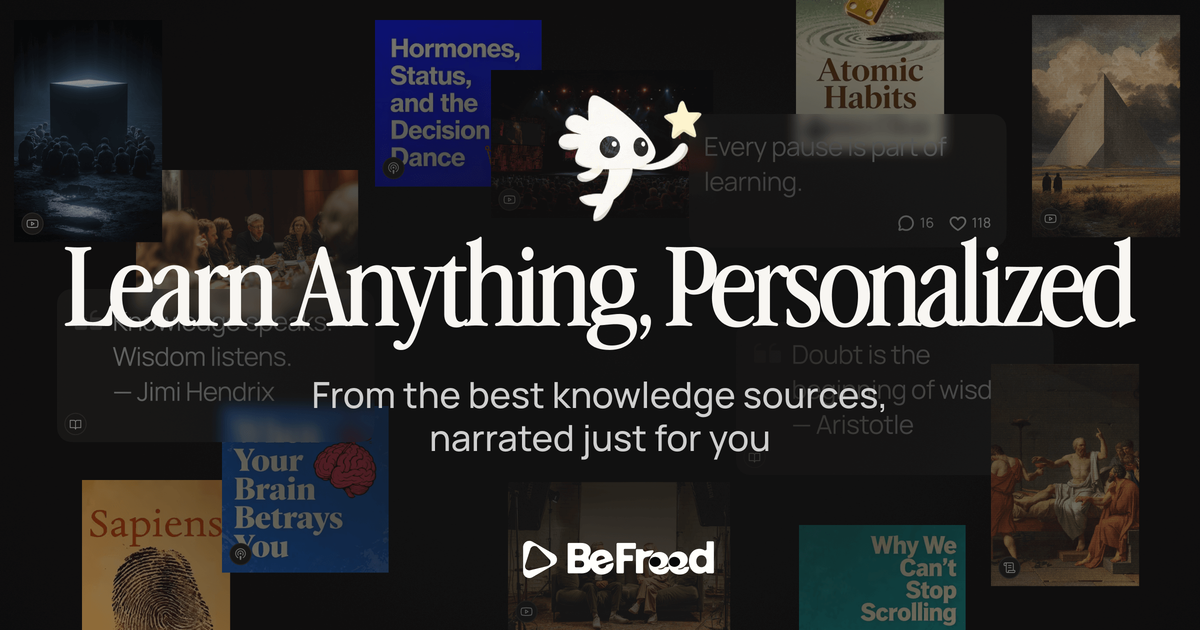
BeFreed delivers personalized audio learning from books, research papers & domain experts. Choose language, voice & depth to listen on demand.
What is BeFreed?
BeFreed is an audio learning service that turns learning content into personalized audio experiences. Users choose an intent and preferences—such as language, voice, and how deeply they want to go—and then listen to narrated material sourced from books, research papers, and domain experts.
Instead of reading end-to-end, BeFreed organizes knowledge into on-demand audio (including book-list style programming) that can be skimmed or explored in depth, depending on what you want to learn at the moment.
Key Features
- Personalized audio lessons from multiple source types: Content is sourced from books, research papers, and domain experts, then delivered as narrated audio for listening.
- User-controlled language and narration depth: You can set your language and choose learning depth to match your goals and schedule.
- Voice selection you control: The site emphasizes that you can pick a voice you like for your narration experience.
- Skim vs. dive options (storytelling or fact): The audio can be formatted as storytelling or presented as facts, with controls to skim or go deeper.
- On-demand listening with “talk” interactions: BeFreed positions learning as something you can engage with “whenever you need,” using the audio as a prompt for conversation.
- Mindspace for learning moments: The platform includes flashcards, journals, and memories to capture and revisit “aha” moments.
How to Use BeFreed
- Get started: Begin by initiating the experience (the page highlights a “Get started” flow).
- Set your intent: Choose what you want to learn, and select preferences such as language, voice, and how deep you want the learning to go.
- Listen to the generated audio: Start playing the personalized audio lessons on demand.
- Use the supporting tools: Save key takeaways into Mindspace items like flashcards, journals, or memories.
- Continue when needed: Use the “talk” capability to interact with the audio at the times you want to revisit or clarify ideas.
Use Cases
- Nonfiction learning without reading full texts: Listen to book-derived audio to learn ideas from nonfiction without committing to reading the entire book.
- Turning commutes into learning time: Use shorter, on-demand audio lessons during walks or travel to make progress on books and topics you otherwise wouldn’t start.
- Choosing a clear starting point for broad subjects: Browse or follow themed book list podcasts that connect ideas across authors in a guided audio journey.
- Reinforcing concepts during daily routines: Capture “aha” moments in flashcards/journals/memories so you can remember and revisit what you learned later.
- Exploring at different depths: Use skim-style listening when you’re short on time, then switch to deeper dives or more factual delivery when you want more detail.
FAQ
Is BeFreed only for books?
No. The page states that audio is sourced from books, research papers, and domain experts.
Can I change the narration voice?
Yes. The site explicitly mentions that you own your narration and can pick your voice.
What does “personalized” mean in BeFreed?
The content is personalized based on user inputs such as intent, language, voice, and learning depth, with options for storytelling vs. facts and skim vs. dive depth.
Does BeFreed support learning-related note-taking?
Yes. The page describes Mindspace, which includes flashcards, journals, and memories tied to “aha” moments.
Can I interact with the audio after I start listening?
The page describes “Talk to the audio” and a “Start the talk” flow, suggesting you can engage with the audio when you need it.
Alternatives
- Audiobook platforms (e.g., for listening to full books): These focus on playing complete recordings, while BeFreed emphasizes personalized narration and learning-focused structuring (skimming/dive depth, voice selection, and learning tools).
- Podcast discovery and playlist apps: Apps that organize podcasts can help you find audio content, but they typically don’t offer the same user-driven personalization for language/voice and depth described on BeFreed.
- Reading-first learning platforms with summaries: Some services deliver written summaries or study materials; BeFreed’s primary workflow is listening to narrated, configurable learning audio.
- General knowledge management tools (notes/flashcards): Tools like flashcards and journals help capture learning, but they don’t generate personalized audio lessons from books and research the way BeFreed positions itself.
Alternatives

Padel Chess
Padel Chess is a puzzle-based learning platform helping padel players improve tactical decision-making with chess-like scenarios on positioning and shot selection.

GameGrad
GameGrad turns PDF class notes into arcade study games, with quiz questions from your notes when you lose to keep you learning.
LangPanda
LangPanda helps you learn languages with Netflix, YouTube and more, plus instant dictionary lookup, flashcards, vocabulary tracking, 36 languages and a 7-day free trial.

Talkpal
Talkpal is an AI language teacher that helps users learn languages faster through immersive conversations and real-time feedback.

TubeKit by Productize Your Mind
TubeKit by Productize Your Mind turns a YouTube video or playlist into AI-powered tools—paste a public link, pick a suggestion, customize and share. Free.

BeFreed
BeFreed is a personalized audio learning platform that transforms knowledge into engaging audio content tailored for individual learning preferences.