
Non-invasive brain-to-text decoding
Decodes natural sentences from real-time magnetoencephalography recordings without requiring a surgical implant.

Brain2Qwerty v2 is a Meta research system that decodes natural sentences from non-invasive MEG brain recordings for communication restoration and neuroscience research.
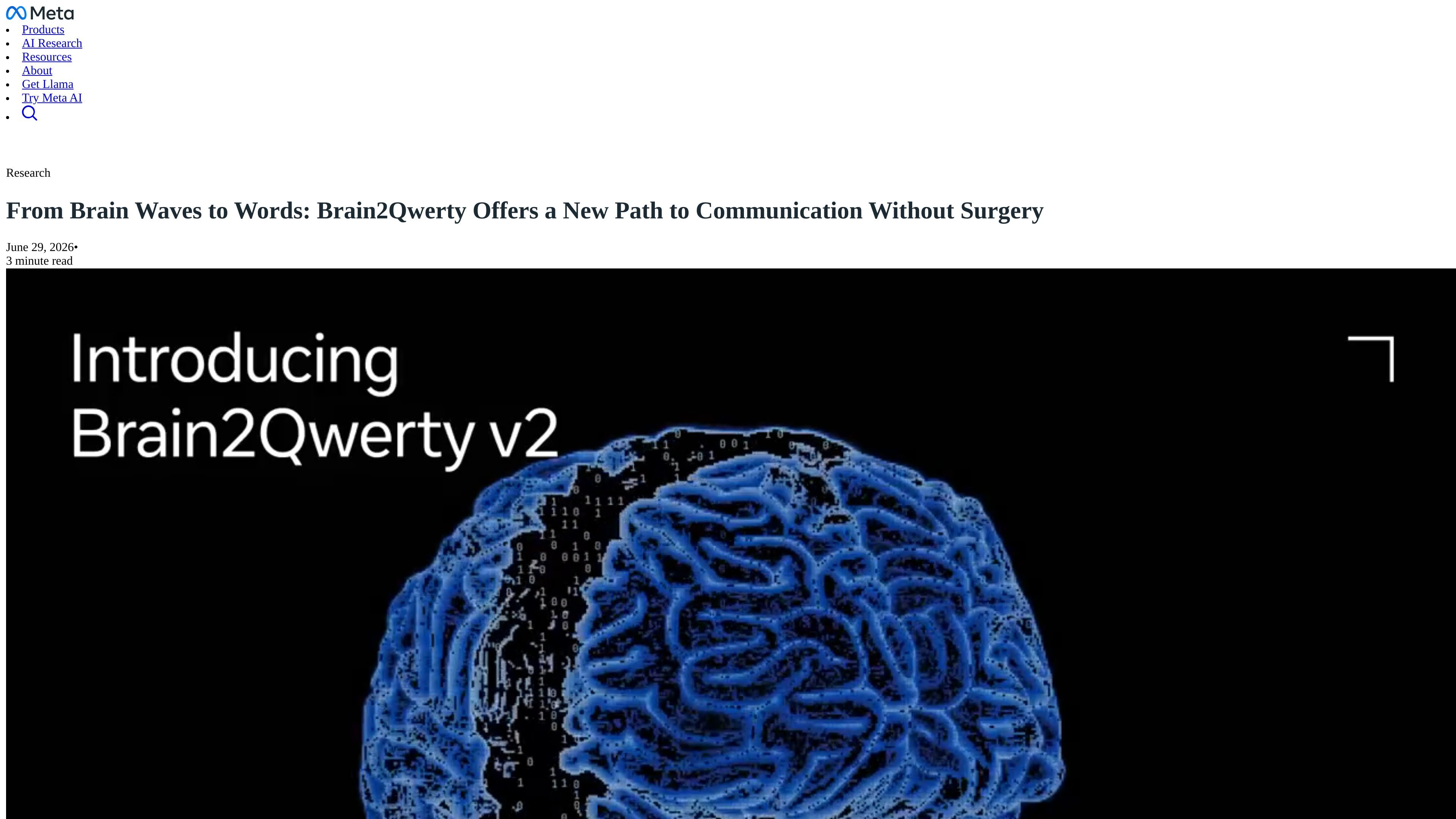
Brain2Qwerty v2 is an AI research system from Meta that decodes language from non-invasive brain recordings. The published work focuses on magnetoencephalography (MEG) and shows how sentence-level text can be recovered from neural signals without surgery.
The project is presented as a research step toward communication assistance for people who have lost the ability to speak or move after a brain injury. It also serves as a neuroscience tool for studying how the brain turns thoughts into words, and it is released with code and supporting research materials for the broader scientific community.
Decodes natural sentences from real-time magnetoencephalography recordings without requiring a surgical implant.
Uses an end-to-end deep learning pipeline that works directly from raw brain signals rather than a hand-crafted event-detection stack.
Fine-tunes large language models on neural data so the decoder can use sentence context to reconstruct text more coherently.
Was trained on about 22,000 typed sentences from nine volunteers, each recorded for 10 hours, giving the model a relatively large non-invasive dataset for this task.
Releases the full training code for Brain2Qwerty v1 and v2, with the v1 dataset released by BCBL, to support reproducibility and follow-on research.
Reports a word accuracy rate of 61% overall and 78% for the best participant, with more than half of sentences decoded with one word error or less for that participant.
Researchers can use the released code and paper to reproduce the decoding pipeline, compare methods, and extend the model to new datasets.
Teams studying brain-computer interfaces can evaluate whether non-invasive decoding can close some of the gap with implant-based approaches.
Neuroscience groups can analyze how language unfolds from thought to words, syllables, and letters using the model’s sentence-decoding workflow.
Organizations building future communication aids can study the feasibility of non-invasive text reconstruction for people affected by brain injury.
Data scientists working with neural signals can use the project as a reference for end-to-end modeling, large language model fine-tuning, and pipeline optimization.
Brain2Qwerty v2 is a research pipeline that decodes natural sentences from non-invasive magnetoencephalography (MEG) recordings. The training code for Brain2Qwerty v1 and v2 is released, and the v1 dataset is being released by BCBL.
The studies were conducted with healthy volunteers typing sentences while wearing MEG or EEG equipment. The research is aimed at communication restoration for people who have lost the ability to speak or move after brain injury, but the published work itself used volunteer data.
The source pages do not describe a commercial product or pricing model. They point to research publications and downloadable code/data rather than a paid software offering.
The blog links to the paper, the code, and the data. The research page also summarizes the model as a real-time MEG sentence decoder, but it does not describe a packaged app, SDK, or hosted API.
The work is non-invasive, but it still has practical limits. The blog notes that MEG currently requires a magnetically shielded room and that decoding accuracy remains imperfect compared with surgical approaches.

Hype is a web tool for finding trending YouTube topics by category, time range, and scoring mode. Spot emerging ideas and review source videos.

MIRA vision develops synthetic-data-driven AI for pathology image analysis, with privacy-compliant training data, automatic annotations and controlled data generation.

Paperpal is an AI tool for academic writing, offering literature reading, language polishing, citations, plagiarism checks, AI detection, and pre-submission review.

Sanota turns spoken memories and interviews into clear written stories for personal storytelling, family history and shared memories, with guided prompts and subscriptions.

VForms lets you place questionnaires inside YouTube videos, capturing feedback in context with timestamped, embeddable video forms.

Carbon Voice is an async voice messaging app for teams and individuals, with transcripts, AI catch-up, and cross-device access.