
Free nonprofit access model
The homepage states that CheckforAi was offered as a free nonprofit project for individuals, which is the clearest public description of the product’s original access model.

CheckforAi from Uphold.ai is a sunset nonprofit project with status, policy and support info on the site.
CheckforAi is a website from Uphold.ai that was presented as a free nonprofit project for individuals. The current homepage says the service has been sunset and that the team has moved on to new projects, so the public site now primarily serves as a status and information page.
The available pages focus on site notices rather than product documentation. The homepage directs visitors to a Substack for updates, while the legal pages describe cookie use, privacy practices, and terms for accessing the site.
The homepage states that CheckforAi was offered as a free nonprofit project for individuals, which is the clearest public description of the product’s original access model.
The site says the service has been sunset, so the public pages now function mainly as a status notice rather than an active product experience.
The homepage invites visitors to subscribe to a Substack for updates on new projects, suggesting the team has shifted attention away from CheckforAi.
The footer provides a direct support contact at [email protected] for questions about the site or its notices.
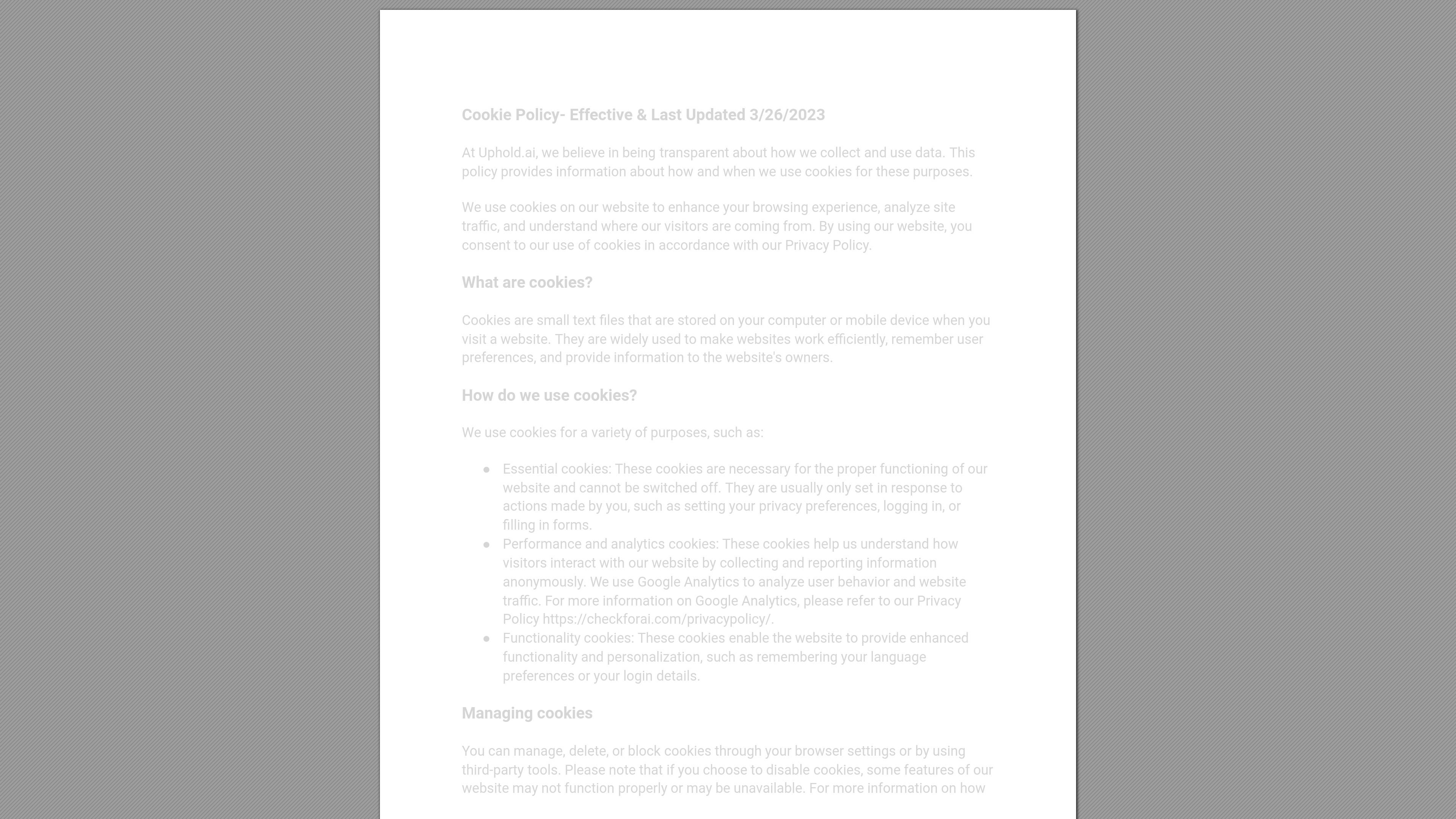
The cookie policy states that the website uses cookies for essential functions, functionality, and performance analytics.
Visitors landing on the homepage can confirm that the service has been sunset instead of assuming the product is still live.
Users with questions about the site or its notices can contact the support address listed in the footer.
People following the project can subscribe to the Substack mentioned on the homepage to receive updates on new projects.
Visitors reviewing the site’s policies can understand that the website uses cookies and Google Analytics for traffic analysis.
The site describes CheckforAi as a free nonprofit project for individuals, but it also says the service has been sunset. The homepage does not provide setup steps for an active product.
The source pages do not describe the product’s output format or workflow in detail. The available public copy only shows the homepage notice and site policy pages.
The site footer says questions can be sent to [email protected], but there is no public documentation showing team accounts, collaboration features, or role management.
The pricing page currently returns a not-found message, so the source does not confirm any active plans, trial, or paid pricing structure.
The privacy and cookie policies state that the site uses cookies and Google Analytics to analyze traffic and understand visitor sources.

Writecream AI Content Detector & Checker is a free tool to check whether pasted text appears written by AI or a human, with an AI content percentage.

Winston AI is an AI content detector and plagiarism checker for text and images, helping educators, publishers, and institutions review originality and share results.

tata.run is a professional free AI content detector that provides a one-click 'reduce AI' feature to significantly lower AI detection rates.

Sapling AI Detector estimates whether text is human-written or AI-generated, with support for pasted text, PDFs and Word documents. API available.

Originality.ai is a content integrity platform for AI detection, plagiarism checks, readability, grammar, fact checking, and content quality review. Supports text, file, URL, and site scans.

StudyCorgi’s ChatGPT Detector is a free tool for checking essays and research papers for AI-generated writing, with a bar chart and word-level analysis.