

Chunk sidecars
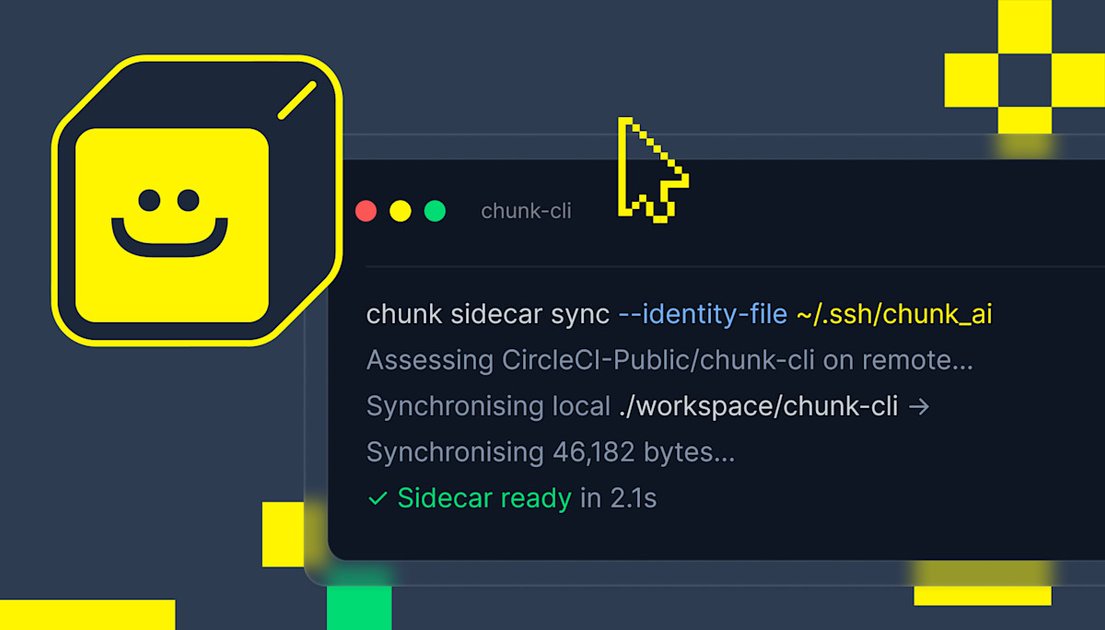
Chunk sidecars is a lightweight microVM validation environment from CircleCI that helps AI coding agents catch build and test failures locally before CI.
What is Chunk sidecars?
Chunk sidecars are lightweight microVM environments from CircleCI that run alongside a local development workflow to validate code before it reaches CI. They are designed to give AI coding agents fast, scoped feedback while the code is still being changed locally, reducing the need to rely on outer-loop CI for basic checks.
The product automatically detects a project’s tech stack, test commands, and build system, then runs a scoped set of checks called microbuilds. It is intended to keep the inner loop moving quickly while reserving CI for integration, security, and release validation.
Key Features
- MicroVM-based sidecar environments: Runs a lightweight environment that mirrors the project stack, so validation happens in a setup closer to CI without requiring a full CI push.
- Automatic stack and command detection: The CLI discovers the project’s build system, tech stack, and test commands, reducing manual setup for getting started.
- Hook-driven validation loop: The sidecar runs automatically when the agent pauses to evaluate work, then returns results so the agent can iterate without manual triggering.
- Scoped microbuild checks: Runs a limited validation set locally, which is meant to catch failures before they reach shared CI.
- Fast feedback target: Designed to return results within 60 seconds, matching the short feedback windows many agents use.
- Agent-agnostic workflow: Works with Claude Code, Codex, Cursor, or custom agents, so the validation layer is not tied to one assistant.
- Snapshot support: Captures a configured environment so later sidecars can boot from a known-good state and reuse the same setup across a team.
How to Use Chunk sidecars
A typical setup starts with installing the Chunk CLI, authenticating it with CircleCI, and running chunk init so the tool can detect the project’s commands and configure validation hooks. After that, the user invokes the chunk-sidecar skill from their AI agent.
During the session, the agent syncs local changes to the sidecar, runs validations there, and uses the failure output to fix code before repeating the loop. If the build passes, the workflow returns control without requiring a push to CI.
Use Cases
- AI-assisted feature development: An agent is generating or editing code and needs quick validation before the change is committed.
- Local test failure triage: Basic unit or build failures can be caught during the inner loop instead of waiting for CI to report them later.
- Reducing CI noise: Teams with many agent-generated commits can shift simple checks out of CI so shared pipelines focus on higher-value validation.
- Shared environment validation: Teams can use snapshots to keep validation environments aligned across developers and agents.
- Custom agent workflows: Builders who have their own coding agent can connect it to the same sidecar validation flow.
FAQ
Does Chunk sidecars replace CI?
No. The source describes sidecars as a local validation layer that helps keep CI focused on integration, security, and release work.
Do I need to configure the project manually?
Not for the initial detection flow. The CLI automatically discovers the tech stack, build system, and test commands, though the source notes that detection is “not always perfect.”
Which agents does it work with?
The source says it is agent-agnostic and works with Claude Code, Codex, Cursor, or a custom agent.
How long do validations take?
Sidecars are designed to return feedback within 60 seconds.
What is a microbuild?
A microbuild is the scoped set of checks the agent runs in the sidecar environment before code is pushed to CI.
Alternatives
- Traditional CI pipelines: These validate code after a push and are better suited to integration and release checks, but they can be slower for catching simple local failures.
- Local development with manual tests: Developers can run tests directly on their machine without sidecars, but that does not provide the same mirrored validation environment or hook-driven agent workflow.
- Other AI agent testing workflows: Some teams validate agent output by adding prompts, scripts, or ad hoc test runs inside the agent loop, but these approaches may lack a dedicated microVM environment and snapshot-based reuse.
- Container-based local test environments: Containers can also mirror a project stack locally, but the source positions Chunk sidecars as a microVM-based workflow built specifically around fast inner-loop validation for agents.
Alternatives

MakerLoft
MakerLoft is an AI app builder for non-developers that connects to your GitHub repo to generate working apps with auth, payments, files, jobs.

Ably Chat
Ably Chat is a chat API and SDKs for building custom realtime chat apps, with reactions, presence, and message edit/delete.

ClawTick
ClawTick is a CLI-first AI agent automation platform for scheduling webhook tasks on cron with monitoring, alerts, retries, and execution logs.

Falconer
Falconer is a self-updating knowledge platform for high-speed teams to write, share, and find reliable internal documentation and code context in one place.
OpenFlags
OpenFlags is an open source, self-hosted feature flag system with a control plane and typed SDKs for progressive delivery and safe rollouts.

AakarDev AI
AakarDev AI is a powerful platform that simplifies the development of AI applications with seamless vector database integration, enabling rapid deployment and scalability.