Cohesor icon

Cohesor

Cohesor is an AI gateway and control plane for agents that routes requests, compresses tokens, brokers MCP tool calls, and enforces policy from one endpoint.

Cohesor

AI gateway and control plane for agents

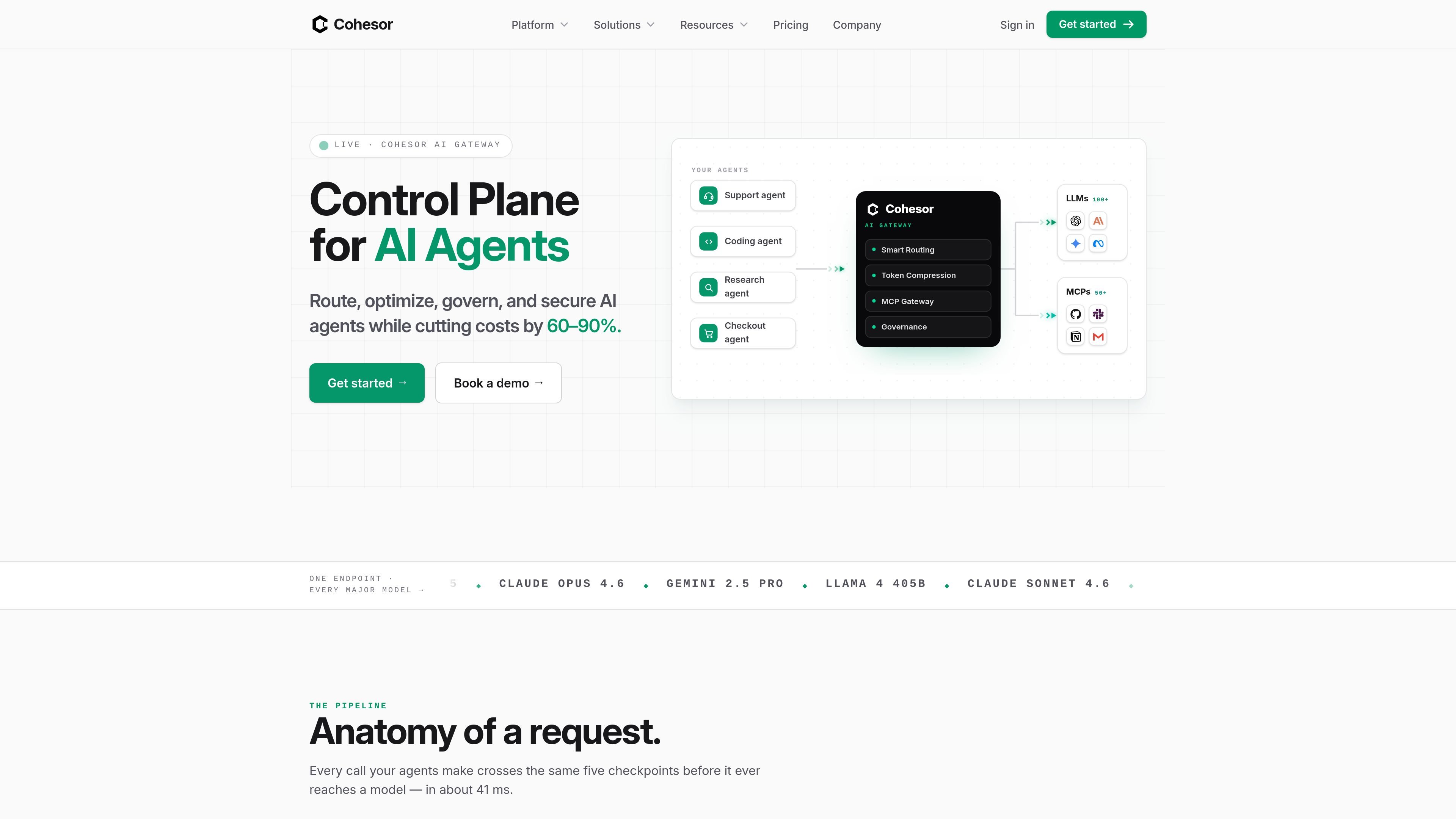
Cohesor is an AI gateway and control plane for agent traffic. It sits between agents and model providers to route requests, compress tokens, broker MCP tool calls, and enforce policy before requests reach a model or external tool.

The product is aimed at teams running AI agents that want one endpoint for multiple models and tools, plus controls for spend and visibility. The site describes Anthropic and OpenAI protocol compatibility, support for common agent clients, and a usage-based pricing model built around a per-request platform fee plus provider-cost LLM usage.

Core capabilities

One endpoint for agent traffic

Point agents to a single Cohesor URL and use Anthropic- and OpenAI-compatible clients without rewriting the agent. The product says Claude Code, Codex, opencode, and any compatible SDK can connect with a one-line configuration change.

Smart request routing

A lightweight complexity classifier scores each request and sends it to either a stronger model or a lower-cost model. The router can be tuned by sensitivity and can also be pinned to a fixed model when routing is disabled.

Token compression before billing

The gateway compresses prompts, conversation history, and tool output before billing. Cohesor describes this as lossless-first and says the transforms run inline without extra round trips.

Managed MCP tool gateway

Cohesor exposes an audited MCP endpoint and brokers OAuth credentials, API keys, and per-agent scopes. Tool calls are traced with arguments, latency, and cost so they can be reviewed later.

Governance and spend visibility

The dashboard tracks traces, per-user spend, model routing, tool usage, and audit logs. Pricing and home-page copy also describe team budgets, caps, and showback reporting.

Common use cases

  • Add a control plane without rebuilding the agent

    Point Claude Code, Codex, or another compatible client at Cohesor to keep the same workflow while moving traffic through a gateway that can route, compress, and govern requests.

  • Reduce model spend on mixed workloads

    Use request complexity scoring to send trivial or low-risk work to cheaper models while keeping harder prompts on stronger models, with the option to adjust sensitivity or pin a fixed model.

  • Centralize MCP tool access

    Broker Gmail, Drive, Calendar, GitHub, and other MCP tools through one audited endpoint with per-agent scopes and credential handling outside the prompt.

  • Control and explain team usage

    Track spend by user, team, and API key, set caps, and review traces or audit logs when you need to understand where tokens, tool calls, and dollars went.

  • Cut token volume in agent-heavy workflows

    Compress prompts, conversation history, and tool outputs before they are billed to reduce input size while keeping the working context intact for the model.

Pros and Cons

Pros

  • Works as a single endpoint for multiple agent clients and model protocols.
  • Combines routing, compression, governance, observability, and MCP tool brokering in one control plane.
  • Offers usage-based pricing where LLM usage is billed at provider cost and the platform fee is tied to requests.
  • Supports per-user, per-team, and per-key spend attribution with budgets and caps.
  • Provides audited tool calls and request traces for review and debugging.

Cons

  • The source does not provide a complete integration catalog, so supported providers and tools are only partially documented on the public pages reviewed.
  • Compression is described as preserving meaning rather than every byte, so teams with strict byte-for-byte prompt requirements may need to validate results in their own workload.
  • The router can be pinned to a fixed model, but the source does not describe detailed policy-building, fallback, or escalation workflows beyond the examples shown.

FAQ

What is Cohesor?

Cohesor is a neutral control plane for AI agents that combines routing, token compression, MCP tool management, governance, and observability behind one endpoint. It is intended for teams building or running agents that want to reduce model spend without changing their existing client setup.

How does Cohesor pricing work?

The pricing page says Cohesor uses usage-based pricing: LLM usage is billed at provider cost, plus a flat platform fee of $10 per 100,000 requests on the Pay as you go plan. Enterprise uses custom volume pricing and terms.

Do I need to rewrite my agent code to use Cohesor?

No. The pricing and FAQ pages say you can point your agent at Cohesor with one environment variable, and Anthropic/OpenAI-compatible clients such as Claude Code and Codex work unchanged.

Can I turn routing or compression behavior down or off?

Compression is described as lossless-first by default, with meaning preserved rather than every byte. Routing can also be pinned to a fixed model when you do not want automatic lane selection.

How does Cohesor handle credentials and tool access?

Cohesor says provider keys are encrypted at rest, gateway keys are hashed, and MCP OAuth tokens stay client-side. Its MCP page also says credentials are brokered at call time and never exposed in prompts or logs.

Quick Facts

Category
AI gateway / agent control plane
Primary users
Teams building or operating AI agents
Platform model
Cloud gateway with one endpoint
Protocols
Anthropic and OpenAI protocols
Pricing model
Usage-based; $10 per 100K requests platform fee plus LLM usage at cost on the pay-as-you-go plan
Domain
cohesor.com