

Clera
Clera is an AI talent agent that matches your startup role preferences and dealbreakers, then makes direct introductions to hiring managers.
What is Clera?
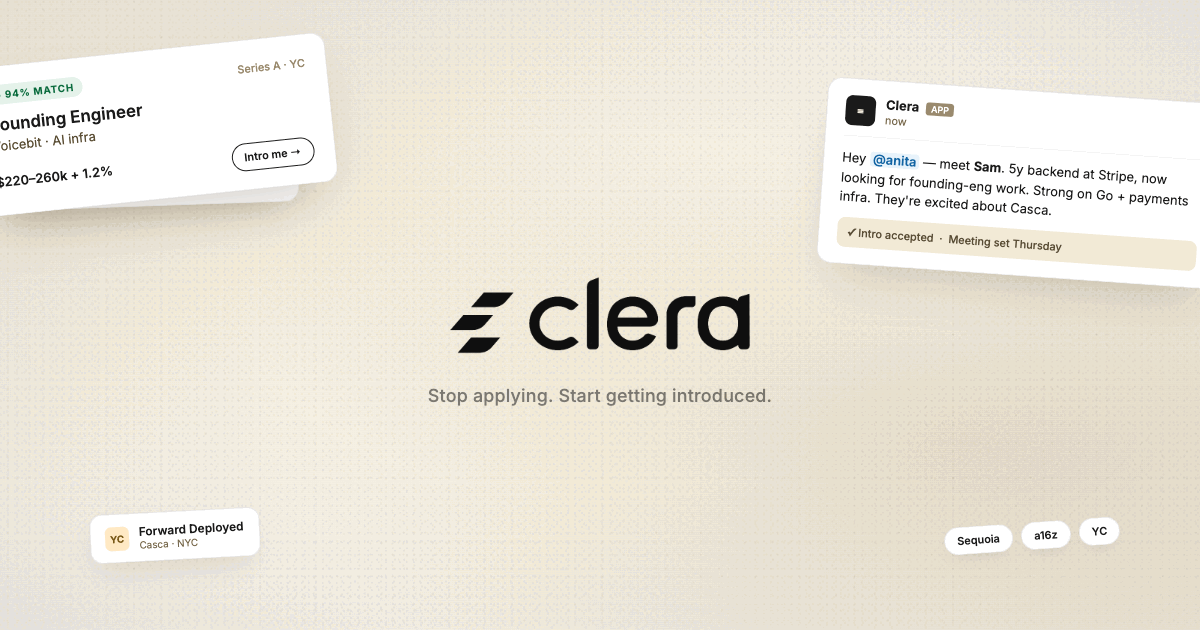
Clera is a talent agent that helps people pursue startup roles by getting them introduced to hiring managers at companies they want to work for—rather than having candidates apply to job listings. The core purpose is to match a candidate’s preferences and dealbreakers to relevant roles and then make direct introductions with context.
Clera’s workflow is designed to be fast: users share what role they want and their constraints, Clera matches them to fit, and then facilitates introductions. The site also states that the service is free for candidates, with companies paying when they hire.
Key Features
- Candidate-to-role intake with constraints (e.g., dealbreakers such as “no crypto” and “remote only”) to help narrow relevant startup opportunities.
- Matching that identifies fit for specific roles (the site shows results like “Senior Backend Engineer” at a “Series B fintech” with location and compensation ranges shown).
- Direct introductions to hiring managers/founders at target startups, using context about the candidate and why they fit.
- Intro workflow that supports the transition from acceptance to scheduling (the page shows “Intro accepted” and “Meeting set for Thursday”).
- Candidate-free positioning: the site states users are never charged and that companies pay Clera when they hire.
How to Use Clera
- Indicate the type of startup role you’re interested in (the page lists examples such as Senior frontend engineer, Founding Engineer, Forward Deployed, Account Executive, and Founders Associate).
- Share your preferences and any dealbreakers (for example, remote-only and exclusions like “no crypto”).
- Review the matching roles Clera surfaces based on the information you provided.
- Choose a role to request an introduction (the page includes a flow like “Yes, intro me to the first one”).
- When the intro is accepted, proceed through the scheduled meeting process.
Use Cases
- Senior engineer targeting Series A/B startups: Share that you want a senior frontend/backend role at a Series A or B startup along with constraints such as remote-only to receive role-specific intros.
- Candidate who wants to avoid high-volume applications: Use Clera’s “skip the application” approach to pursue roles via introductions rather than applying individually.
- Career change with clear constraints: Provide dealbreakers (e.g., “no crypto”) so matching focuses on companies and roles that align with your preferences.
- Hiring-manager-style outreach for startup roles: Use Clera to get introduced with context about your background and fit, rather than initiating first contact without that framing.
- Planning next-step interviews efficiently: Once an intro is accepted, use the scheduling step to move toward a meeting without spending weeks on repetitive outreach.
FAQ
-
Is Clera free for candidates? Yes. The site states it is “totally free,” and that companies pay Clera when they hire you; you won’t be charged for anything.
-
How does Clera know what roles I’m looking for? Clera uses your profile and the role details you provide (including preferences and dealbreakers) to match you to relevant startup roles.
-
What happens after I say yes to a role? The site indicates that Clera makes the intro directly and, after acceptance, a meeting is set (it shows an “Intro accepted · Meeting set for Thursday” example).
-
Can Clera help with negotiating? The page includes a question about negotiation (“Can Clera help me negotiate?”), but no answer is provided in the extracted content. For now, the supported information is that the topic is addressed via “More info.”
-
What if I’m not ready to move yet? The page includes a question about readiness to move (“What if I’m not ready to move yet?”) but does not provide the answer in the extracted content.
Alternatives
- Apply-to-job platforms (general job boards and startup job listings): Instead of introductions, you submit applications directly. The workflow is more candidate-driven and typically involves more asynchronous screening.
- Recruiter-led startup recruiting: Hiring firms can reach out to candidates, but the process depends on recruiter coverage and matching, rather than a candidate-driven “skip the application” intro flow.
- Direct networking (LinkedIn outreach and warm referrals): You can seek intros yourself through founders, employees, or community connections; it’s more manual and may not include the structured matching step Clera uses.
- Other “talent agency” or “career matching” services: These also aim to match candidates to opportunities, but the key difference is whether they facilitate direct introductions to hiring managers and whether they’re positioned as free for candidates.
Alternatives

HiringPartner.ai
HiringPartner.ai is an autonomous recruiting platform with AI agents that source, screen, call, and interview candidates 24/7, reducing time-to-hire from weeks to as little as 48 hours.

CVComp
CVComp is a free ATS resume scanner with keyword gap analysis, formatting checks, and interactive refinements to improve your ATS score.

JusRecruit
JusRecruit is an AI recruiting platform: Saina runs phone screens and first-round interviews to deliver ranked shortlists, plus a lightweight ATS.

EarnBetter
EarnBetter is an AI job search assistant and AI screening support for employers—resume tailoring, application autofill, job matches, and phone screens.

Fountain
Fountain is an AI-powered frontline workforce management platform designed to streamline and scale recruiting functions for leading brands.

Ranpo AI
Ranpo AI offers automated risk assessment for rental listings, helping property managers and landlords identify potential issues before they arise. It streamlines the screening process by analyzing various data points to ensure tenant suitability and property safety.