

GitAgent
GitAgent is an open AI agent standard to define, version, and run Git-native AI agents across frameworks, with support for Claude, OpenAI, CrewAI and more.
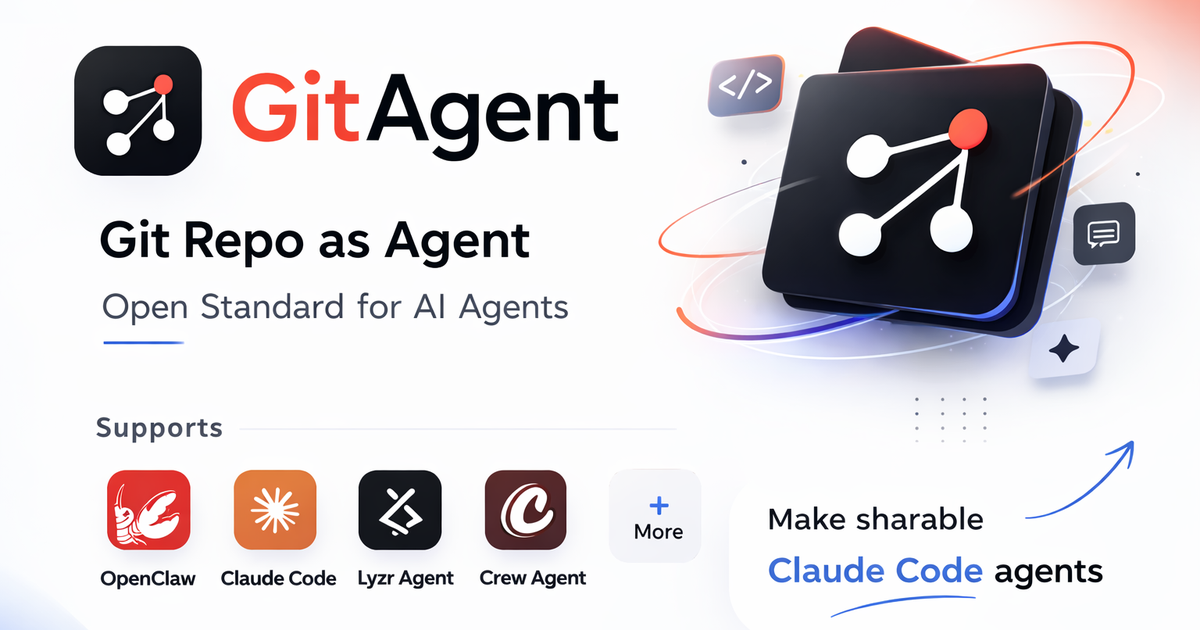
What is GitAgent?
GitAgent is an open AI agent standard for working with Git-native workflows. It defines how AI agents can be represented, versioned, and run directly in a Git context, aiming to be framework-agnostic across different agent implementations.
The core purpose of GitAgent is to provide a consistent, Git-centered way to build and operate AI agents—so teams can define agent behavior as part of their repository and run it with tooling that supports the standard.
Key Features
- Open AI agent standard for Git-native workflows: Provides a shared specification for representing agents in a Git context, helping coordinate agent definitions with the rest of a codebase.
- Versionable agent definitions: Aligns agent configuration and behavior with Git practices so changes can be tracked over time in the same way as code.
- Framework-agnostic design: Intended to work across multiple agent frameworks rather than being locked to a single runtime or library.
- Model-provider compatibility: The site states it works with Claude, OpenAI, CrewAI, Lyzr, and more, indicating broad compatibility with common agent ecosystems.
- Run agents natively with Git context: Positions execution as part of the Git workflow rather than as a separate, untracked process.
How to Use GitAgent
- Define an agent in your repository using the GitAgent standard so the agent’s behavior is captured alongside your code.
- Use a compatible setup/runtime that supports GitAgent to interpret and run the agent definition from the Git context.
- Iterate using Git: update the agent definition in version control and rerun as needed, keeping agent changes auditable.
Use Cases
- Repository-based AI assistance for developers: Keep agent instructions and behavior defined in the same repo as the development work, making it easier to maintain consistent workflows across iterations.
- Team-managed agent workflows: Coordinate agent behavior across different projects or teams by standardizing agent definitions within Git.
- Testing agent behavior changes over time: Use Git history to review and reproduce changes to agent configuration when outcomes differ.
- Multi-framework agent experimentation: Use GitAgent as a common layer so teams can work with different agent frameworks while keeping a consistent Git-native representation.
- Model-provider flexibility: Run the same Git-native agent definition with different supported providers (such as Claude or OpenAI) depending on what the environment supports.
FAQ
What does “Git-native” mean for GitAgent?
Based on the site description, it means defining and running AI agents in a way that is native to Git workflows—so agent definitions can be managed and versioned in repositories.
Is GitAgent tied to a specific agent framework?
No. The site describes GitAgent as framework-agnostic, and states it works with multiple frameworks.
Which model providers and frameworks does GitAgent support?
The page explicitly mentions compatibility with Claude, OpenAI, CrewAI, Lyzr, and more.
How do I start if I want my agent definitions tracked in Git?
Start by creating/defining the agent according to the GitAgent standard in your repository, then run it using tooling that supports the standard.
Is there any pricing or hosted service mentioned?
The provided source content does not include pricing or any hosted product details, so that information isn’t confirmed here.
Alternatives
- Framework-specific agent configurations (no shared standard): Many agent toolkits define agents in their own formats. Compared with GitAgent, these approaches may not provide a consistent Git-native representation across frameworks.
- Prompt-and-script workflows: Teams sometimes implement agents using custom scripts or prompt templates without a standardized Git-native agent definition. This can be flexible, but may lack standardized versioning/execution semantics.
- Other agent standards/specifications: Some ecosystems offer their own standards for agent behavior and execution. These may differ in portability, Git integration depth, or how definitions are represented in repositories.
- Direct model orchestration without agent abstraction: Using provider SDKs to call models directly can work for narrow tasks, but it may not provide a standardized agent layer comparable to GitAgent’s Git-native agent definitions.
Alternatives

Codex Plugins
Use Codex Plugins to bundle skills, app integrations, and MCP servers into reusable workflows—extending Codex access to tools like Gmail, Drive, and Slack.

Falconer
Falconer is a self-updating knowledge platform for high-speed teams to write, share, and find reliable internal documentation and code context in one place.

OpenFlags
OpenFlags is an open source, self-hosted feature flag system with a control plane and typed SDKs for progressive delivery and safe rollouts.

AakarDev AI
AakarDev AI is a powerful platform that simplifies the development of AI applications with seamless vector database integration, enabling rapid deployment and scalability.

AgentMail
AgentMail is an email inbox API for AI agents to create, send, receive, and search email via REST for two-way agent conversations.

skills-janitor
Audit, track usage, and compare your Claude Code skills with skills-janitor—nine focused slash commands and zero dependencies.