

Kollab
Kollab is an AI-native workspace where teams and AI Agents collaborate in one shared space, with Skills, Bots and a living knowledge base.
What is Kollab?
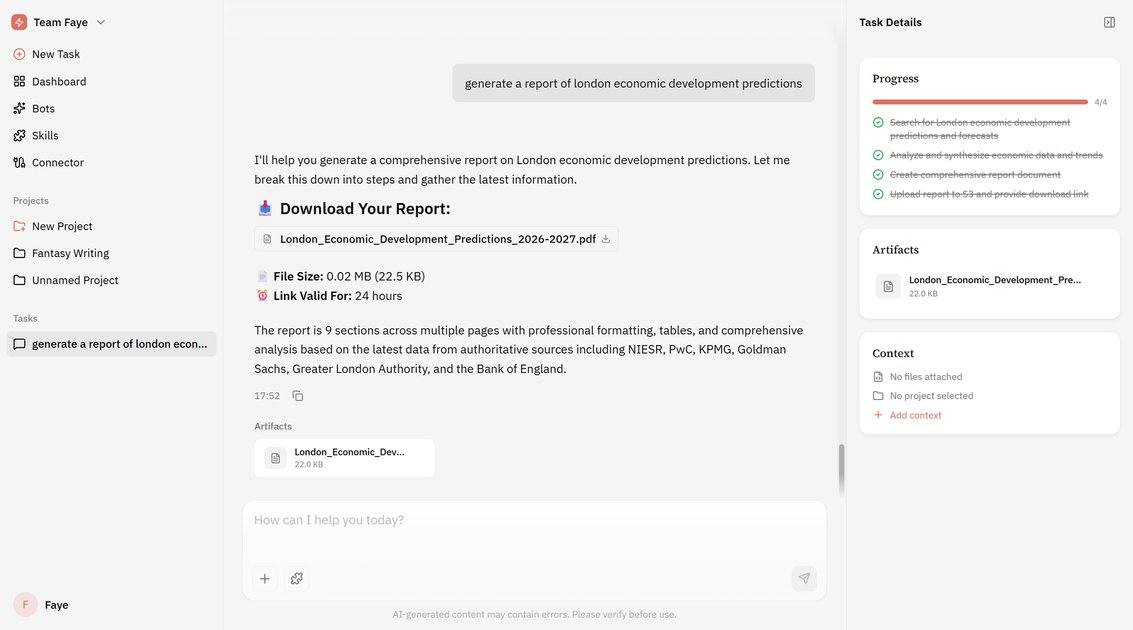
Kollab is an AI-native workspace where teams and AI Agents collaborate in one shared space. Instead of treating AI as a standalone chat, it connects agent-driven work, shared knowledge, and project activity so teams can execute work together.
The core purpose is to keep team tasks, outputs, and references visible and actionable while AI Agents assist with research, report generation, and follow-through on work items—without losing the context of what the team has already decided.
Key Features
- Shared workspace for team execution: Consolidates work across projects so progress can be tracked and tasks can be picked up with existing context.
- AI Agents integrated into outputs: Enables refining reports, research, and other deliverables alongside AI Agents within the same working space.
- Bots that run in existing conversations: Lets you trigger an AI Agent from messaging tools (Slack or Lark) and have results synced back to your workspace.
- Agent Skills for reusable workflows: Provides a way to save prompts, multi-step processes, and analysis routines as repeatable “skills” that can be applied across projects.
- Living knowledge base with traceable references: Turns documents, meeting notes, and archives into an active knowledge hub where agents can retrieve, compare, and synthesize information with links back to sources.
How to Use Kollab
- Set up your workspace and connect tools: Link Kollab with tools your team already uses (the page lists Notion, Linear, and Figma, among others).
- Add AI Agents via Skills and Bots: Prepare reusable Skill workflows and use Bots to trigger agent runs from Slack or Lark conversations.
- Work with agents on shared deliverables: Execute research, reports, and reviews directly in the shared workspace so outputs stay connected to the project context.
- Build a knowledge base from your team’s materials: Add documents and notes (e.g., meeting notes and archives) so agents can retrieve and synthesize information with references.
Use Cases
- Project reporting and iteration: A team runs research and report drafts in the shared workspace, then refines outputs with AI Agents while keeping project progress visible.
- Slack-based agent assistance: A user triggers an AI Agent from a Slack conversation and immediately syncs the results into the workspace, reducing the need to switch apps.
- Reusable analysis routines: An operations or analytics team saves repeatable prompts or multi-step analysis processes as Skills, then applies them across multiple projects to keep quality consistent.
- Team knowledge continuity: A contractor or new team member uses Kollab Agents to understand prior decisions and direction captured in the team’s knowledge base, rather than hunting for context.
- Evidence-linked decision support: Agents retrieve and compare information from a document-backed knowledge hub, producing synthesized outputs with traceable references to the underlying sources.
FAQ
What is Kollab?
Kollab is an AI-native workspace for teams that brings together shared AI Agents, Agent Skills, Bots, and a living knowledge base to support daily collaboration and execution in one place.
How is Kollab different from typical AI chat tools?
Kollab is positioned as a workspace that connects agent activity to team projects and shared knowledge, rather than using AI only as a standalone chat interface.
Do I need technical skills to use Kollab?
The provided content does not specify technical requirements. If you plan to create or manage Agent Skills, you may need to follow whatever setup is required within the workspace.
How does Kollab connect with existing tools?
Kollab supports connecting to tools such as Notion, Linear, and Figma. It also supports triggering Bots from Slack or Lark conversations.
Does Kollab help teams keep track of references and sources?
Yes. The knowledge base is described as supporting retrieval, comparison, and synthesis with traceable references back to sources.
Alternatives
- AI chat assistants with knowledge-grounding: Tools that focus on conversational AI, sometimes with document upload or retrieval. Compared to Kollab, they may be less centered on a shared project workspace for team execution.
- Project management systems with automation: Platforms like issue trackers and project boards (e.g., workflow tools) can centralize tasks and progress. They differ from Kollab by not inherently providing agent-driven collaboration, Skills, and a living knowledge hub.
- Team document/workspace platforms: Wikis and note-based knowledge bases can store meeting notes and archives. Kollab differs by describing AI Agents that retrieve, synthesize, and keep outputs connected to project work with traceable references.
- Slack/Lark-centric AI integrations: Messaging-first bot integrations can run AI actions from chat. Kollab’s positioning emphasizes syncing results into a shared workspace and linking work to reusable Skills and shared knowledge.
Alternatives

Biji
Biji is a versatile platform designed to enhance productivity through innovative tools and features.

BotBoard
Manage AI agents like a team with a shared backlog, structured context, and human review workflow to assign, track, and approve outputs.
Struere
Struere is an AI-native operational system that replaces spreadsheet workflows with structured software—dashboards, alerts, and automations.

garden-md
Turn meeting transcripts into a structured, linked company wiki with local markdown and an HTML browser view. Sync from supported sources.

Falconer
Falconer is a self-updating knowledge platform for high-speed teams to write, share, and find reliable internal documentation and code context in one place.

Planndu: Daily Task Planner
Planndu is an intuitive productivity application designed to help users organize tasks, manage projects, build routines, and enhance focus using tools like AI generation and a built-in Pomodoro timer.