
AI-assisted domain discovery
Turn a plain-language description of a business into an explicit model that captures people, information, actions, rules, permissions, and flows.

modelARch turns business descriptions into explicit models and runnable full-stack apps with AI-assisted visual modeling for teams.
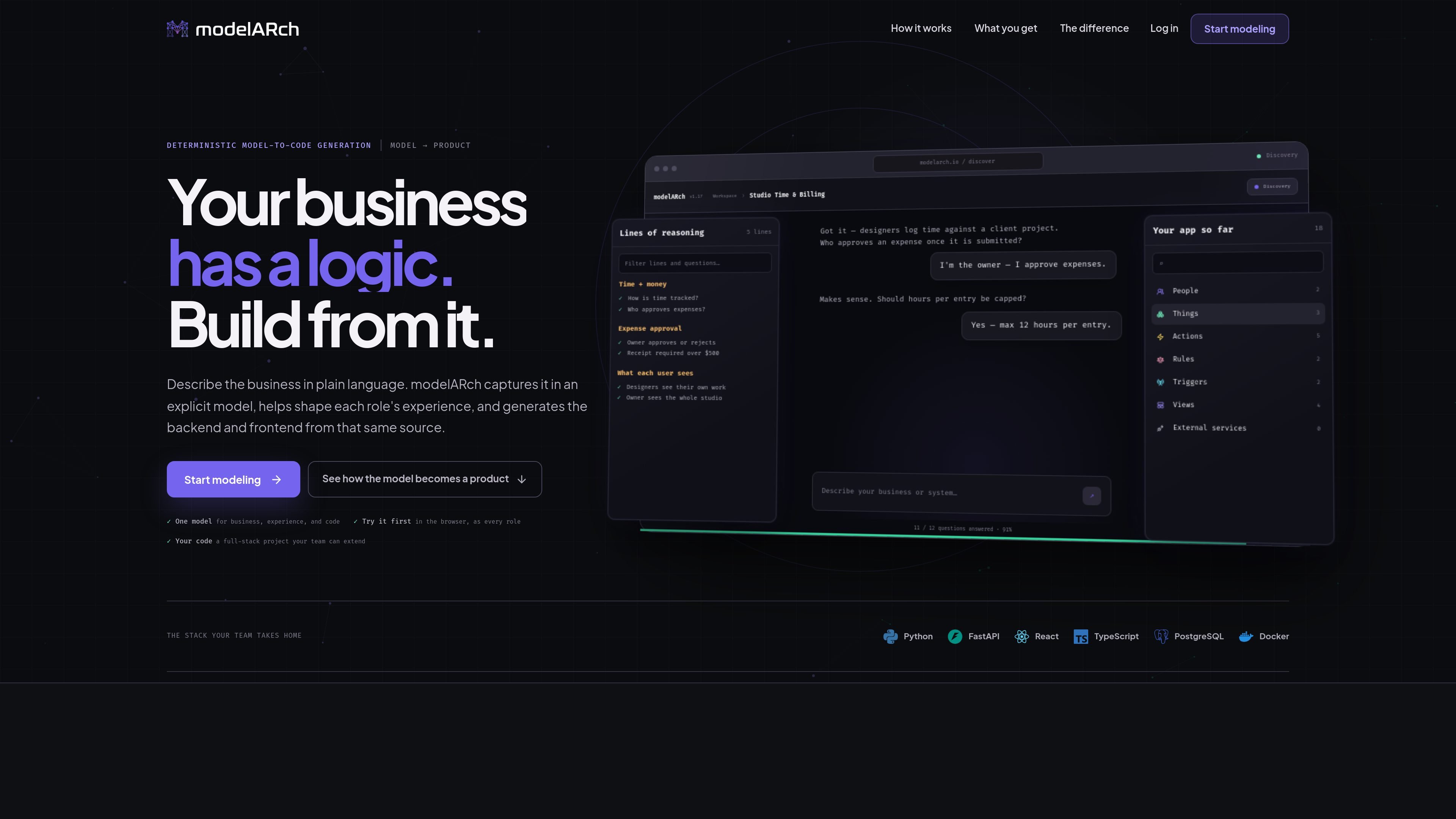
modelARch is a visual and AI-assisted domain modeling tool that turns a business description into an explicit model, then generates a runnable application from that same source. The product emphasizes a deterministic model-to-code workflow: the model is the source of truth, and the generated output follows from it.
The site describes a step-by-step flow that starts with discovery, moves through modeling and designer setup, and ends with preview, generated app, code, and tests. The goal is to let teams validate business logic, role experiences, and implementation details before they take ownership of the code.
Turn a plain-language description of a business into an explicit model that captures people, information, actions, rules, permissions, and flows.
Validate screens, roles, and flows in the browser before generating the application, so the model can be checked before code is produced.
Shape the user experience for different roles in a dedicated Design Studio, including custom and advanced views on higher plans.
Generate a full-stack project with a Python/FastAPI backend and React/TypeScript frontend, plus database setup, migrations, Docker, and tests.
Choose the app’s data and infrastructure components from supported options such as PostgreSQL, MySQL, MariaDB, SQLite, MongoDB, Redis, RabbitMQ, Amazon SQS, and Celery.
Keep portable source artifacts with the generated code, including MODEL.md and DESIGN.md contracts, so the project can be inspected and extended by a team.
Use modelARch when a prototype is turning into a product and you need roles, permissions, and workflows to be explicit before the system is handed off or extended.
Model bookings, approvals, inventory, or service delivery as software rather than a spreadsheet when the business logic has outgrown manual tools.
Use the browser preview to align stakeholders on screens and role-specific behavior before paying to generate the code.
Adopt it when a team wants a full-stack starting point, tests, and documented model artifacts instead of a blank codebase.
Use the enterprise contact flow when a company wants help modeling, validating, and shipping software with direct support from the modelARch team.
modelARch is a visual, AI-assisted domain modeling tool. You describe how the business works, it captures that structure as a model, and you can then generate a runnable application from it.
The pricing page says Basic and Pro plans cover discovery, modeling, and validation. Code generation is purchased once per app, by size, when you are ready to take the code.
The generated stack is based on Python/FastAPI for the backend and React with TypeScript for the frontend. The pricing page also lists database, cache, and queue options, plus Docker and tests.
The terms state that you retain ownership of the domain models, Gherkin features, generated code, and other content you create with modelARch. The contact page also says you own the generated source and can deploy it anywhere.
The product is in active development, and the terms note that features may change over time. The service is provided as-is and as-available.

Speculos deploys Claude Code apps to shareable URLs, with private, org-wide or public visibility and team controls for domains, data and cloud deployments.

ByteAsk is a terminal-first AI coding agent for C and C++ that edits repos and verifies changes with compilers, debuggers, sanitizers, and tests.

CreateOS Sandbox is an isolated compute environment for running code and agent workloads in Firecracker micro-VMs with private networking and SDK, CLI, or MCP control.

hob is an independent workspace for coding agents, with local control over sessions, terminals, history, routing, and follow-up work.

Ably Chat is a chat API platform for custom realtime chat apps, with rooms, typing indicators, presence, reactions, message updates and usage-based pricing.

Make Real is a Next.js app that turns hand-drawn wireframes into HTML prototypes with the tldraw SDK and AI models, with canvas sketching and embedded preview.