
Contract-first repo readiness
Ota centers repo setup, readiness checks, CI validation, and agent-safe task execution in a single contract file named ota.yaml. That keeps humans and automation aligned on the same repository truth.

Ota is repo readiness infrastructure for developer onboarding and AI agents. One ota.yaml contract for setup, validation, and task execution.
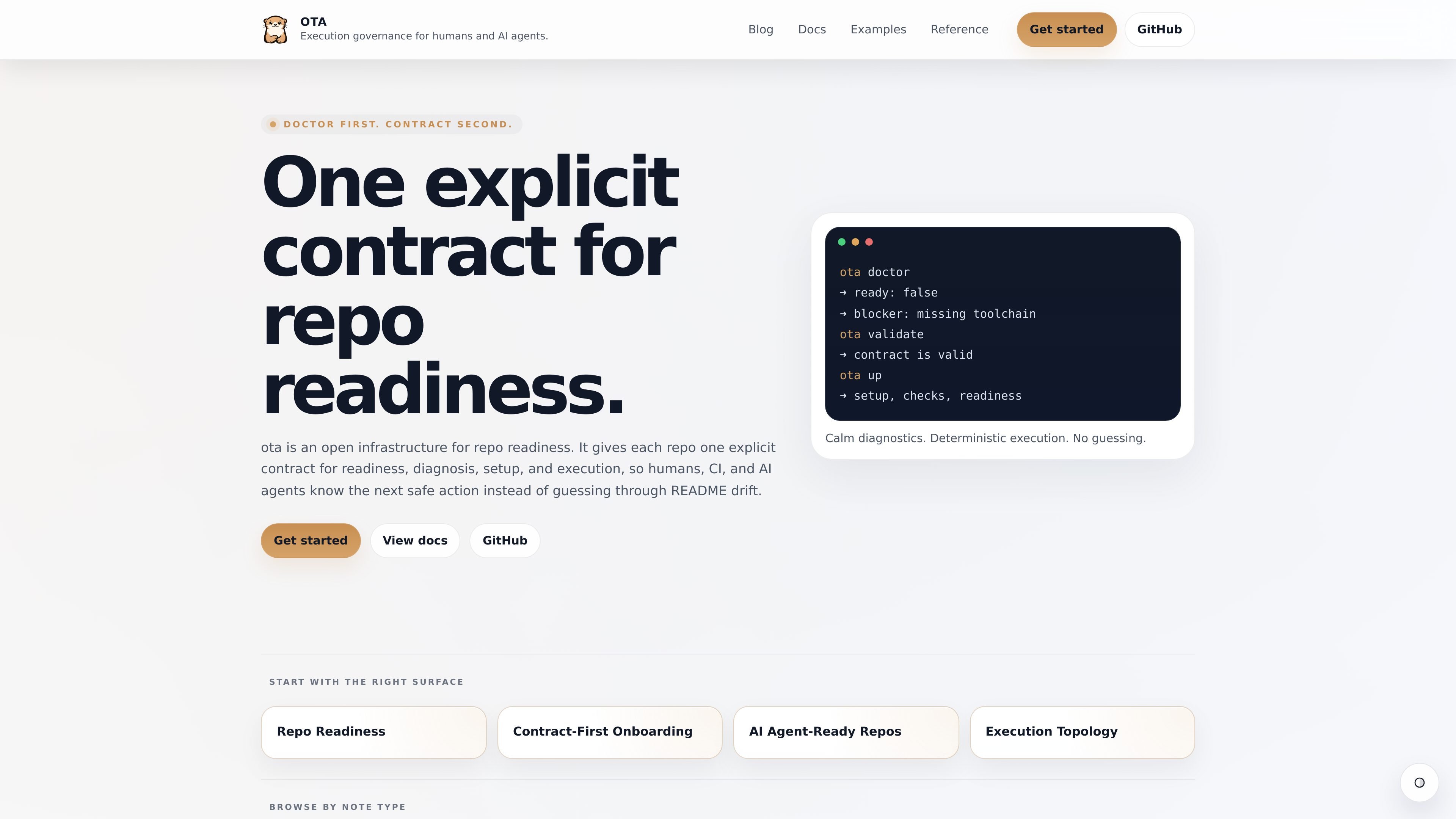
Ota is repo readiness infrastructure for developer onboarding and AI agents. It gives each repository one explicit ota.yaml contract for readiness, diagnosis, setup, validation, and execution, so humans and automation can understand the next safe action without digging through README drift or scattered scripts.
The product is positioned as an open, contract-first system for repo-local workflows. Its core commands—ota doctor, ota validate, ota up, and ota run—cover the path from first diagnosis to prepared setup and declared task execution, while the docs add reference surfaces for contracts, workspaces, JSON output, and execution governance.
The site repeatedly frames ota around calm diagnostics and deterministic execution. The result is a shared repository contract that can support onboarding, CI checks, and agent-safe operations from the first run, with the contract acting as the source of truth for what the repo needs and what should happen next.
Ota centers repo setup, readiness checks, CI validation, and agent-safe task execution in a single contract file named ota.yaml. That keeps humans and automation aligned on the same repository truth.
ota doctor reports readiness, the top blocker or warning, and the next safe action. The site positions it as the first command to run when a repo feels broken, incomplete, or inconsistent.
ota validate checks that the contract is sound before CI or teammates rely on it. The docs present it as a guard against invalid configuration becoming a shared dependency.
ota up prepares a repo for its first run through the contract instead of relying on ad hoc setup. The workflow examples show it being used before work starts or before a contract-first run.
ota run executes declared tasks through the contract so local work, CI, and agents follow the same task definition. The source highlights explicit task ordering, dependency checks, and a consistent execution path.
The docs and reference pages expose JSON output surfaces, workspace concepts, and command/contract boundaries for automation and multi-repo coordination. They also describe policy and provisioning as a separate layer above the repo contract.
Run ota doctor first when a repository is hard to trust, then use the reported blocker and next safe action to decide what to fix before editing files or starting work.
Use ota validate after editing ota.yaml, and before CI or teammates rely on it, to confirm the contract is structurally sound.
Use ota up when a repo should be ready before work starts so setup follows the contract rather than a set of undocumented local steps.
Use ota run for tasks that should execute the same way in local development, CI, and agent-driven workflows, with the contract defining the declared task and any dependencies.
Use the docs and JSON-oriented reference surfaces when another system needs machine-readable outputs, workspace coordination, or a stable contract boundary instead of prose.
ota is a repo readiness tool that centers setup, checks, validation, and task execution around one explicit ota.yaml contract. The site presents it as useful for humans, CI, and AI agents that need a shared source of truth for what a repository needs next.
The source emphasizes ota doctor for diagnosis, ota validate for checking contract soundness, ota up for preparing a repo, and ota run for executing declared tasks. The getting-started page also points users to begin with diagnosis rather than guessing.
The docs describe ota.yaml as the main repo readiness contract. The home page shows an example contract with runtimes, tools, tasks, and agent settings, and the reference docs point to contract semantics and workspace execution surfaces.
The site says ota is designed to help humans, CI, and AI agents use the same source of truth. It also mentions generating AGENTS.md from the contract and using JSON output for automation.
The pricing route does not resolve to a pricing table on the captured page; it returns a 404-style route-not-found message and points visitors to the canonical docs, getting started, reference, and GitHub paths.
OpenFlags is an open-source, self-hosted feature flag platform for JavaScript teams, with local evaluation, targeted rollouts, and controlled launches.

ByteAsk is a terminal-first AI coding agent for C and C++ that edits repos and verifies changes with compilers, debuggers, sanitizers, and tests.

CreateOS Sandbox is an isolated compute environment for running code and agent workloads in Firecracker micro-VMs with private networking and SDK, CLI, or MCP control.

Codex Plugins bundle reusable skills, app integrations, and MCP servers into workflows you can install in the Codex app or use from Codex CLI.

Struere turns spreadsheet data into structured operational software with dashboards, alerts, and automations for teams replacing manual spreadsheet workflows.

hob is an independent workspace for coding agents, with local control over sessions, terminals, history, routing, and follow-up work.