
Typed MCP actions
Agents can create data rooms, folders, links, and documents through typed tool calls instead of manual UI steps.

Papermark for agents lets AI agents and custom software create data rooms, upload documents, mint secure links, and read page-level analytics via MCP and REST.
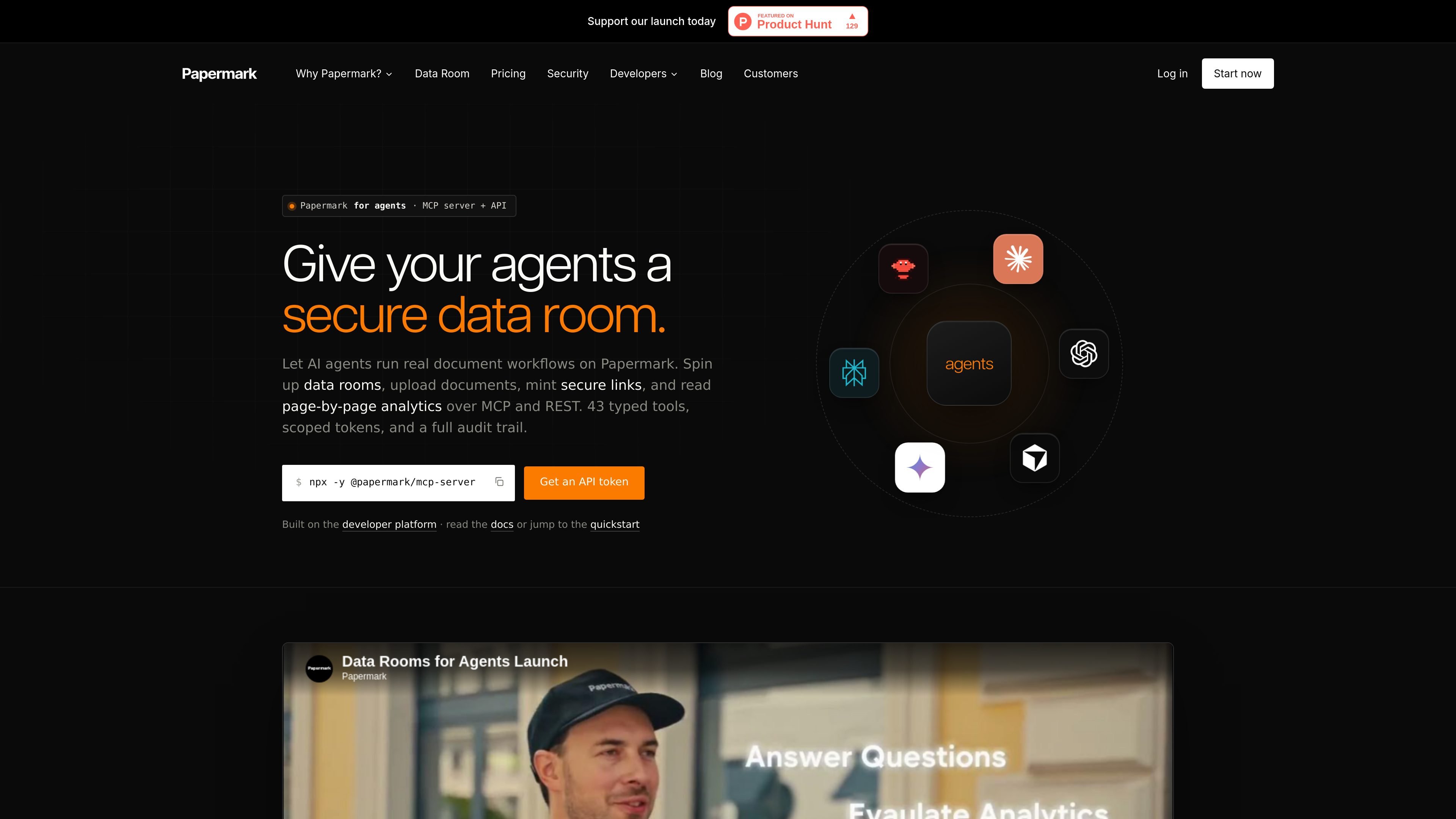
Papermark for agents exposes the Papermark document-sharing platform to AI agents and software workflows through MCP and REST. It is designed for tasks such as creating data rooms, uploading documents, minting secure links, and reading page-by-page analytics without requiring manual work in the web app.
The source describes a setup built around scoped `pm_live_...` tokens, typed MCP tools, and versioned REST endpoints. Agents can work with data rooms, documents, links, visitors, and analytics while staying within the permissions of the token they use, and the platform records actions in an append-only audit log.
Agents can create data rooms, folders, links, and documents through typed tool calls instead of manual UI steps.
Every tool maps to a versioned REST endpoint, so custom agents and server-side workflows can use the same surface over HTTP.
The developer page shows a `papermark` CLI with OAuth device flow or token-based login, plus JSON output for pipelines.
Share links can include passwords, expiry dates, email gating, download controls, watermarking, and allow/block lists.
Agents can list visitors, inspect page-by-page engagement, and read view analytics to understand how documents are used.
Webhooks and an append-only audit log let automations respond to events and preserve a record of views, downloads, and changes.
A founder can ask an agent to create a data room, upload a folder of diligence files, organize them into folders, and generate password-protected, email-verified links for investors.
An advisor or banker can provision a buyer-specific room after an NDA, upload transaction documents, apply firm-level watermarking, and send the link back without duplicating the whole workspace manually.
An IR or partnership team can distribute quarterly materials through unique links, then review who opened them, which pages they spent time on, and where follow-up is needed.
A broker can forward property PDFs into a monitored workflow that creates a room, files documents into preset folders, and returns a shareable listing page with gated access.
A product or platform team can embed Papermark behind the scenes and provision rooms and links from its own backend while keeping its own user interface.
Papermark for agents exposes Papermark through typed MCP tools and versioned REST endpoints. The developer page shows a quickstart that uses a scoped token, the CLI device flow, or the SDK to make the first API call.
The source shows MCP access through `@papermark/mcp-server`, REST access over HTTP, and CLI access through the `papermark` command. The same token can be used across these surfaces.
The developer page shows actions such as creating data rooms, uploading documents, creating links, listing visitors, and reading page-level analytics. The agents page adds workflows for webhooks, audit logs, and grounded Q&A over allowed documents.
Papermark uses scoped `pm_live_...` tokens and an append-only audit log. The product pages also describe password protection, link expiration, email verification, watermarking, and permissions as available controls.
The source does not list a hard limitation for team usage, but it does show that some plans include a fixed number of team members and that enterprise support and self-hosting are separate options on the pricing page.

ByteAsk is a terminal-first AI coding agent for C and C++ that edits repos and verifies changes with compilers, debuggers, sanitizers, and tests.

CreateOS Sandbox is an isolated compute environment for running code and agent workloads in Firecracker micro-VMs with private networking and SDK, CLI, or MCP control.

hob is an independent workspace for coding agents, with local control over sessions, terminals, history, routing, and follow-up work.

Manta AI is an autonomous web app testing tool that maps app behavior, catches regressions, and generates tests from a URL, no scripts or selectors needed.

SonOf connects to your repo and PM tool, audits your codebase, and turns approved work into shipped tickets with senior engineering review.

Ghost is a terminal-based AI assistant for chatting, code generation, and CLI tasks. Includes free models, supports Linux, macOS, Windows, and is open source.