

Relevance AI
Relevance AI builds AI agents for sales and GTM teams to run playbooks with human steering and autonomous execution, including research and outreach.
What is Relevance AI?
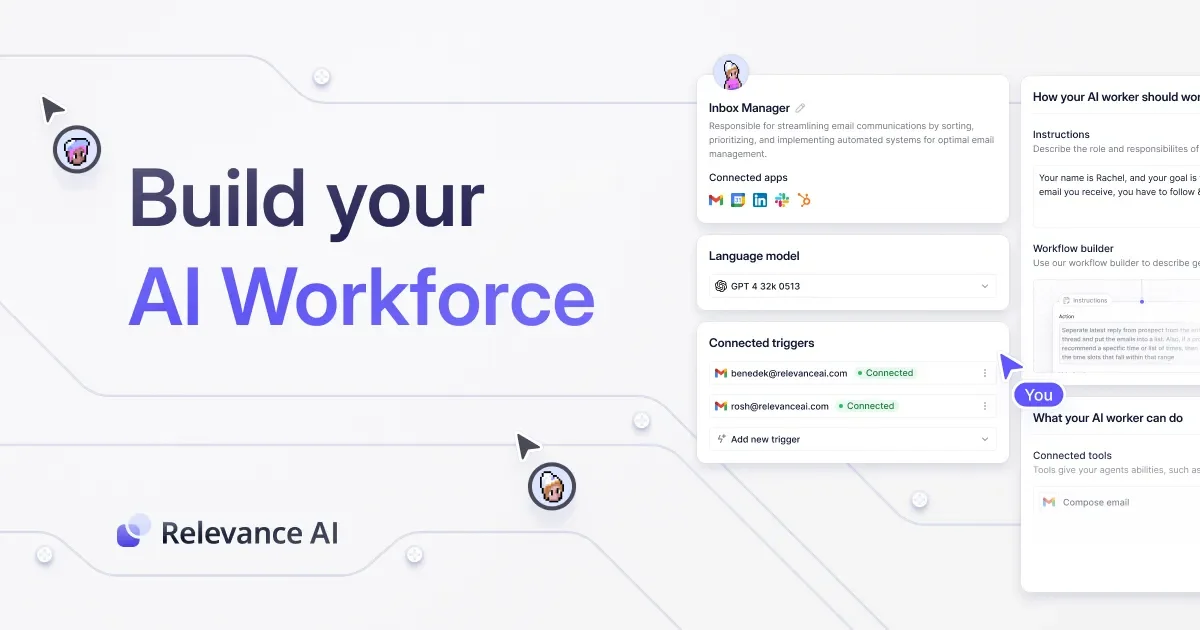
Relevance AI is a platform for building AI agents that help sales and GTM (go-to-market) teams execute their workflows. It supports an adoption path where teams can start by delegating individual tasks and evolve toward AI workforces that run autonomously on GTM playbooks.
The core purpose is to run sales and customer-facing processes—such as outreach, meeting preparation, qualification, and follow-ups—using agent workflows that can be triggered by pipeline signals or other events, with humans able to steer, handle escalations, and manage strategy.
Key Features
- SuperGTM teammate for day-to-day support: Delegates busywork such as research, CRM updates, and drafting emails while keeping the rep in control.
- Playbook-based workflow ownership (Copilot stage): Teaches SuperGTM your GTM playbooks so it can execute end-to-end workflows like outbound or meeting preparation.
- Autonomous AI Workforces (Autopilot stage): Turns established playbooks into AI Workforces that run on pipeline signals; reps handle escalations.
- Self-optimizing agents (Self-Driving stage): As agents mature, they can create new agents and run tests, while leaders focus on strategy.
- Agent infrastructure for common GTM roles: Includes agent types for sales development and qualification, such as an always-on BDR Agent, a Research Agent, an Inbound Qualification Agent, and a Customer Support Agent.
- Lead and event-driven routing: Inbound qualification can route leads in real time to the right rep by automatically asking questions.
- Enterprise governance and security controls: SOC 2 Type II & GDPR claims are present on the site, along with SSO and RBAC, multi-region data residency, version control for agents, monitoring dashboards & evals, and a trust center with pre-built documentation/DPA templates.
- Version history and rollback: “Full version history on every agent” with the ability to roll back instantly is explicitly described.
- Integrations: The page indicates “100+ integrations” and describes that agents can sit in tools like calendar, email, and CRM, though specific app names are not listed in the excerpt.
How to Use Relevance AI
Start by identifying one GTM workflow you want to accelerate (for example, research + drafting for outbound, or meeting preparation). If you’re in the early stage, delegate tasks such as prospect research, CRM updates, and initial outreach drafting while you steer the outcome.
Next, teach the system your playbooks so the agent can take on an end-to-end workflow. Once the playbook is stable, move toward autonomous operation where an AI workforce runs based on pipeline signals and escalations are handled by your team.
Finally, as agents become established, use the self-driving stage to let workforces optimize themselves through tests and new agent creation, while you retain responsibility for overall GTM strategy.
Use Cases
- Stalled-deal follow-ups for account executives: The site describes checking what’s blocking stalled deals and sending personalized nudges, backed by deal context handled by the agent.
- Outbound sales development with always-on engagement: Use the BDR Agent to engage leads instantly and drive pipeline 24/7, including coverage of accounts a team can’t reach manually.
- Prospect research before calls: Before meetings, run the Research Agent so each call is prepped with the right insights, reducing manual research work.
- Real-time inbound lead qualification and routing: Use the Inbound Qualification Agent to qualify leads and route them to the right rep instantly, based on automated questions.
- Customer support ticket resolution with escalation to humans: Deploy the Customer Support Agent to respond quickly with understanding of the product and customer context, escalating to humans when needed.
FAQ
-
Does Relevance AI replace reps and customer success teams? The site describes a progression where reps steer early workflows, handle escalations during autonomous runs, and lead overall strategy in later stages.
-
How does Relevance AI learn my GTM playbooks? The “Copilot” stage is described as teaching SuperGTM about your playbooks so it can own end-to-end workflows such as outbound or meeting preparation.
-
Can agents act on pipeline signals automatically? Yes. The “Autopilot” stage is described as converting playbooks into AI Workforces that run autonomously and are triggered by pipeline signals.
-
What security and governance features are available? The page states SOC 2 Type II & GDPR, SSO and RBAC, multi-region data residency, version control with rollback, monitoring dashboards & evals, and a trust center with pre-built security documentation and DPA templates.
-
Does Relevance AI integrate with existing tools? The site mentions “100+ integrations” and indicates agents can connect to systems such as calendar, email, and CRM, though the excerpt does not list specific integrations.
Alternatives
- CRM/workflow automation platforms with AI capabilities: These can automate steps in outreach, routing, or task creation, but typically focus on workflow automation rather than dedicated multi-stage AI agent workforces tied to playbooks.
- Sales engagement and sales intelligence tools: These often provide prospecting, enrichment, and outreach support. Compared with agent workforces, they may be more centered on sequences and data rather than autonomous, event-triggered execution across GTM workflows.
- Customer support AI assistants: Tools that help draft responses and triage tickets can address support workloads, but may not cover the broader set of GTM roles (outbound, research, qualification) described for Relevance AI.
- AI agent frameworks and automation builders: General platforms can be used to build agents and workflows, but usually require more engineering effort to achieve the specific GTM agent roles, governance, and playbook-driven progression outlined by Relevance AI.
Alternatives

Codex Plugins
Use Codex Plugins to bundle skills, app integrations, and MCP servers into reusable workflows—extending Codex access to tools like Gmail, Drive, and Slack.

Struere
Struere is an AI-native operational system that replaces spreadsheet workflows with structured software—dashboards, alerts, and automations.

Podium
Podium is an AI-powered lead generation and management platform designed to help businesses convert more leads and increase revenue.

OpenFlags
OpenFlags is an open source, self-hosted feature flag system with a control plane and typed SDKs for progressive delivery and safe rollouts.

AakarDev AI
AakarDev AI is a powerful platform that simplifies the development of AI applications with seamless vector database integration, enabling rapid deployment and scalability.

AgentMail
AgentMail is an email inbox API for AI agents to create, send, receive, and search email via REST for two-way agent conversations.