
Academic Paper Editing
Rubriq optimizes grammar, sentence structure, and cohesion based on academic language so manuscripts read more clearly and smoothly while preserving the original writing style as much as possible.

Rubriq is an AI tool for academic paper editing and translation, with personal subscriptions, institutional plans, and plagiarism-check services.
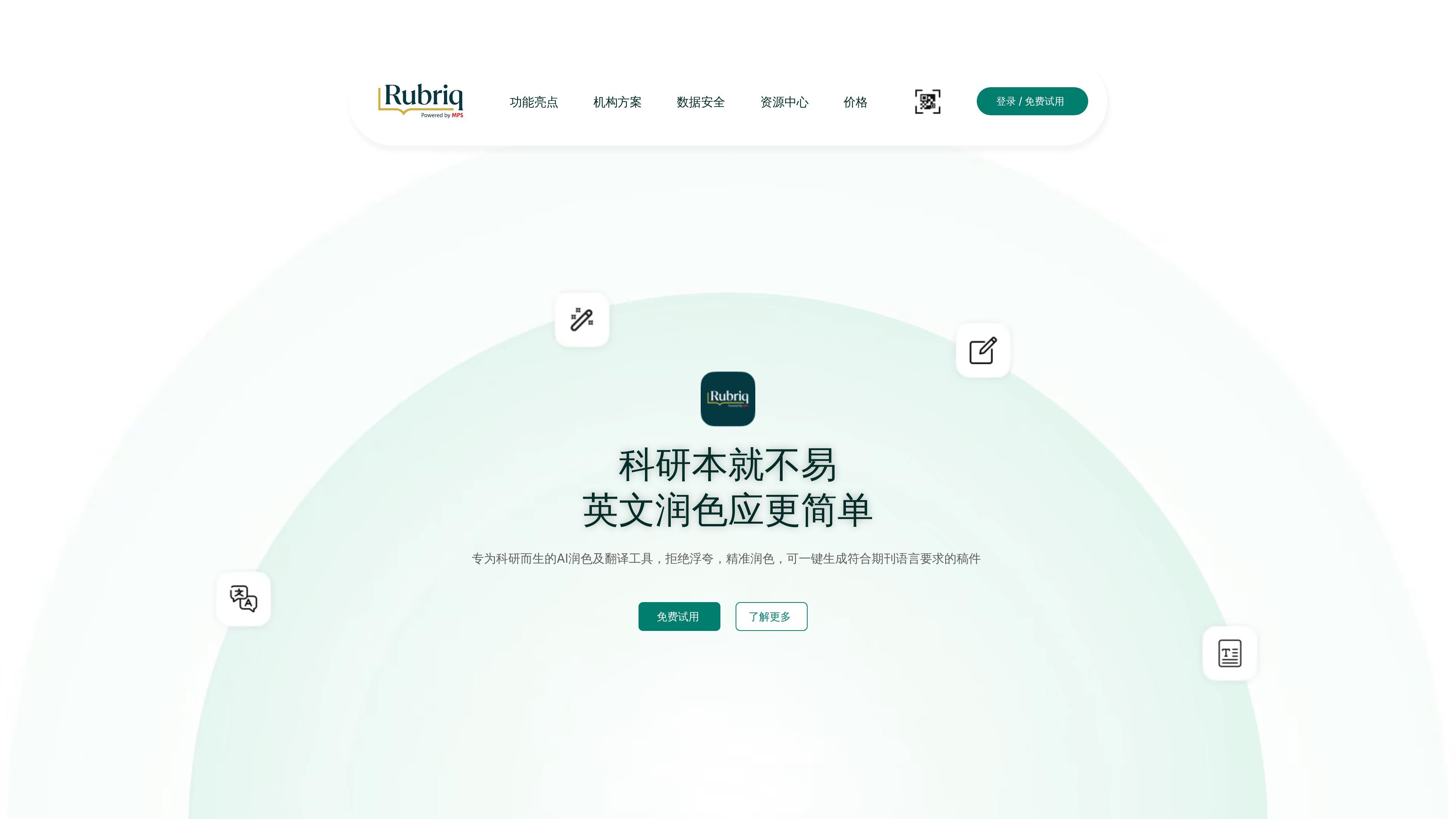
Rubriq is an AI tool for academic paper editing and translation designed for research writing scenarios. It focuses on improving the accuracy, logic, and academic tone of papers without changing the original meaning. The official website says it supports automatic analysis after manuscript upload and generates results with tracked changes, which users can review before downloading.
The product page positions Rubriq as a writing assistant for researchers, teams, and institutions. It includes personal subscriptions as well as institutional partnership plans and plagiarism-check services. A typical workflow is to register or log in, upload a document, wait for processing, review the changes in tracked mode, and export the result.
Rubriq optimizes grammar, sentence structure, and cohesion based on academic language so manuscripts read more clearly and smoothly while preserving the original writing style as much as possible.
The system identifies redundancy, unclear wording, and inconsistent structure to improve argumentation and expression, rather than only making surface-level grammar corrections.
Rubriq provides context-aware academic translation, emphasizing terminology consistency and semantic accuracy while preserving the original research meaning as much as possible.
All edits are shown in tracked changes, allowing users to review each sentence and choose whether to accept or reject changes.
The upload, analysis, and download workflow is short, and the official site indicates that editing or translation can usually be completed in a few minutes and returned as a document ready for review.
Institutional plans support role- or department-based permissions, flexible authorization, and dedicated support for deployment at the department, laboratory, or university level.
Suitable for authors who want to quickly bring a Chinese or English research draft up to submission-ready quality. After uploading the draft, Rubriq automatically handles grammar, sentence structure, and cohesion, then returns a reviewable version.
Suitable for multilingual researchers working on academic expression across Chinese-English, Spanish-English, or Portuguese-English pairs. The product emphasizes terminology consistency and academic context rather than literal word-for-word conversion.
Suitable for scenarios where supervisor groups, laboratories, or departments want to improve manuscript quality consistently. Institutional plans support flexible authorization, member configuration, and dedicated support for use across multiple researchers.
Suitable for individual users who want to validate the results before committing to a long-term subscription. The official website offers a free trial so users can first experience the editing workflow and output format.
Suitable for users who need an additional similarity check before submission. The Rubriq page also provides iThenticate plagiarism-check related services for pre-submission duplicate-content review.
Yes. Rubriq offers a free trial, so users can try the editing features before deciding whether to subscribe.
Yes. Subscription plans can be canceled in account settings, and changes or cancellations usually take effect in the next billing cycle.
Yes. Rubriq’s group plans are designed for institutions, colleges, and research teams, with configurable members, discounted pricing, and dedicated support.
Rubriq can process up to 25,000 words per document, with a limit of 3 documents per hour.
Rubriq does not currently provide an editing certificate. It also states that editing results are returned as Word documents with tracked changes, making them easy to review.

ProWritingAid is a writing assistant for storytellers with grammar checking, style editing, paraphrasing, and story analysis in popular writing apps.

Dictro is a private AI dictation app for Mac that turns speech into polished text in any editable app. Runs locally on Apple Silicon Mac by default, with optional Fast Mode.

Goldfish is an AI memory app for macOS that helps you reply, write, summarize, and continue with context already on your Mac. It stores memory locally and writes in your tone.

SpeakoFlow is a free, open-source desktop voice-to-text app for Windows, macOS, and Linux. Dictate into any app, use Flow, cleanup, translation, and a screen-aware assistant.

Paperpal is an AI tool for academic writing, offering literature reading, language polishing, citations, plagiarism checks, AI detection, and pre-submission review.

Sanota turns spoken memories and interviews into clear written stories for personal storytelling, family history and shared memories, with guided prompts and subscriptions.