

Scite
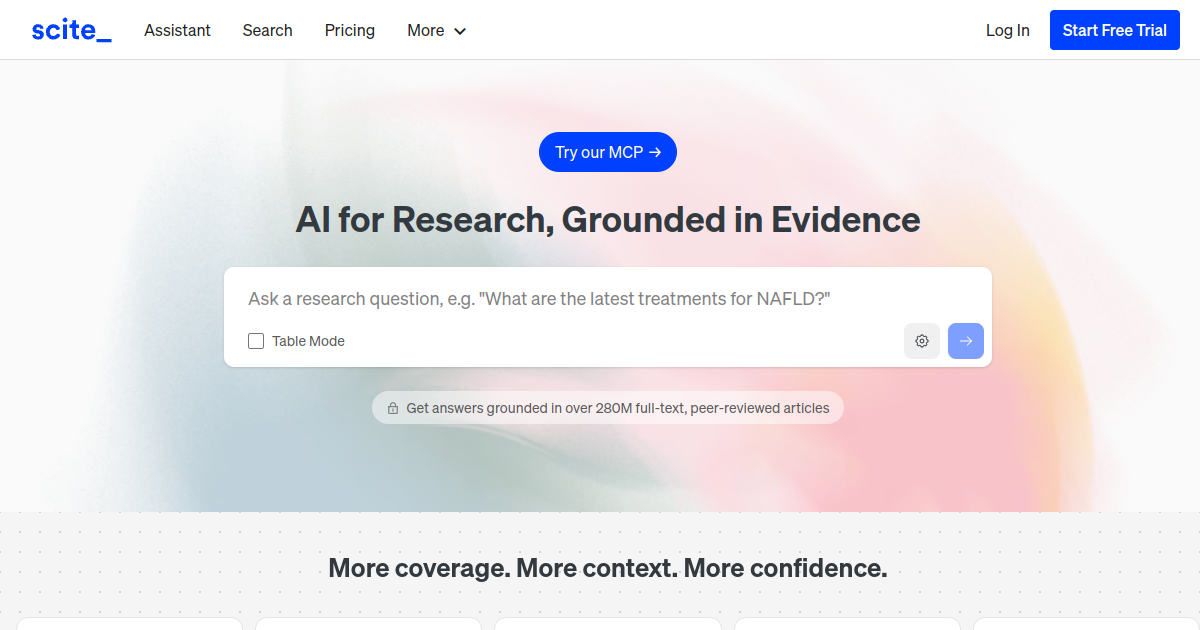
Scite is an AI for research platform to search scientific literature and see whether findings are supported or contradicted by later papers.
What is Scite?
Scite is an AI for research platform designed to help researchers understand what prior studies support or contradict. Its core purpose is to let users explore research relationships with answers grounded in real, peer-reviewed papers rather than generated text.
Scite pairs large-scale full-text access with a citation analysis database that classifies citation contexts. This combination is intended to support more evidence-focused literature searching, writing, and verification when citing scientific claims.
Key Features
- Grounded AI answers in over 280M full-text, peer-reviewed articles: responses are tied to real papers rather than being generated without source grounding.
- Full-Text Search beyond abstracts: search is positioned to help users find what is actually inside research documents, not only the summary-level abstract.
- Smart Citations for supported vs. contradicted findings: citation contexts are analyzed so users can see whether later research supports or contradicts an earlier claim.
- Verifiable evidence workflow: the platform emphasizes that answers can be traced back to papers, avoiding “hallucinated” output.
- Citation context classification with confidence: Scite uses a deep learning model to classify citation contexts and display a confidence figure for the classification.
- Broad source coverage including open access and paywalled content: Scite describes access to both Open Access and paywalled material via direct agreements with publishers such as Wiley, SAGE, and others.
How to Use Scite
Start by running a search for a paper or topic using Scite’s search interface. When results are returned, use the Smart Citations view to inspect whether specific findings are supported or contradicted by later work.
As you review results, follow the citation interactions shown in excerpts—such as clicking into exact citation contexts and opening the citing paper—so you can verify the surrounding text and where in the paper the citation appears.
Use Cases
- Literature search for a specific claim: search for a relevant paper and use Smart Citations to identify which later studies support or contradict the claim you care about.
- Writing with citation verification: while drafting, consult citation contexts to understand how other papers engage with the original finding before including it in your manuscript.
- Moving from abstract-level summaries to full context: use full-text search to locate details inside the document rather than relying only on abstract statements.
- Investigating scholarly debate: when research outcomes appear inconsistent across studies, use supported/contradicted classification to map where disagreements emerge.
- Following citation trails during review: click from an excerpt to the citing paper and check where the citation occurs within the paper to ensure your interpretation matches the source context.
FAQ
-
Does Scite generate answers without sources? The site states that answers are grounded in real papers and not generated or “hallucinated.”
-
What does “Smart Citations” do? Scite classifies citation contexts to indicate whether a finding is supported or contradicted by later research.
-
How does Scite search? Scite describes search that goes beyond abstracts using full-text search across its covered sources.
-
Is Scite limited to open access material? The site states Scite combines access to both Open Access and paywalled content via publisher agreements.
-
What output can I verify? The site emphasizes that citation contexts can be explored, including the exact citation context and where the citation appears in the citing paper.
Alternatives
- General-purpose academic search engines: these can help you find papers, but they typically don’t provide citation-context classification for support vs. contradiction.
- Citation indexes and bibliographic databases: useful for identifying related literature and citation counts, but often less focused on analyzing the specific textual context of each citation.
- Research assistant or “AI literature review” tools that rely on user-provided PDFs/notes: these may summarize or compare papers, but the workflow and grounding may differ from Scite’s emphasis on evidence-grounded answers and citation context classification.
- Manual systematic review workflows: researchers can assess support and contradiction by reading full texts directly; this can be rigorous but is usually more time-consuming than citation-context-driven exploration.
Alternatives

Model Council
Model Council is a multi-model research feature by Perplexity that runs a single query across several top AI models simultaneously to generate a synthesized, comprehensive answer.

GoldenRetriever
GoldenRetriever is an AI search tool for videos, audio, and documents—answering in plain English with sources and timestamps, using visual and audio context.

Comet
Comet is an AI-powered browser for iPhone and iPad with a built-in assistant to help you research, summarize, shop, schedule, and more.

garden-md
Turn meeting transcripts into a structured, linked company wiki with local markdown and an HTML browser view. Sync from supported sources.

ClayHog
ClayHog tracks AI Search Visibility & GEO—see what ChatGPT, Gemini, Perplexity, Claude, and Google AI Overviews say about your brand, incl. citations and sentiment.

Grok AI Assistant
Grok is a free AI assistant developed by xAI, engineered to prioritize truth and objectivity while offering advanced capabilities like real-time information access and image generation.