
SAM.gov registration support
The service helps businesses complete SAM.gov registration, which is the required federal vendor registration referenced in the source material.

SLED.AI helps small and medium B2B businesses with SAM.gov registration, opportunity matching, and proposal support for federal, state, local, and education contracts.
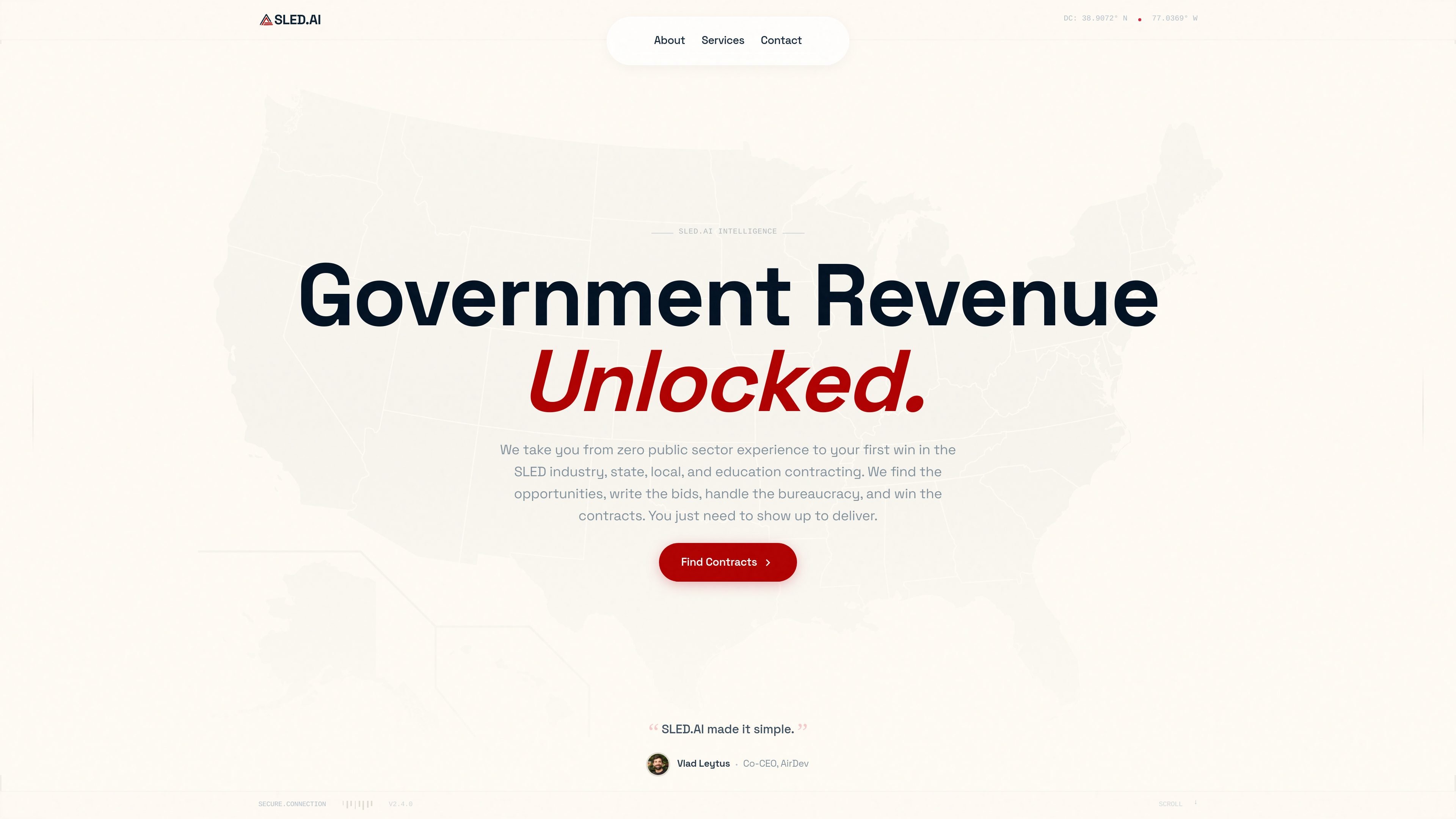
SLED.AI is a government contracting service for small and medium B2B businesses. The site describes it as an end-to-end offering that helps companies pursue federal, state, local, and education contracts.
The source material specifically mentions three core services: SAM.gov registration, opportunity matching, and proposal support. Its published guides focus on the adjacent work that government buyers expect, including capability statements, proposal compliance, and SAM.gov maintenance.
The service helps businesses complete SAM.gov registration, which is the required federal vendor registration referenced in the source material.
SLED.AI describes opportunity matching as part of its service, suggesting help identifying government contract opportunities that fit a business profile.
The site says it handles proposals, and its blog focuses on government contract proposal writing, including compliance, Sections L and M, and review steps.
The blog library includes practical guidance on capability statements, which are a standard government contracting document used to present qualifications to buyers.
The site publishes educational guides on topics like SAM.gov, capability statements, and proposal writing, which can support teams that are learning the contracting process.
A small business that needs to complete SAM.gov registration before bidding on federal work can use SLED.AI for the registration step and related setup guidance.
A team that wants to find relevant government opportunities can use the service’s opportunity matching focus to narrow the search to contracts that fit its offerings.
A company preparing an RFP response can use SLED.AI’s proposal support and its related educational material on compliance, Sections L and M, and review steps.
A business that needs a one-page capabilities document for buyers can use the site’s capability statement guidance to better present competencies and past performance.
An owner entering government contracting for the first time can use the site’s articles as background reading on registration, proposal writing, and buyer expectations.
SLED.AI positions itself as an end-to-end government contracting service for small and medium B2B businesses. The source material shows help with SAM.gov registration, opportunity matching, and proposal work, but it does not describe the full onboarding process in detail.
The source content explicitly mentions SAM.gov registration, opportunity matching, and proposal development. It does not provide a complete feature list beyond those services.
The website frames the service for small and medium B2B businesses that want to pursue federal, state, local, and education contracts.
The pricing page currently resolves to a 404-style fallback and does not publish a pricing model, plan list, or fee structure in the provided sources.
The blog content emphasizes government contracting workflow topics such as SAM.gov registration, capability statements, and proposal writing. The source does not describe software integrations or a platform ecosystem.

GentleCase is immigration case management software for law firms, with client profiles, case tracking, visa templates, document management, messaging, and a branded client portal.

Codex Plugins bundle reusable skills, app integrations, and MCP servers into workflows you can install in the Codex app or use from Codex CLI.
Struere turns spreadsheet data into structured operational software with dashboards, alerts, and automations for teams replacing manual spreadsheet workflows.

Wysera is an AI business platform with PostWyse for content and OpsWyse for CRM and revenue workflows, powered by shared Wyse AI and approval-first automation.
OpenFlags is an open-source, self-hosted feature flag platform for JavaScript teams, with local evaluation, targeted rollouts, and controlled launches.

Awish is an AI no-code automation platform that turns natural-language requests into workflows across connected apps—no manual setup.