
Sparse MoE architecture
The sparse Mixture-of-Experts model has 600 billion total parameters and activates 27 billion parameters per token, reducing the amount of computation used for each token relative to a fully active model.

Step 5 Preview is StepFun’s flagship AI model for agentic software engineering, professional knowledge work, and finance tasks, with vision input, a 1M-token context window, and API access.
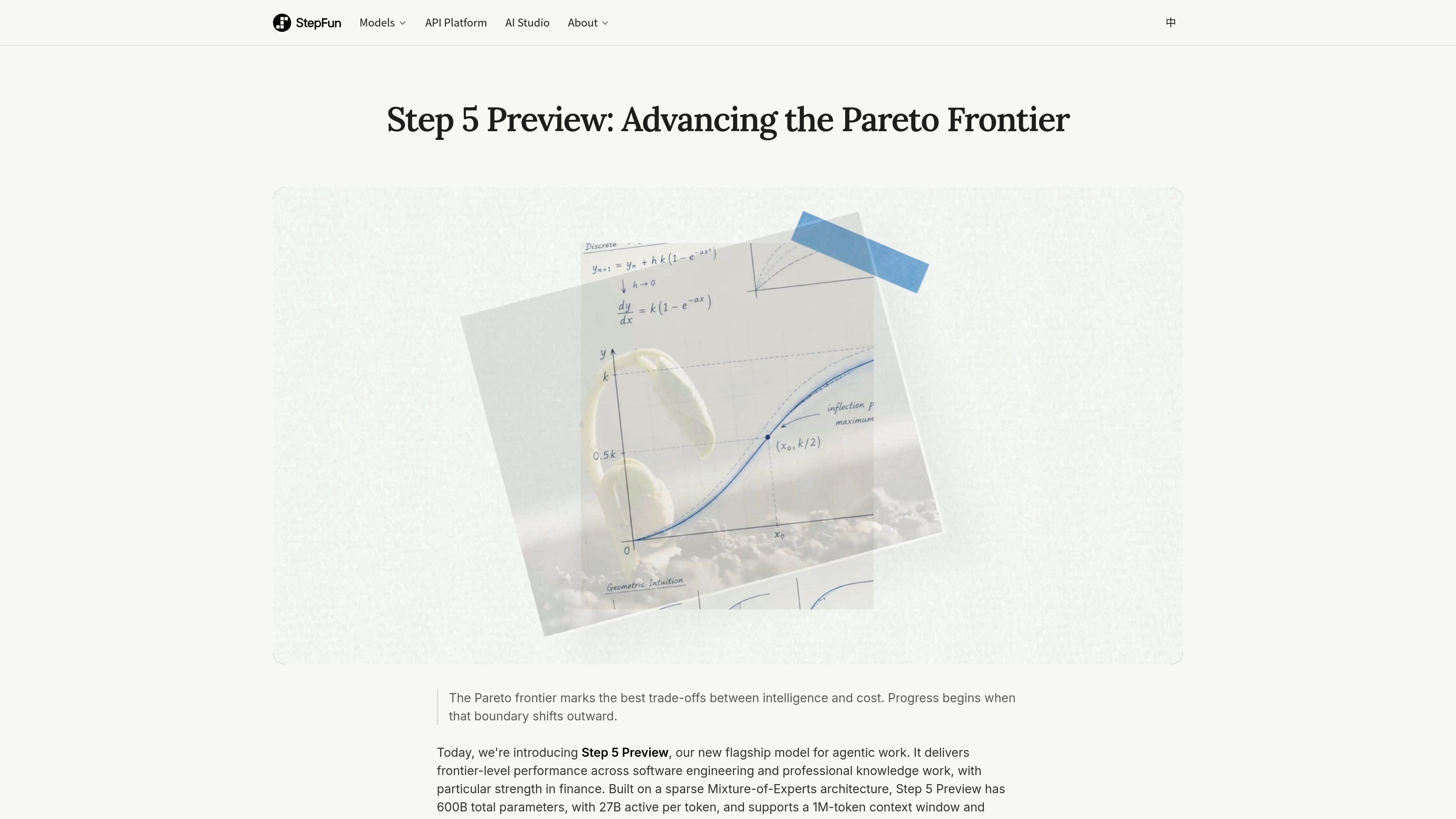
Step 5 Preview is a flagship AI model from StepFun for agentic work, software engineering, and professional knowledge tasks. It combines a sparse Mixture-of-Experts architecture with 600B total parameters, 27B active per token, a 1M-token context window, and vision input.
The model is available through StepFun products and API, and the source says open weights are planned for release on October 15. Its published evaluations cover coding, agentic tasks, professional knowledge work, and finance, while its demonstrations show workflows that depend on execution, feedback, and iterative revision rather than one-shot text generation.
The sparse Mixture-of-Experts model has 600 billion total parameters and activates 27 billion parameters per token, reducing the amount of computation used for each token relative to a fully active model.
A 1M-token context window supports work across extensive codebases, long documents, and other large working contexts.
Vision input and examples such as photo-to-3D room planning extend the model beyond text-only software tasks into visual application development.
The model covers bug repair, feature modification, refactoring, documentation, performance tuning, code generation, CI/CD operations, and other repository-level work across 33 programming languages.
Step 5 Preview is evaluated on tasks that require repeated execution, feedback, and revision, including GPU-kernel optimization and automated post-training data-loop improvement.
The source reports capabilities in professional knowledge work with particular strength in finance, alongside results from the FrontierFinance and DRACO evaluations.
Use the model for repository-level work such as feature changes, bug repair, refactoring, documentation, performance tuning, and CI/CD-related tasks. The source reports coverage across 553 repositories and 33 programming languages in StepCodeBench.
Give the model development documentation and authorization to work with programmable hardware. The product page describes use of cameras, COM ports, screenshots, and simulated mouse input during development and debugging.
Apply the model to visually oriented development, such as turning a room photo into an editable 3D environment, refining Blender assets, and incorporating them into interactive web applications or games with Three.js.
Use extended execution loops for technical optimization or model-development workflows. Demonstrated examples include optimizing an MLA GPU kernel through repeated measurement and improving a post-training data loop based on downstream results.
Support finance-oriented professional knowledge work and analysis. The page includes finance-specific evaluations, but it does not document a complete production trading or advisory workflow for Step 5 Preview.
Step 5 Preview is available through StepFun products and its API. The source also states that open weights are planned for release on October 15, but it does not specify the year in the available page text.
The model supports a 1M-token context window and vision input, making it suitable for large codebases, extended documents, and visual development tasks. The available evidence does not specify file-size limits, output formats, or an exact API setup process.
The model is designed for software engineering, agentic tasks, professional knowledge work, and finance. It can also work with programmable hardware when given development documentation and user authorization.
The page reports strong results across several evaluations, but also notes that a meaningful gap to the frontier remains on the most challenging long-running software tasks. Results may vary by task, prompting, tools, and execution environment.

CreateOS Sandbox is an isolated compute environment for running code and agent workloads in Firecracker micro-VMs with private networking and SDK, CLI, or MCP control.

GitBot is a local browser workspace for reusable coding bots powered by Claude Code, Codex, or OpenCode, with persistent threads and configurable permissions.

Grok 4.7 is an xAI model for coding and knowledge work, available via Grok Build, Cursor, the Grok API and more, from $2 per million input tokens.

AakarDev AI helps teams manage AI provider access, project setup, logs, and analytics in one dashboard. BYOK support included.

ByteAsk is a terminal-first AI coding agent for C and C++ that edits repos and verifies changes with compilers, debuggers, sanitizers, and tests.

MeetStream is a meeting bot API for Zoom, Google Meet, Microsoft Teams, and Webex. Record, stream, and analyze meetings with usage-based pricing and $5 free credit.