
Detect harness problems
Checks committed harness files against repository paths and configuration, identifying conflicts, missing-file references, patterns that match no files, and over-broad permissions with evidence and detector coverage.

tetriz-harness is an open-source developer tool that scans and improves AI coding tool configuration, with reviewed distribution and controlled rollouts for teams.
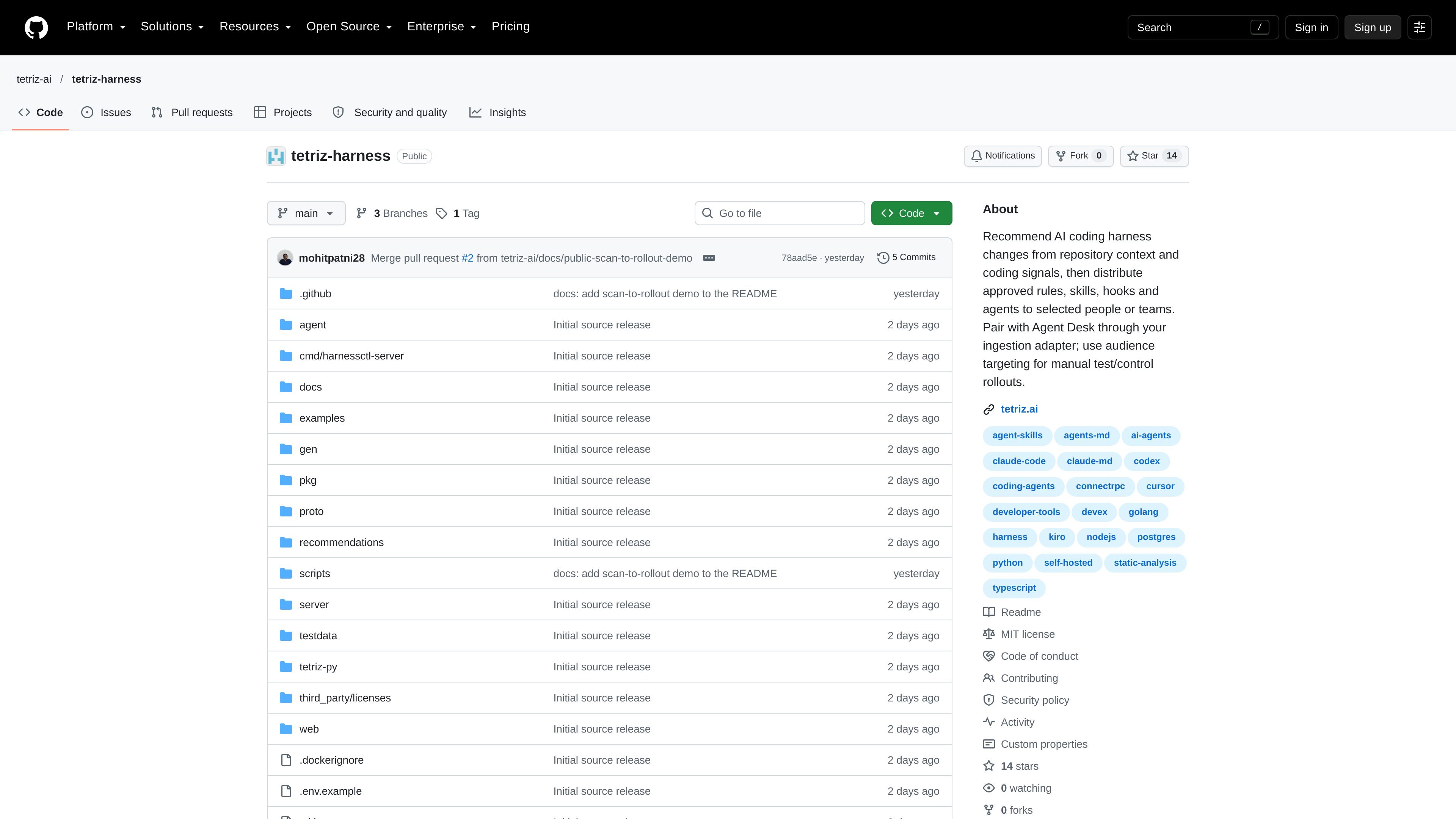
tetriz-harness is an open-source developer tool for evaluating and improving the harnesses that guide AI coding agents. Its harness model includes rules, skills, agents, commands, hooks, and MCP configuration for tools such as Claude Code, Codex, Cursor, and Kiro.
The repository combines a repository-aware scanner and recommendation engine with a control plane for distributing approved changes. Teams can inspect detected problems, use coding and organizational signals to derive additional recommendations, review findings, then target selected artifacts to developers or groups. Audience targeting also supports manually managed test/control rollouts, while outcome analysis remains external to the control plane.
Checks committed harness files against repository paths and configuration, identifying conflicts, missing-file references, patterns that match no files, and over-broad permissions with evidence and detector coverage.
Uses organizational session analyses, code-review themes, and security signals to propose new rules, agents, and hooks; this workflow depends on populated signal data, the bundled tetriz-py service, and a model key.
Can incorporate personal harness inventories and invocation records supplied through an ingestion layer for usage-informed checks; an on-disk checkout scan cannot infer those inputs by itself.
Persists findings and recommendations so teams can review them and explicitly choose which changes to adopt before publication.
Provides a Go server library, reference host with an admin UI, harness-agent CLI, and Node library for distributing approved harness artifacts.
Targets rules, skills, hooks, and agents to named people, teams, or the whole organization, installs them in supported user configuration locations or known repository checkouts, and reports per-person installation status.
Run the DETECTED scan against committed harness files to find stale references, ineffective file patterns, conflicts, and permissions that are broader than intended before changing the harness.
Combine session analyses, code-review themes, and security signals to identify candidate rules, agents, or hooks that address recurring engineering patterns.
Review and publish only selected recommendations, then deliver them to named developers, teams, or the full organization while checking installation status.
Create disjoint test and control groups, target a harness change only to the test group, and compare coding outcomes using an external session or review analysis system.
Use the standalone Agent Desk discovery and session-extraction packages through an adapter to supply harness inventory and observed activity to the recommendation workflow.
It is an open-source repository that scans AI coding harness files, generates recommendations from repository and organizational signals, and distributes approved artifacts through a control plane.
The DETECTED scan can inspect committed harness files against repository paths and configuration without making a model call. Recommendation workflows that use organizational signals require populated signal tables, the bundled tetriz-py service, and a model key.
The control plane can target approved artifacts to named people, teams, or the whole organization, place them in tool user configuration or known repository checkouts, and report installation status.
Yes. Audience targeting can deliver a selected artifact to a test group while leaving a separate control group untargeted. The system reports delivery state, but outcome measurement and experiment analysis remain in the user's own analysis system.
The repository states that it does not randomize cohorts, calculate experiment results, automatically restore an earlier harness version, or guarantee that untargeted users lack equivalent files from another source.

CreateOS Sandbox is an isolated compute environment for running code and agent workloads in Firecracker micro-VMs with private networking and SDK, CLI, or MCP control.

GitBot is a local browser workspace for reusable coding bots powered by Claude Code, Codex, or OpenCode, with persistent threads and configurable permissions.

ByteAsk is a terminal-first AI coding agent for C and C++ that edits repos and verifies changes with compilers, debuggers, sanitizers, and tests.

hob is an independent workspace for coding agents, with local control over sessions, terminals, history, routing, and follow-up work.

Manta AI is an autonomous web app testing tool that maps app behavior, catches regressions, and generates tests from a URL, no scripts or selectors needed.

SonOf connects to your repo and PM tool, audits your codebase, and turns approved work into shipped tickets with senior engineering review.