

VibeAround
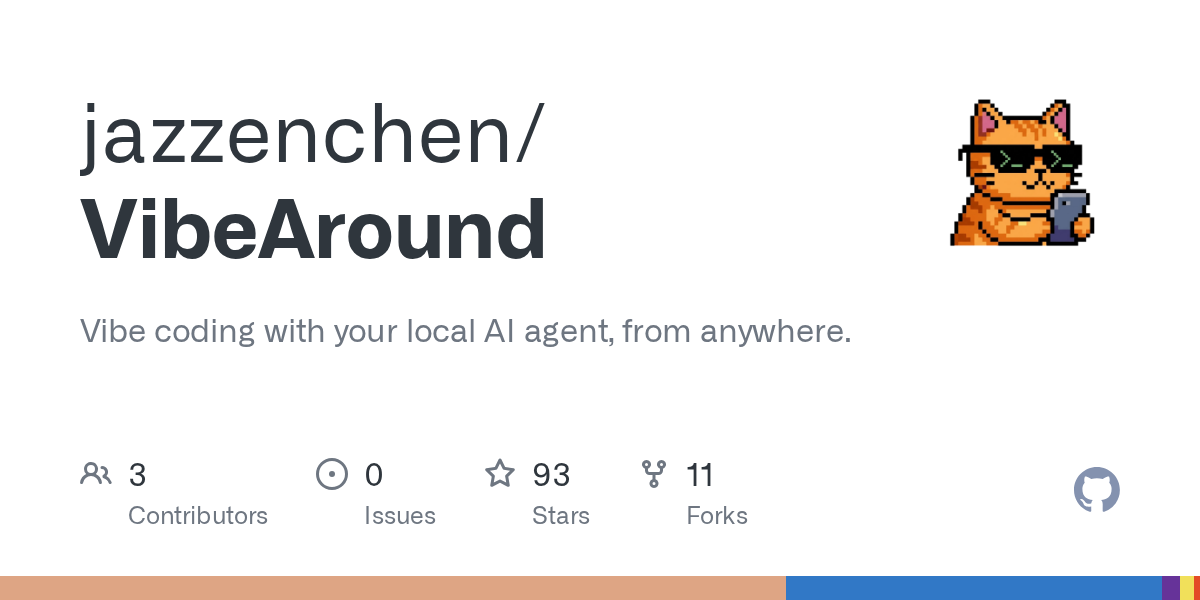
VibeAround connects to supported local AI coding agents from anywhere via IM chat and a browser web terminal, with live preview and session handover.
What is VibeAround?
VibeAround is a local-agent coding interface that lets you reach supported AI coding agents from anywhere. It provides two main surfaces—chat via popular IM platforms and a browser-based web terminal—backed by the same local workspace so you can keep working whether you’re on your phone, at a café laptop, or in a desktop shell.
The project also includes a lightweight desktop app (built with Tauri) for configuration and service management. Agents and IM channels are implemented as plugins that can be enabled on demand, while underlying connectivity and session behavior are handled through consistent protocols and built-in tunneling.
Key Features
- Chat with your local AI agent from any IM: DM your agent in Telegram, Slack, Feishu/Lark, or Discord to write code and run commands through chat interfaces.
- Web terminal with tmux compatibility: Use a full shell in the browser; on mobile, an on-screen command pad supports one-tap access to keys like ESC and Ctrl/arrow inputs. Pair with tmux so sessions can remain alive after closing the browser.
- Bidirectional session handover: Move a live coding session between terminal and IM using
/handoverand/pickup, preserving full context. - Switch agents mid-conversation: Change which supported agent is driving the session (e.g.,
/switch claude,/switch codex,/switch cursor) without restarting VibeAround. - Live preview via short-lived links: Share rendered Markdown/HTML from dev servers and open the links from a phone or any browser.
- One-click setup wizard for tunnels and credentials: The setup wizard installs agent dependencies, fills channel credentials, and selects a tunnel provider, reducing manual configuration.
How to Use VibeAround
- Build and run the project (for local development):
cd src, thenbun install,bun run prebuild, andbun run dev. - Launch the desktop app: On first launch, it opens the setup wizard.
- Choose agents and channels: Enable the agent(s) you want to use and configure IM channel credentials as prompted by the wizard.
- Set up tunneling: The wizard selects a tunnel backend so the web terminal and live preview can be accessed through token-gated public URLs.
- Start working: Open the IM client to DM your agent for chat-based coding, or use the web terminal in a browser. When needed, hand a live session between surfaces with
/handoverand/pickup.
Prerequisites listed in the repository are Rust 1.82+, Node.js 20+, and Bun 1.1+; on macOS you must also run xcode-select --install.
Use Cases
- Coding from an IM while traveling: Keep development going from Telegram/Slack/Feishu/Discord by sending commands and receiving coding output directly in chat.
- Terminal work on a borrowed laptop: Open the browser-based web terminal on a café machine; use tmux so the session can persist after the browser is closed.
- Switching between phone and terminal: Start a session in the web terminal, then use the handover commands to continue from an IM (or vice versa) with the same context.
- Using different agents for different tasks: Run one agent in Telegram while working with another in Slack, or switch agents mid-conversation using the provided
/switch ...commands. - Sharing a quick preview to validate UI/content: Publish rendered Markdown/HTML or dev-server output via short-lived links and view it on your phone.
FAQ
-
Which AI coding agents does VibeAround support? The repository lists support for Claude Code, Gemini CLI, Codex CLI, Cursor CLI, Kiro CLI, and Qwen Code, with communication handled over stdio using ACP (Agent Client Protocol).
-
How does VibeAround connect to IM platforms? Each IM channel runs as a standalone Node.js plugin loaded on demand. Channel authentication details vary by platform (for example, bot tokens, app credentials, or QR code login), and the setup wizard helps fill them.
-
What does “session handover” mean in practice? It lets you move a live coding session between the web terminal and IM using commands (
/handoverand/pickup) while preserving full context. -
Do the web terminal and live preview URLs require access control? Yes. The repository states that the exposed URLs are token-gated: they are publicly reachable, but only you can open them.
-
Is tmux required for session persistence? The documentation says the web terminal can be paired with tmux so sessions stay alive after you close the browser.
Alternatives
- Local terminal workflow using a CLI agent directly: You can use the agent CLI in your own terminal, but you won’t get the IM integration, web-terminal surface, or built-in session handover between chat and terminal.
- Web-based AI coding assistants: Browser-based assistants can provide a consistent interface from anywhere, but they won’t match VibeAround’s focus on connecting to local agent processes and preserving the same workspace across chat and terminal.
- Chat-based coding via platform bots (without session handover/web terminal): IM bot approaches can bring agent output into chat, but may not provide the same bidirectional handover and web terminal experience described in VibeAround.
- General-purpose tunneling + your own web terminal: Using tunneling and a terminal-in-browser setup can approximate remote access, but you would need to assemble and maintain agent/session management yourself rather than using VibeAround’s plugin architecture and handover commands.
Alternatives

Devin
Devin is an AI coding agent that helps software teams complete code migrations and large refactoring by running subtasks in parallel.

Claude Opus 4.5
Introducing the best model in the world for coding, agents, computer use, and enterprise workflows.

Codex Plugins
Use Codex Plugins to bundle skills, app integrations, and MCP servers into reusable workflows—extending Codex access to tools like Gmail, Drive, and Slack.

Falconer
Falconer is a self-updating knowledge platform for high-speed teams to write, share, and find reliable internal documentation and code context in one place.
OpenFlags
OpenFlags is an open source, self-hosted feature flag system with a control plane and typed SDKs for progressive delivery and safe rollouts.

AakarDev AI
AakarDev AI is a powerful platform that simplifies the development of AI applications with seamless vector database integration, enabling rapid deployment and scalability.