
Unified agent workspace
Run supported agent CLIs side by side in one native Swift interface with a shared sidebar, conversation view, composer, and approval cards. Each agent keeps its own controls and available choices.

Yardlet is a free, open-source Mac app for running Codex and Claude Code side by side, with task management, approvals, code review, browser automation, MCP connectors, and usage limits.
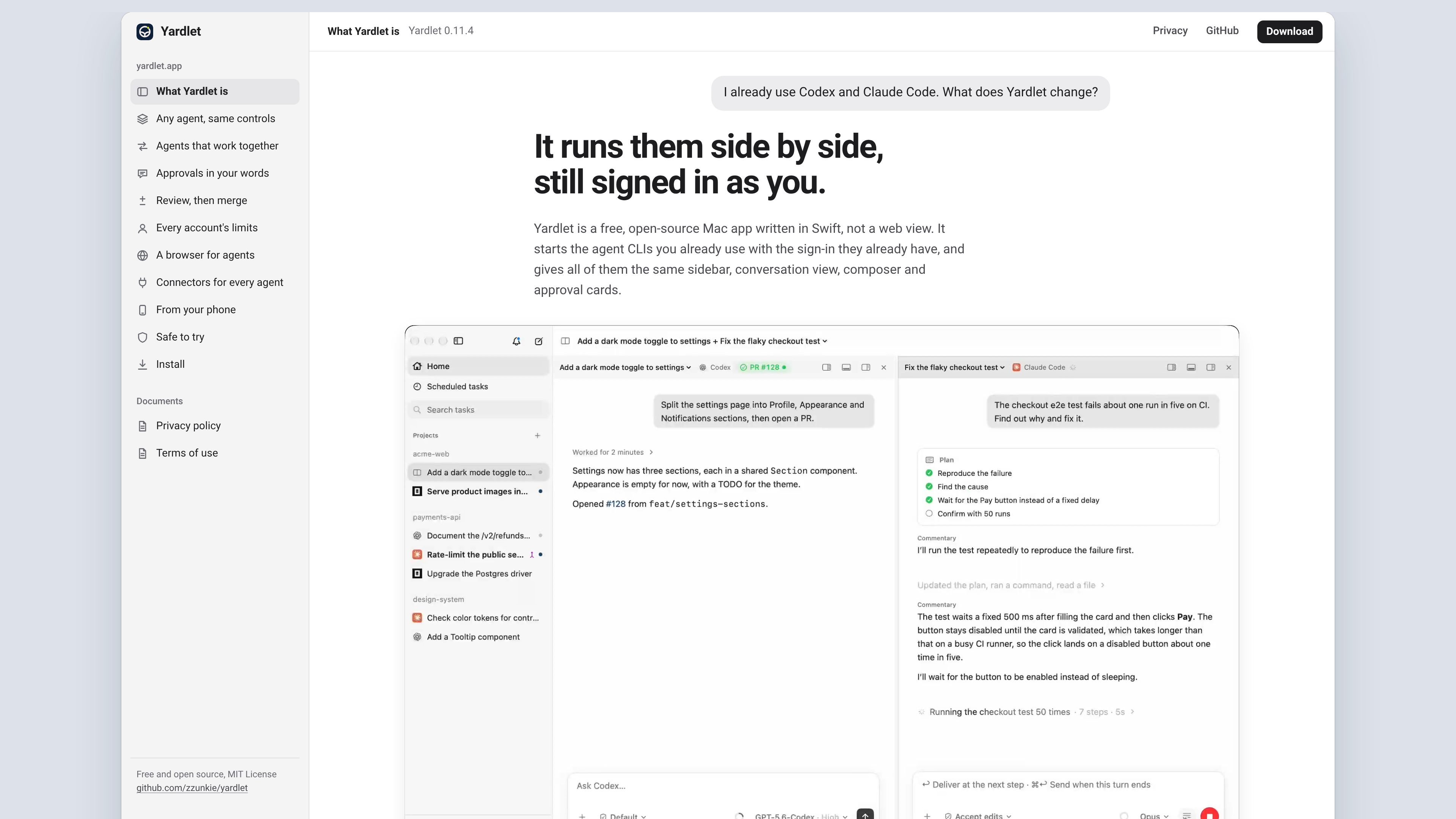
Yardlet is a native Mac application for running the coding-agent CLIs you already use side by side. Written in Swift rather than presented as a web view, it provides a shared sidebar, conversation view, composer, and approval-card interface while preserving each agent's existing sign-in and provider-specific choices.
The app is designed for workflows that span multiple agents and tasks: agents can exchange messages, start subtasks on another provider, wait for results, and schedule work. It also brings task review, pull-request checks, browser automation, MCP connectors, account-limit visibility, and optional phone-based approvals into the same workspace.
Run supported agent CLIs side by side in one native Swift interface with a shared sidebar, conversation view, composer, and approval cards. Each agent keeps its own controls and available choices.
Give agents access to task-level tools for reading or messaging other tasks, creating tasks, running subagents on another provider, waiting for results, and scheduling work while Yardlet remains open.
Review the last turn's diffs file by file, restore files or fork work, and use the terminal and files panes beside the conversation. Pull request cards follow checks and reviews through the user's own gh, with a Fix CI option when checks fail.
See each account's session and weekly limits, use more than one account per provider, and distribute concurrently started tasks across accounts with the most remaining room. Saved tasks retain the account they started on.
Let agents operate a Chromium panel beside the conversation using browser tools. Yardlet can fill saved sign-ins, two-step codes, and passkeys from its vault, while CAPTCHA or payment steps can be handed back to the user.
Set up connectors once for agents to use, including built-in Gmail, Google Calendar, and Google Drive support through Yardlet's local MCP server, plus GitHub, Slack, remote MCP services, registries, and imported servers.
Keep Codex, Claude Code, or another supported CLI visible in a shared workspace while retaining the sign-in, model choices, and permission behavior supplied by each agent.
Have one task inspect another task's latest turns, send it a message, create a subtask, or call a subagent from another provider when a workflow needs specialized agent handoffs.
Inspect changes beside the conversation, review files and pull-request checks, and use the user's own gh setup to merge when the review and checks are ready.
Use browser tools for an agent to work in a signed-in Chromium panel, then take over for CAPTCHA, passkey, or payment steps that require direct user action.
Connect email, calendar, storage, GitHub, Slack, or other MCP services once and make the selected connectors available to agent tasks, with per-task control to turn them off.
Yardlet starts the agent CLIs already installed and signed in on your Mac. Install Yardlet, then sign in to at least one supported agent before launching a task.
The home page lists Codex, Claude Code, OpenCode, Cursor Agent, Antigravity CLI, Kimi Code, Grok Build, Hermes Agent, Muse Code, and Pi. Yardlet's Settings > Harnesses list shows the agents it can start.
Each task has a composer for prompts and file attachments, a permission-mode selector, model and effort choices supplied by the selected agent, plan tracking, and usage indicators for context and account limits.
Yes. Agents can read and message other tasks, create tasks under themselves, run a subagent on another agent, wait for results, and schedule work while Yardlet is open. Messaging or starting a task in another project requires an approval.
Yardlet is a native Mac app written in Swift. The site specifies macOS 15 or later and Apple silicon, and says it is free and open source under the MIT License. The pricing page does not provide separate plan details.

CreateOS Sandbox is an isolated compute environment for running code and agent workloads in Firecracker micro-VMs with private networking and SDK, CLI, or MCP control.

GitBot is a local browser workspace for reusable coding bots powered by Claude Code, Codex, or OpenCode, with persistent threads and configurable permissions.

ByteAsk is a terminal-first AI coding agent for C and C++ that edits repos and verifies changes with compilers, debuggers, sanitizers, and tests.

hob is an independent workspace for coding agents, with local control over sessions, terminals, history, routing, and follow-up work.

Manta AI is an autonomous web app testing tool that maps app behavior, catches regressions, and generates tests from a URL, no scripts or selectors needed.

SonOf connects to your repo and PM tool, audits your codebase, and turns approved work into shipped tickets with senior engineering review.