
Multichannel AI support
Agent 5 handles customer interactions through voice, web chat, email, WhatsApp, SMS, Slack, Instagram, and Facebook Messenger, maintaining a shared AI experience across channels.

Open is a unified AI customer support platform for automating conversations and operations across voice, chat, email, WhatsApp, SMS, Slack, and social channels.
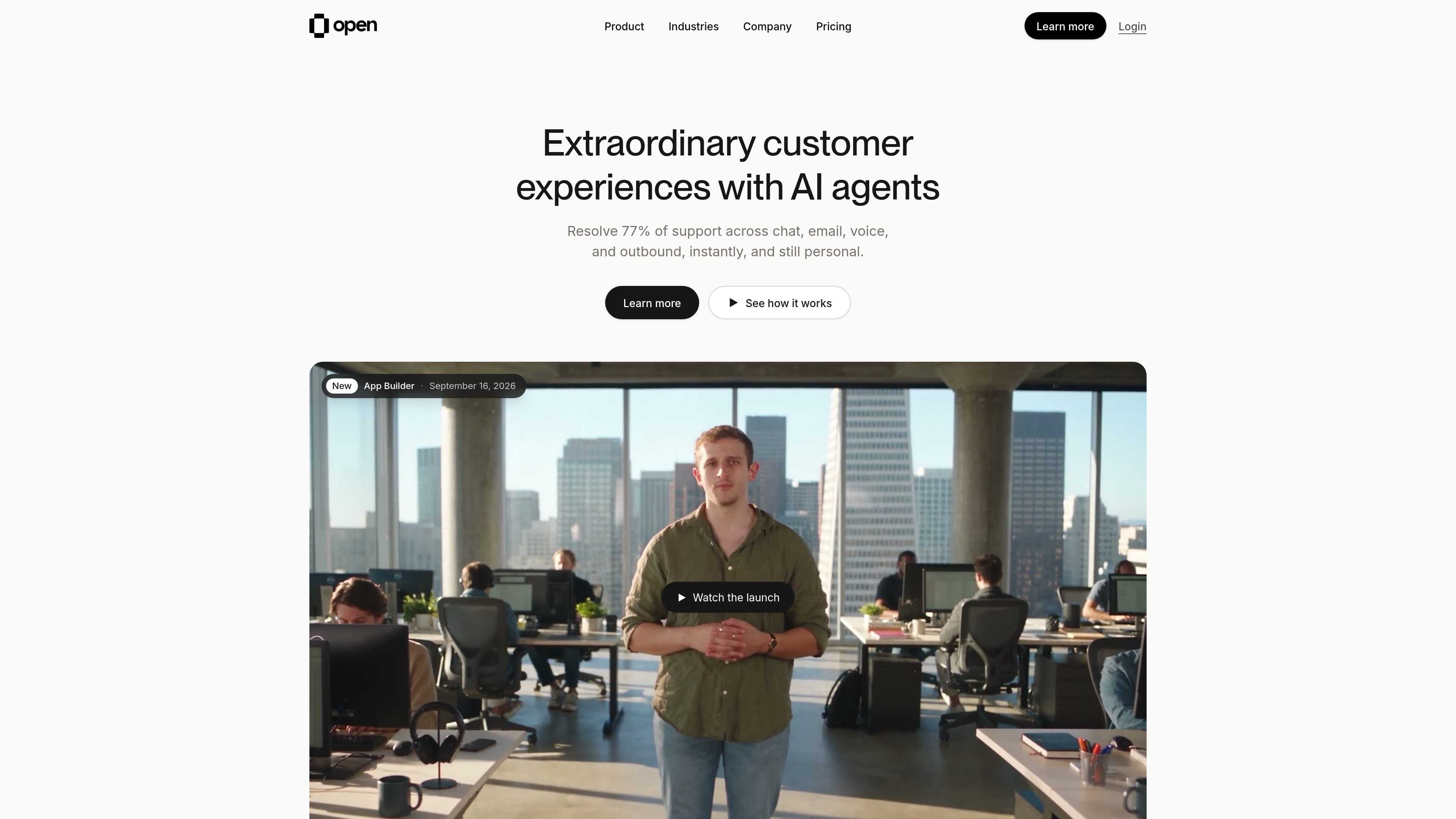
Open is a unified AI customer support platform that combines a helpdesk, multichannel AI agents, workflow automation, knowledge management, and observability. It is designed for support teams that want one system for handling customer conversations, taking actions through APIs, and routing work to people when automation is not appropriate.
The platform can be used across voice, chat, email, WhatsApp, SMS, Slack, and social messaging. Teams can deploy Open’s built-in helpdesk or use its AI with an existing support stack. Its pricing is based on fully resolved tickets rather than seats or messages, while human-handled tickets are not billed as AI resolutions.
Agent 5 handles customer interactions through voice, web chat, email, WhatsApp, SMS, Slack, Instagram, and Facebook Messenger, maintaining a shared AI experience across channels.
The platform includes an AI-native inbox with ticketing, macros, SLAs, routing, reporting, and unlimited agent seats. Teams can use Open’s helpdesk or connect the AI to an existing helpdesk.
Visual workflows let the agent carry out API actions and manage conditional, multi-party processes such as lookups, account changes, refunds, routing, escalations, and follow-ups.
Open can ingest documentation and articles, identify knowledge gaps, learn from resolved tickets, and roll back knowledge changes. Customer insights and voice-of-customer analysis are also included.
Inbound, outbound, assistant, quality-assurance, customer-understanding, and apps agents cover resolution, proactive outreach, human-agent assistance, conversation review, analysis, and workspace extensions.
The platform provides observability, analytics, conversation insights, and evaluation metrics. Its QA capabilities can review conversations for quality, compliance, and coaching opportunities.
Use inbound AI agents to answer and resolve routine questions across web chat, email, messaging, and voice. Cases that require a person can be handed to a human agent rather than counted as an AI resolution.
Build workflows for account lookups, changes, refunds, ticket tagging, prioritization, and skill-based routing. These workflows reduce repetitive operational work while retaining conditional logic and optional human review.
Run proactive customer or sales outreach through personalized sequences using email, phone, SMS, or WhatsApp. Response branching and API access allow follow-up behavior to change based on customer replies.
Use the assistant agent to populate fields, summarize conversations, and suggest replies, while QA reviews conversations for standards, compliance, and coaching opportunities.
Analyze conversations for trends and sentiment, identify knowledge gaps, and use resolved tickets to keep the support knowledge base current. This helps teams find recurring issues that need documentation or product attention.
Open can operate as an all-in-one helpdesk with built-in AI, workflows, training, observability, and compliance features. It can also work with an existing helpdesk, including Zendesk, Intercom, Salesforce, HubSpot, Freshdesk, and Twilio Flex, according to the site.
The platform supports voice, web chat, email, WhatsApp, SMS, Slack, and social channels including Instagram and Facebook Messenger. Its AI agent is intended to respond consistently across these surfaces, with handoff to human agents when needed.
Open can run workflows that perform lookups, updates, refunds, routing, tagging, prioritization, escalations, and other API-based actions. Workflows can include conditional logic and a human handoff where the team wants one.
Open charges between $0.75 and $0.90 per fully resolved ticket, with the exact volume-based rate agreed in writing before launch. Tickets handed to a human agent are not billed as AI resolutions; carrier costs for services such as telephony and messaging are passed through at cost.
The site describes implementation support from a named solutions engineer and AI trainer, plus 24/7 support and white-glove onboarding. Its workflow page says setup can take less than an hour with implementation experts, although the actual deployment process may depend on the customer’s environment.

IntellAgents is an AI voice and chat agent service for customer calls, outbound outreach, and messaging on WhatsApp, Instagram, Facebook, Telegram, and websites.

BookAI allows you to chat with your books using AI by simply providing the title and author.

Goldfish is an AI memory app for macOS that helps you reply, write, summarize, and continue with context already on your Mac. It stores memory locally and writes in your tone.

Lasso is an ecommerce product data platform for enriching catalog records, processing supplier files, generating product content, and tracking competitors. It includes a web app, REST API, SDK, and MCP server.

ArtDeck is a visual reference board app for iPhone, iPad, and Mac. Collect mixed references on one canvas and study them with ToolBox lenses. Offline, optional iCloud sync, one-time purchase.

Struere turns spreadsheet data into structured operational software with dashboards, alerts, and automations for teams replacing manual spreadsheet workflows.