Agent Barn icon

Agent Barn

Agent Barn is a self-hosted control plane for creating, configuring, running, and monitoring AI agents across Slack, Microsoft Teams, Telegram, and business systems.

Agent Barn

What Agent Barn does

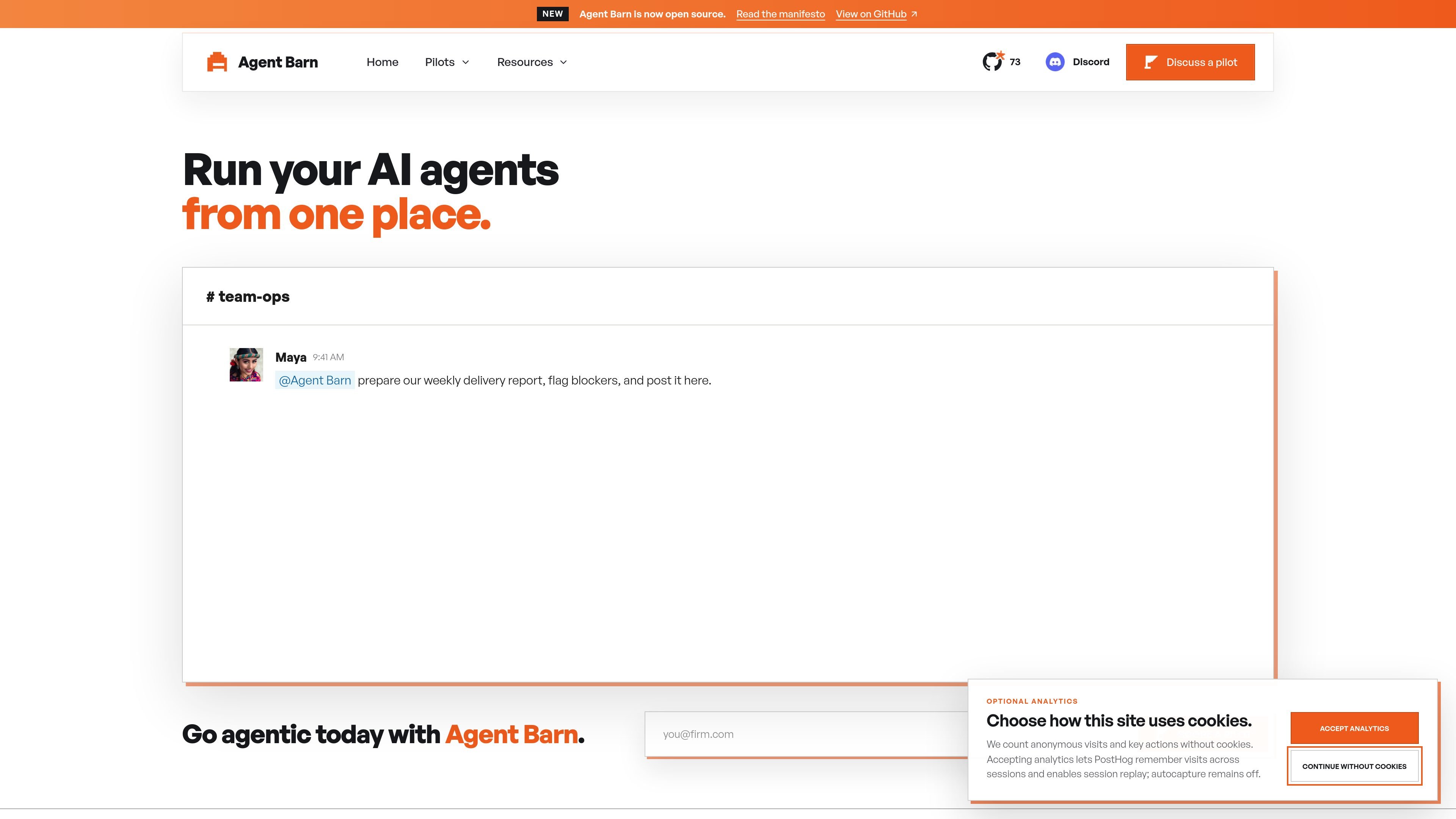
Agent Barn is a self-hosted control plane for running AI agents from one place. It is designed to let teams create, configure, run, and monitor agents that operate in Slack, Microsoft Teams, Telegram, and connected business systems.

The site positions the product as orchestration software for agents rather than a single agent app. It runs on a customer’s Kubernetes infrastructure with Helm, uses PostgreSQL for product state and LiteLLM for model routing, and supports multiple runtimes such as OpenClaw and Hermes.

Core features

Self-hosted deployment

Run agents from a self-hosted control plane instead of a separate hosted SaaS environment. The site says Agent Barn deploys to your Kubernetes cluster, with PostgreSQL for product state and LiteLLM for model routing and cost attribution.

Chat-based access

Expose agents through Slack, Microsoft Teams, and Telegram so users can interact with them in the channels they already use. The homepage frames this as control from one place across chat and internal tools.

Versioned templates

Create reusable Markdown templates that define an agent’s role, identity, instructions, tools, startup behavior, and restrictions. This is meant to make agent setup repeatable across teams and workflows.

Skills and integrations

Attach reusable skills and encrypted credentials to connect agents with systems such as Jira, Confluence, GitHub, Bitbucket, and Gmail. The product also positions skills as the way to reach internal services and data sources.

Operational observability

Inspect conversations, tool executions, logs, lifecycle state, and model costs in the control plane. The homepage presents this as the main way to understand what each agent did and why.

Per-agent runtime selection

Assign a runtime per agent, with OpenClaw or Hermes mentioned as supported runtimes. Agent Barn manages each agent’s pinned configuration, skills, credentials, and lifecycle across the chosen runtime.

Representative use cases

  • RFQ intake

    Collect RFQ context from shared channels or source systems, identify missing information, and prepare the next action for manufacturing teams that need a structured intake process.

  • Custom quoting

    Combine product data, prior examples, and calculation tools to prepare quotes for review instead of starting from a blank spreadsheet.

  • Drawing and nesting checks

    Orchestrate auditable scripts or domain tools that compare drawings, nesting output, or specifications against agreed rules before work moves ahead.

  • Order status updates

    Gather current status across systems and turn it into concise updates for customers, operations staff, or project teams.

  • Legal intake and claims support

    Classify new legal requests, extract the key facts, route work to the right owner, and gather evidence, dates, and correspondence for repetitive matters.

Pros and Cons

Pros

  • Runs in the customer’s infrastructure, which keeps credentials and business data in an environment the team operates.
  • Supports common team channels including Slack, Microsoft Teams, and Telegram.
  • Provides observability into conversations, tool calls, logs, lifecycle state, and model costs.
  • Lets teams reuse templates and skills across agents instead of rebuilding every configuration from scratch.
  • Includes pilot workflows for specific operational scenarios in manufacturing and legal work.

Cons

  • The public site emphasizes pilot scopes and documentation, but does not show published pricing or plan details.
  • The source material does not provide a full integrations catalog, so compatibility beyond the named systems is not fully specified.

FAQ

Where do the agents run?

Agent Barn is deployed into your Kubernetes cluster and runs in your infrastructure. The manifesto and homepage both describe it as self-hosted, with Helm used for deployment and PostgreSQL plus LiteLLM supporting the control plane.

Which chat tools are supported?

Yes. The homepage says Agent Barn supports Slack, Microsoft Teams, and Telegram, and the agents are reachable from the channels your team already uses.

Do all agents need to use the same runtime?

No. The homepage says you can choose a runtime per agent, with OpenClaw or Hermes, and Agent Barn handles configuration, skills, credentials, and lifecycle for each one.

Does Agent Barn publish pricing?

The site points to pilot scopes rather than published plans or prices. The pricing page is a 404, and the homepage invites teams to scope a pilot around a workflow and measurable outcome.

Can agents use internal business systems?

Agents can connect to internal systems through skills and encrypted credentials. The homepage names Jira, Confluence, GitHub, Bitbucket, Gmail, and other services as examples.

Quick Facts

Category
AI agent orchestration platform
Deployment
Self-hosted on Kubernetes with Helm
Supported chat tools
Slack, Microsoft Teams, Telegram
Named runtimes
OpenClaw, Hermes
Named integrations
Jira, Confluence, GitHub, Bitbucket, Gmail
Primary source domain
agentbarn.dev