

Agentset
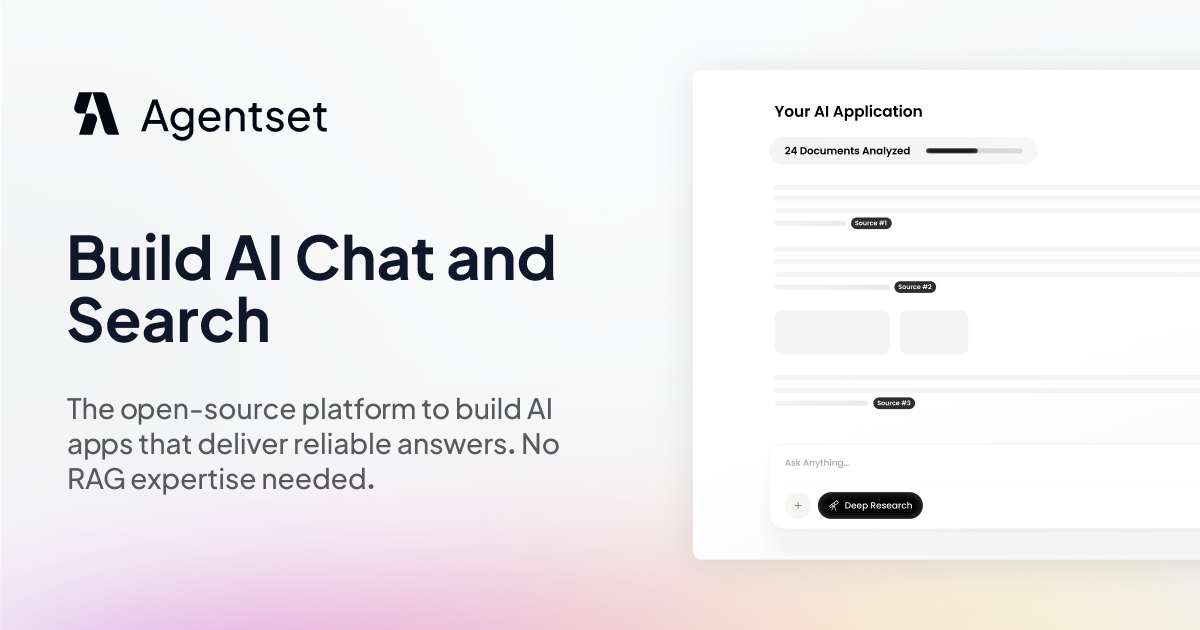
Agentset is an open-source platform for production-ready RAG apps with reliable search and Q&A, including citations, multimodal ingestion, and metadata filtering.
What is Agentset?
Agentset is an open-source infrastructure platform for developers building production-ready RAG (retrieval-augmented generation) applications that provide search and Q&A inside their own products. The focus is on making RAG behave reliably beyond demos—especially as real users interact with larger document collections.
According to the site, Agentset is designed to reduce the engineering effort of standing up and maintaining a RAG pipeline by providing production-grade components “out of the box,” including ingestion, retrieval behavior, and answer presentation features such as citations and metadata-based filtering.
Key Features
- Production-grade RAG for Q&A and search: Built to address gaps that show up when real data and usage replace demo datasets.
- Accurate answers with evaluation benchmarks: The site references benchmarks for MultiHopQA and FinanceBench to support answer quality on relevant tasks.
- Multimodal support (images, graphs, tables): Agentset is stated to work natively with images, graphs, and tables, not just plain text.
- Automatic citations: Answers include citations so users can inspect the sources behind responses.
- Metadata filtering: Supports filtering over subsets of the indexed data to constrain what the system retrieves and answers from.
- Developer APIs and SDKs: Provides JavaScript and Python SDKs for uploading data, with file formats supported (see below) and example usage for creating ingestion jobs.
- Broad file-format ingestion: The page lists support for formats including PDF, DOCX, HTML, TXT, CSV, JSON-like sources shown as HTML/TXT/CSV, and office formats such as PPTX/XLSX (as reflected in the file type list).
- Model- and vector-store flexibility: The platform is described as model agnostic, letting you select your vector database, embedding model, and LLM.
- MCP server integration: An MCP server is available to connect the knowledge base to external applications.
How to Use Agentset
A typical start is to instantiate the Agentset client in your app, create (or use) a namespace, and submit ingestion jobs that point to files you want indexed.
From there, you would use Agentset’s search or chat interfaces in your product: questions are answered using retrieval from your ingested content, with citations automatically attached. If you need to scope responses, you can apply metadata filters so only a relevant subset of the data is considered.
Use Cases
- Legal search and productized AI Q&A over large corpora: Teams can power search and question answering across extensive document sets, with answers grounded in their indexed content and cited sources.
- Clinical or research-oriented grounded answers: When accuracy and traceability matter, citations and grounded retrieval help users validate responses against the underlying documents.
- Municipal or policy content with complex media: The multimodal support is positioned for knowledge bases that include images, graphs, or tables, where text-only indexing is insufficient.
- Internal knowledge base assistants: Organizations can let employees ask questions across company documents, with retrieval constrained using metadata filtering (e.g., department, time period, or other tags) when needed.
- Feedback-driven chat workflows: The site mentions preview links and a customizable chat interface for capturing external feedback quickly.
FAQ
-
What kind of applications does Agentset support? It targets production-ready RAG applications that deliver search and Q&A inside other products.
-
Does Agentset work beyond demo data? The site explicitly describes a problem where many RAG demos fail under real usage and large document sets, and positions Agentset for those production conditions.
-
Is Agentset limited to text documents? No. The page states Agentset works natively with images, graphs, and tables.
-
Does Agentset include source attribution? Yes. The platform is described as automatically citing the sources used for answers.
-
Can I use my own model or vector database? The site says Agentset is model agnostic, allowing you to select your vector database, embedding model, and LLM.
Alternatives
- Framework-based RAG stacks (e.g., building with RAG libraries and your own pipeline): Instead of using an infrastructure platform, you assemble ingestion, retrieval, and answer formatting yourself; this may require more integration work to reach production reliability.
- Managed search/Q&A services: These can offer faster setup for basic search and chat, but may be less flexible for multimodal ingestion or specific retrieval/answer presentation needs compared with a developer-focused RAG platform.
- Self-hosted RAG pipelines with custom tooling: Similar to framework-based approaches, but typically involves maintaining the entire retrieval/ingestion infrastructure and integrations in-house.
- General-purpose knowledge-base and document search tools with AI add-ons: Useful when the primary goal is document discovery, but may not match the depth of RAG-specific capabilities like automatic citations and metadata-filtered retrieval described for Agentset.
Alternatives

AakarDev AI
AakarDev AI is a powerful platform that simplifies the development of AI applications with seamless vector database integration, enabling rapid deployment and scalability.

BenchSpan
BenchSpan runs AI agent benchmarks in parallel, captures scores and failures in run history, and uses commit-tagged executions to improve reproducibility.

Edgee
Edgee is an edge-native AI gateway that compresses prompts before LLM providers, using one OpenAI-compatible API to route 200+ models.

Codex Plugins
Use Codex Plugins to bundle skills, app integrations, and MCP servers into reusable workflows—extending Codex access to tools like Gmail, Drive, and Slack.

Wallie
Wallie is an open-source AI streamer framework with real-time vision, persona profiles, chat, TTS, and avatar output for VTuber-style streams.

Falconer
Falconer is a self-updating knowledge platform for high-speed teams to write, share, and find reliable internal documentation and code context in one place.