
Plain-language agent creation
Describe an automation in plain language and Airtop builds a compiled agent from it. The product positions this as a way to create reliable workflows without writing selectors or scripts.

Airtop Agent Builder turns plain-language browser tasks into reusable web agents for logins, site navigation, data extraction, and scheduled or triggered workflows.
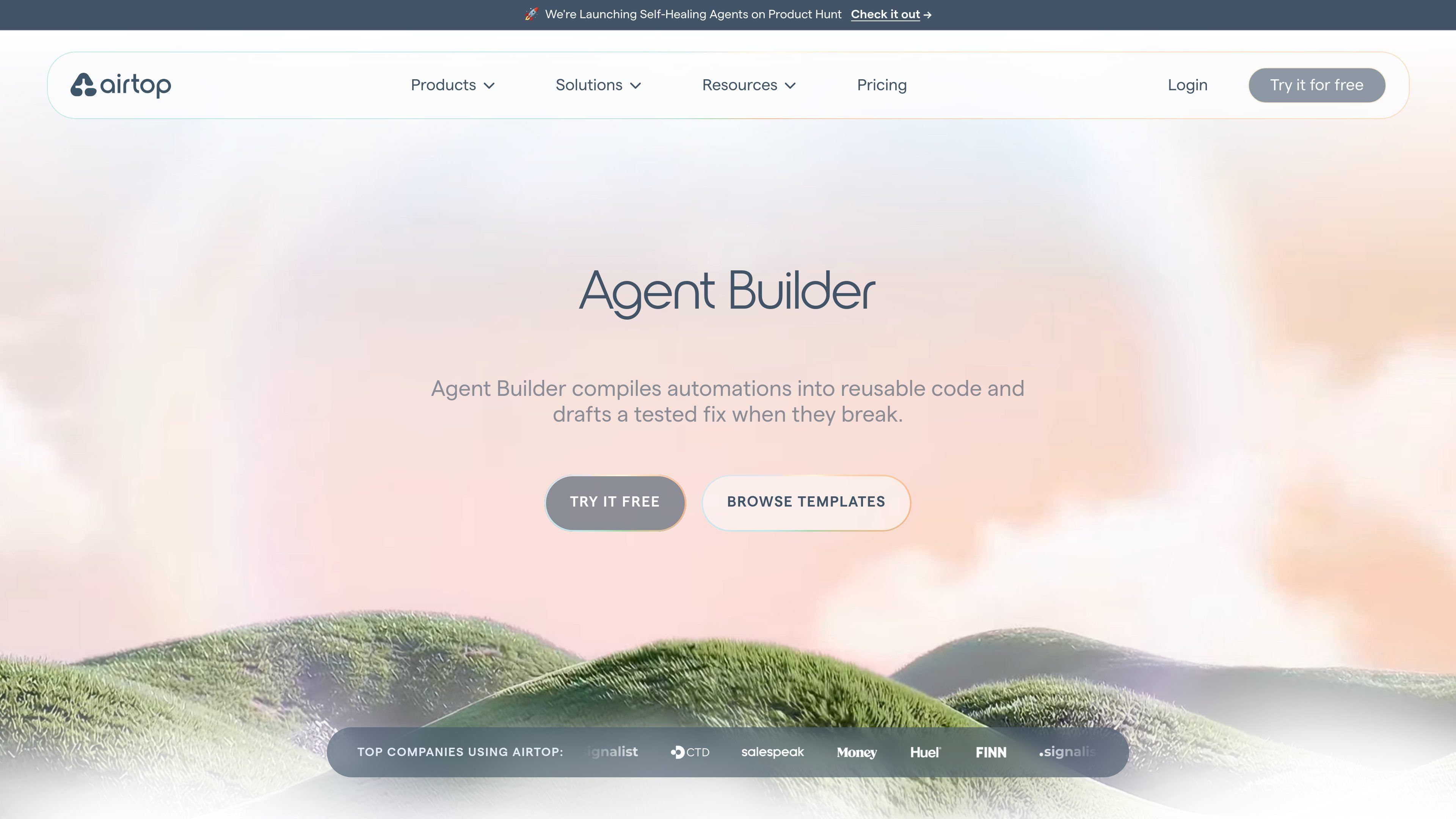
Airtop Agent Builder is a web automation product for creating AI agents from natural-language instructions. It compiles those instructions into reusable code that can run browser-based workflows across websites, including logged-in pages, forms, and data extraction tasks.
The page positions Agent Builder as a way to build and deploy automations from chat, then run them on schedules, triggers, or on demand. Airtop also emphasizes repair workflows: if an automation breaks, the system can draft a fix and test it before you decide whether to deploy the update.
Describe an automation in plain language and Airtop builds a compiled agent from it. The product positions this as a way to create reliable workflows without writing selectors or scripts.
Compiled agents are tested at build time and then run as reusable code. Airtop says this approach is faster and more efficient than prompt-based, LLM-per-step agents.
Agents can log in to websites using stored credentials, interact with forms, and extract the requested data from real pages. The site highlights secure vault-based credential handling for authenticated workflows.
Runs can be scheduled, triggered by webhooks, or launched on demand. This makes the same agent usable for recurring jobs and one-off tasks.
If a run fails, Airtop can diagnose the issue, draft a fix, and test the repair before you choose whether to deploy it. Live agents are not changed automatically without your approval.
The product provides logs, session replay, and video traces so you can inspect what happened during a run. Airtop also states that it can support up to 100 simultaneous sessions.
Use the product to log in to a website, navigate multi-step pages, and extract structured data from portals that do not expose a simple API.
Set an agent to monitor a site, check for updates on a schedule, and collect results into a repeatable workflow instead of running the task by hand.
Compile recurring support conversations into a formatted summary document, similar to the Slack-to-Google-Docs template shown on the site.
Turn web research or page crawling into a document that consolidates findings from multiple pages, as shown by the website-to-Google-Docs template.
Run repeated list-based jobs, such as processing many URLs or rows in one pass, when the same steps need to be applied at scale.
Airtop Agent Builder lets you describe an automation in plain words, then compiles and tests it into reusable code. The site shows examples such as logging into sites, extracting data, scheduling runs, and repairing broken runs with a drafted fix.
The product is built for automations that need to interact with real websites and logged-in workflows, not just simple API calls. Airtop’s pages emphasize use cases such as scraping, form filling, lead enrichment, support reporting, and monitoring web portals.
The templates show outputs including Google Docs reports, Google Sheets-style datasets, Slack notifications, and direct run logs or video traces. The output depends on how the agent is configured and which template or workflow you start from.
Airtop says agents can run on schedules, on triggers, or on demand. The pricing page also shows plan limits tied to credits, simultaneous sessions, and deployed agents, so team usage depends on the plan you choose.
The source shows Airtop integrates with web destinations and several workflow targets in templates, including Google Docs, Google Sheets, Slack, Notion, and Confluence. Specific connector coverage beyond these examples is not fully documented on the provided pages.

CreateOS Sandbox is an isolated compute environment for running code and agent workloads in Firecracker micro-VMs with private networking and SDK, CLI, or MCP control.

ByteAsk is a terminal-first AI coding agent for C and C++ that edits repos and verifies changes with compilers, debuggers, sanitizers, and tests.

MeetStream is a meeting bot API for Zoom, Google Meet, Microsoft Teams, and Webex. Record, stream, and analyze meetings with usage-based pricing and $5 free credit.

Codex Plugins bundle reusable skills, app integrations, and MCP servers into workflows you can install in the Codex app or use from Codex CLI.

hob is an independent workspace for coding agents, with local control over sessions, terminals, history, routing, and follow-up work.

Wallie is an open-source AI streamer that watches your screen, hears chat, and delivers live commentary in a configurable persona. Runs locally with your own keys.