
Interview every applicant
Aperture interviews every applicant with a conversational, adaptive interview instead of relying on resumes or static question banks.

Aperture is an AI-assisted interview and candidate screening platform for hiring teams. It interviews applicants, verifies identity, and delivers ranked shortlists with evidence.
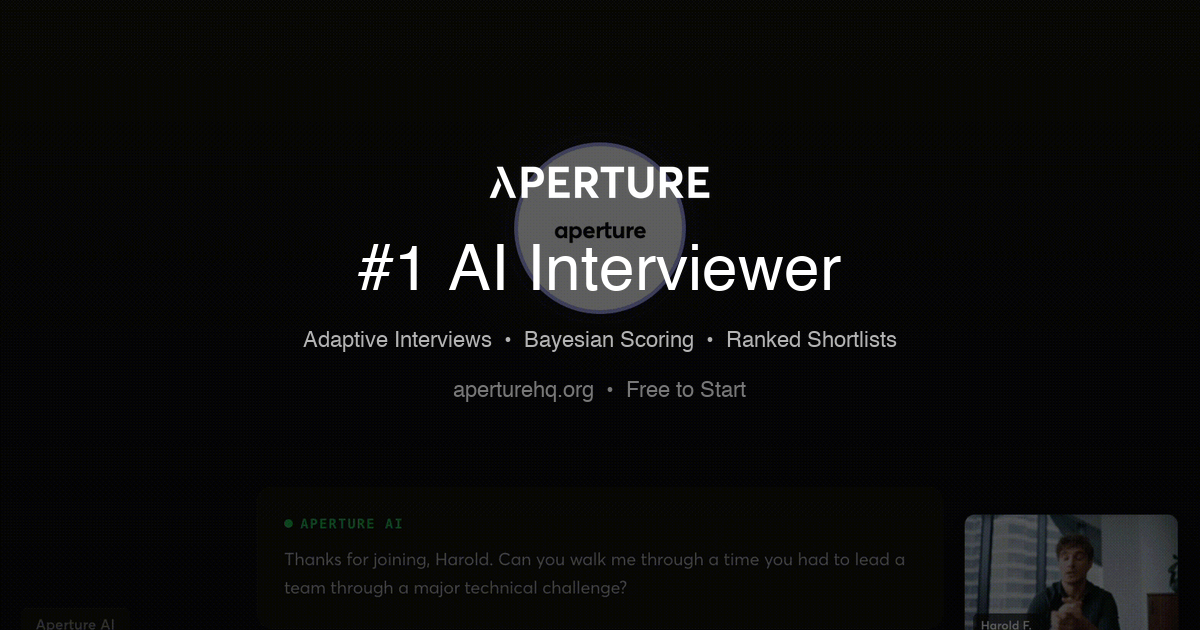
Aperture is an AI-assisted interview and candidate screening platform for hiring teams. It interviews applicants, analyzes their responses, verifies that the person in the interview is the person being evaluated, and returns a ranked shortlist with evidence behind each result.
The product is built around structured, conversational interviews rather than keyword screening. Public pages describe a built-in ATS, adaptive interviews, proctoring, candidate search, and comparison tools, with integrations listed for LinkedIn, Greenhouse, Ashby, Lever, Indeed, and Wellfound.
Aperture interviews every applicant with a conversational, adaptive interview instead of relying on resumes or static question banks.
The platform evaluates candidates during the interview and returns a ranked pool with reasons and supporting evidence for each score.
Aperture checks for signs of fraud and coaching by reviewing session location, device, identity, second-screen signals, and related interview behavior.
The product includes a built-in ATS where teams can post roles, move candidates through custom stages, and track where applications get stuck.
Teams can search candidates in plain English and compare close calls side by side, with Aperture explaining the reasons behind the ranking.
The platform is designed around transparent AI use, including candidate disclosure and interview records that show the basis for decisions.
For teams that receive more applications than they can manually screen, Aperture can interview every applicant and surface a ranked shortlist so strong candidates are less likely to be missed.
For roles where proxy interviewing, deepfakes, or answer-feeding tools are a concern, Aperture adds identity and session checks before the team reviews candidates.
For recruiters who want to understand why a candidate ranks highly, the platform shows interview evidence, strengths, concerns, and the reasons behind comparisons.
For teams running hiring from a central board, Aperture’s built-in ATS supports posting roles, moving candidates through stages, and tracking bottlenecks.
For sourcers and hiring managers looking for a specific type of candidate, the AI candidate search lets them ask in plain language and review ranked matches.
Aperture is AI-assisted interview software that interviews applicants, analyzes responses, and returns ranked shortlists with evidence behind each score. It also includes a built-in ATS, interview records, and candidate identity/proctoring checks.
The source describes Aperture as offering AI-assisted interviews and scoring, with humans still making the hiring decision. The AI supports interview interactions, transcripts, analysis, summaries, and recommendations, but does not make the final decision.
The site says candidate interviews are proctored for location, device, identity, and other signals that can indicate fraud or coaching. It also says candidates always know they are talking with Aperture and that the platform is transparent about AI use.
The pricing page says you can sign up and start using the platform today with no credit card required, and that pricing will be announced later. The public pages also say early teams can get access now.
The product and pricing pages show it works with roles that use structured interviews and ranked shortlists, including hiring workflows run through a built-in ATS. The site also mentions integrations with LinkedIn, Greenhouse, Ashby, Lever, Indeed, and Wellfound.

HiringPartner.ai is an autonomous AI recruiting platform for sourcing, screening, and interviewing candidates 24/7 with ATS-connected workflows and bulk resume uploads.

SelectPrism is an agentic AI hiring platform for high-volume recruiting teams. Automates screening, scheduling, first-round interviews, and structured evaluation.

JusRecruit is an AI recruiting platform that posts jobs, runs AI phone screens and first-round interviews, and returns ranked candidate shortlists.

Fountain is a frontline workforce platform for high-volume hiring, onboarding, sourcing, and scheduling, with Frontline OS and AI-assisted workflows.

Elvixs is an AI job outreach tool for freshers and students that finds hiring contacts, writes personalized cold emails, sends from Gmail, and tracks opens and replies.

Badge turns anonymous peer reviews into a Trust Score, helping job seekers, freelancers and candidates show proof of work to recruiters.