
Dataflow-focused inference
Maia 300 uses a software-defined dataflow architecture and AI-assisted kernel optimization to improve locality and reduce data movement across compute, memory and networking resources.

Azure Maia is Microsoft’s purpose-built Azure AI infrastructure for large-scale inference. Explore Maia 200 in production and Maia 300 for long-context, conversational workloads.
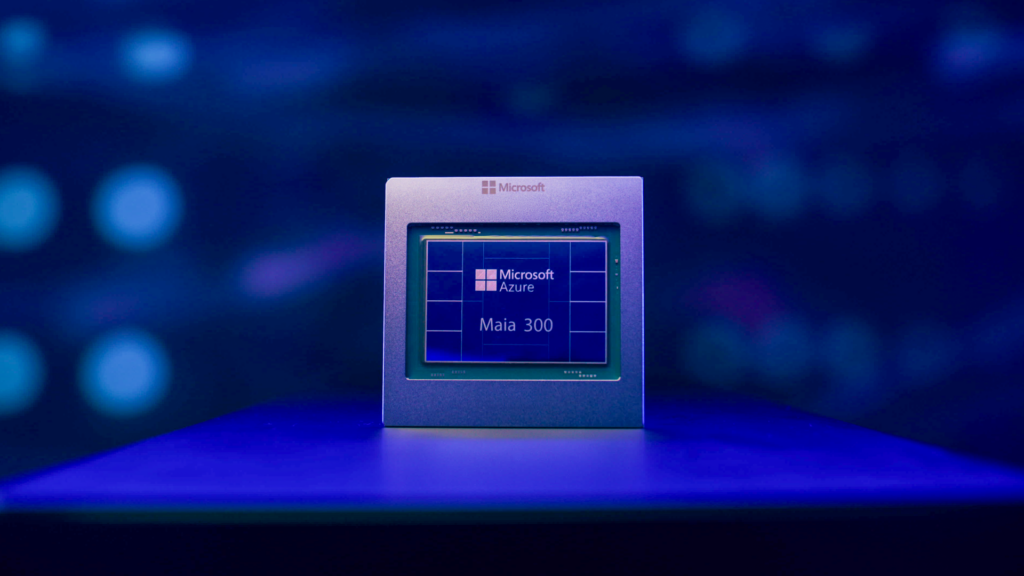
Azure Maia is Microsoft’s multigenerational, purpose-built AI infrastructure system for running inference workloads across Microsoft products and services. Maia 200 is in production and supports workloads such as Microsoft Copilot, while also being used by Microsoft’s MAI team for model development and evaluation. The system runs OpenAI models, Microsoft MAI models and leading open-source model families.
The next generation, Azure Maia 300, is designed for long-context reasoning, latency-sensitive conversational interactions and sustained multi-step agentic tasks. Microsoft plans to begin Maia 300 production deployments in 2027 and scale the Azure Maia family to multi-gigawatt deployments starting that year. Its design emphasizes memory bandwidth, data movement, networking and power efficiency at cloud scale.
Microsoft reports that Maia 200 delivers up to 1.7x more tokens per watt than leading GPU infrastructure for built-in AI capabilities in Teams, Copilot and Cowork experiences. For Maia 300, Microsoft expects 40% more tokens per megawatt than leading GPU-based systems and up to 7x the rack-scale token throughput of Maia 200 in a full 96-accelerator configuration. These figures are Microsoft-reported results and expectations from the cited announcement.
Maia 300 uses a software-defined dataflow architecture and AI-assisted kernel optimization to improve locality and reduce data movement across compute, memory and networking resources.
Eight HBM4 stacks provide 18.0 TB/s of peak memory bandwidth within a 950-watt TDP, supporting large models and long-context workloads.
Compute, memory-controller and I/O functions are separated into chiplets, with compute chiplets built on TSMC’s N2P process node.
Support for low-precision formats including enhanced MXFP4 reduces memory and bandwidth requirements for computation and KV-cache storage.
High-bandwidth accelerator interconnects and a custom AI transport use Ethernet-based networking to extend the dataflow topology from a rack to datacenter scale.
A 96-accelerator rack configuration provides 27.6 TB of HBM capacity and 1.7 PB/s of aggregate HBM bandwidth within a 167-kilowatt power envelope.
Maia 200 is serving Microsoft Copilot and built-in AI capabilities in Teams, Copilot and Cowork experiences across Microsoft’s production environment.
The MAI team uses Maia 200 for inference and data generation while developing next-generation Microsoft models.
Maia is intended to help GitHub deliver coding experiences more efficiently through multi-step agentic workloads; GitHub Copilot support is identified as a planned workload.
Microsoft Foundry is expected to use Maia for cloud-scale model serving across diverse architectures and deployment environments.
Maia is intended to support latency-sensitive interactions for Dragon Copilot, helping scale workflows and reduce clinicians’ administrative burden.
Azure Maia 200 is already serving Microsoft production workloads, including Microsoft Copilot. The source says GitHub Copilot and Microsoft Foundry are expected to follow by the end of 2026; Maia 300 is planned for production deployments in 2027.
Maia 200 runs OpenAI models, Microsoft’s MAI models and leading open-source model families across Microsoft workloads. The source does not provide a complete compatibility list or customer-facing model onboarding process.
Maia 300 is designed for long-context reasoning, latency-sensitive conversational experiences and sustained, multi-step agentic tasks, with an inference-first architecture for memory-intensive and decode-heavy workloads.
The source describes Maia as infrastructure for Microsoft products and services and states that Microsoft Foundry support is planned. It does not document general customer access, ordering, pricing or deployment steps.

MacSpoof is a macOS MAC address changer that lets you change or randomize your Wi‑Fi MAC to reconnect and limit device logging on public Wi‑Fi.

DemoTV is an audience-ranked station for discovering and comparing independent product demos. Submit videos, embed approved demos, collect inquiries or commission production and labelled promotion.

Ship It: Idle Dev Tycoon is an iPhone idle simulation game about building apps, managing a software studio, and selling it for lasting progression benefits.

NomNak is a free iPhone app for discovering restaurants through friends’ recommendations, with saved spots, a food passport and city search.
CAPTA is a mobile GPS waypoint app for saving, organizing, and revisiting locations offline, with camera capture, optional sync, and GPX export.

Ctrl+Shift+3 is a calm, text-first community platform with chronological feeds, profiles, RSS, and private Clicks for smaller communities.