

Composer 2.5
Composer 2.5 is an AI coding model in Cursor, built for longer agentic tasks, more reliable instruction following, and smoother collaboration.
What is Composer 2.5?
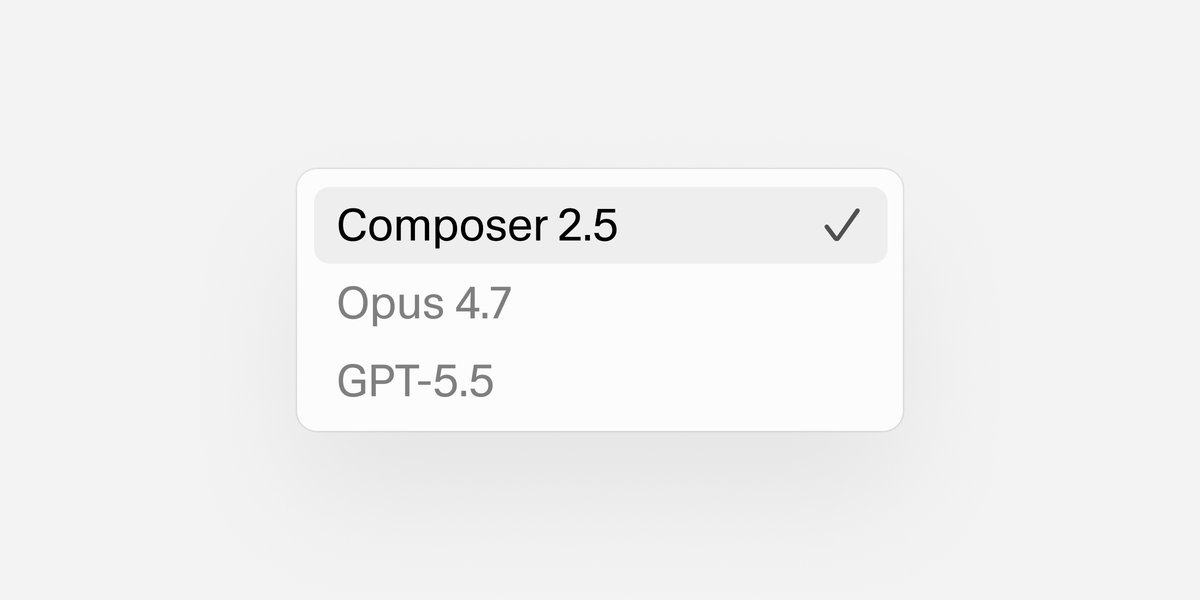
Composer 2.5 is an AI coding model available in Cursor. It is described as a major improvement over Composer 2, with stronger performance on long-running agentic tasks, better instruction following, and more consistent collaboration behavior.
The model is built on the same open-source checkpoint as Composer 2, Moonshot's Kimi K2.5, but it is trained with additional methods aimed at improving both intelligence and usability. According to the source, the training process includes scaled reinforcement learning, more complex RL environments, targeted textual feedback, and more synthetic tasks grounded in real codebases.
Key Features
- Better long-horizon task handling: Composer 2.5 is designed to stay effective on long-running agentic work where rollouts can span many tokens and multiple tool calls.
- More reliable instruction following: the model is trained to follow complex instructions more consistently, which matters for coding workflows with many steps and constraints.
- Targeted textual feedback in RL: training can insert localized hints into the context of a specific problematic turn, then distill the desired behavior into the policy for that point in the trajectory.
- Expanded synthetic task training: Composer 2.5 uses 25x more synthetic tasks than Composer 2, with tasks grounded in real codebases and verifiable rewards.
- Behavioral tuning beyond benchmark scores: the training process also adjusts communication style and effort calibration, which the source notes are important for real-world usefulness.
- Built on an open-source checkpoint: Composer 2.5 continues from Moonshot's Kimi K2.5 checkpoint, while Cursor also mentions work with SpaceXAI on a much larger model trained from scratch.
How to Use Composer 2.5
In Cursor, users would select Composer 2.5 as the model for coding and agentic tasks. It is intended for workflows that involve extended interaction, tool use, code changes, and iterative refinement.
A typical workflow would be to give the model a coding task, let it inspect the codebase, follow instructions, call tools as needed, and then review the resulting changes or explanations. It is especially relevant when the task is long-running or requires careful adherence to constraints.
Use Cases
- Long-running coding tasks: useful when an agent needs to make many decisions across a large rollout, such as editing multiple files or iterating on a feature.
- Complex instruction-following: suitable for tasks with detailed constraints, such as preserving behavior while changing implementation details.
- Tool-heavy workflows: helpful when the model must use tools repeatedly and recover from local errors, such as unavailable tools or failed calls.
- Codebase-grounded synthetic tasks: supports training and evaluation setups where the model works against real codebases with tests and verifiable outcomes.
- Communication-sensitive collaboration: relevant when users care not just about correctness but also about clearer explanations, style, and calibrated effort.
FAQ
Is Composer 2.5 a new product or a model update? It is a new version of Composer available in Cursor, positioned as an improvement over Composer 2.
Does the source say Composer 2.5 is based on a different checkpoint than Composer 2? No. The source says it is built on the same open-source checkpoint as Composer 2: Moonshot's Kimi K2.5.
What changed in training? The source highlights scaled training, more complex RL environments, targeted textual feedback, and a larger set of synthetic tasks.
Is it mainly for benchmark performance? Not only. The source emphasizes behavior and usability improvements, including communication style and effort calibration, in addition to intelligence.
Alternatives
- Composer 2: the previous Cursor model version, useful as a direct baseline for comparing the newer training and behavior changes.
- General-purpose coding agents: other AI coding assistants that focus on code generation and tool use, though they may differ in how they handle long-horizon tasks and behavioral tuning.
- IDE-integrated LLM assistants: editor-based assistants that support coding workflows but may not use the same RL-heavy training approach described for Composer 2.5.
- Human code review and iterative development: a non-model alternative for teams that prefer manual control over long, complex changes, especially when behavior precision matters.
Alternatives

Devin
Devin is an AI coding agent that helps software teams complete code migrations and large refactoring by running subtasks in parallel.

AakarDev AI
AakarDev AI is a powerful platform that simplifies the development of AI applications with seamless vector database integration, enabling rapid deployment and scalability.

Arduino VENTUNO Q
Arduino VENTUNO Q is an edge AI computer for robotics, combining AI inference hardware and a microcontroller for deterministic control. Arduino App Lab-ready.

imgcook
imgcook is an intelligent tool that converts design mockups into high-quality, production-ready code with a single click.

open-codex-computer-use
open-codex-computer-use is an open-source “Computer Use” MCP server that lets AI agents run desktop GUI actions on macOS, Linux, and Windows.

Codex Plugins
Use Codex Plugins to bundle skills, app integrations, and MCP servers into reusable workflows—extending Codex access to tools like Gmail, Drive, and Slack.