
Public AI Reports
Browse live market reports that show which local businesses AI assistants recommend for a given city and industry, with per-engine answers available on the page.

findloc.ai publishes local AI reports and checks business sites for AI visibility signals, helping owners, marketers, and agencies see which businesses AI assistants recommend.
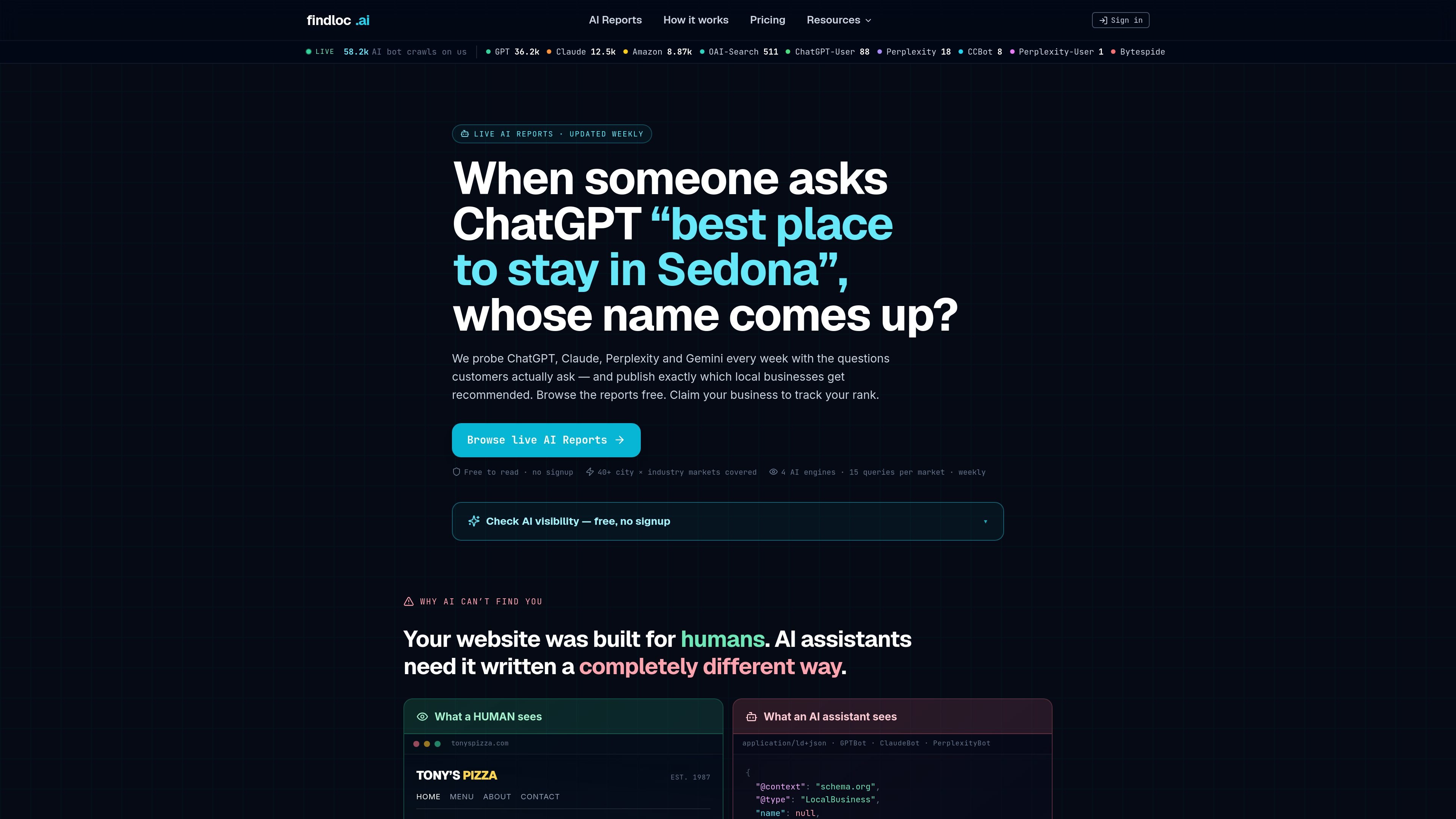
findloc.ai is an AI visibility and location research product focused on local businesses. It publishes public reports that show which businesses ChatGPT, Claude, Perplexity, and Gemini recommend for city × industry searches, and it also offers a site-level visibility check for individual businesses.
The product is aimed at owners and marketers who want to understand whether a business is likely to be cited by AI assistants and what signals may be missing. It combines public market research, a free claim flow, and paid tracking tiers for ongoing rank monitoring and improvement suggestions.
Browse live market reports that show which local businesses AI assistants recommend for a given city and industry, with per-engine answers available on the page.
Check one business site at a time by pasting a URL or business name, then review whether it exposes signals such as schema.org, robots.txt, sitemap, and /llms.txt.
See what ChatGPT, Claude, Perplexity, and Gemini return for the same query set, so you can compare citation patterns across engines.
Use 15 hand-curated query intents per market, grouped around common customer needs such as family, budget, romantic, business, and location.
Claim a business to get an AI-native mini-page and weekly rank tracking, with Monday email updates for paid subscribers.
Publish weekly data updates so the market reports and tracked rankings reflect current AI recommendations rather than a one-time snapshot.
Review a city and industry market to see which businesses AI assistants currently recommend, then compare the per-engine answers to spot consistency or disagreement.
Audit a single business site for structured data and crawlability signals before relying on AI assistants to discover or cite it.
Claim a business and monitor weekly rank changes, competitor movement, and improvement suggestions over time.
Use the public reports and ranked answers as research input when planning local SEO, GEO, or content updates.
For agencies or multi-property operators, compare a portfolio against market winners and decide which locations need attention first.
findloc.ai does two related things. It publishes public AI Reports for city × industry markets, showing which businesses ChatGPT, Claude, Perplexity, and Gemini recommend for real search-style queries. It also offers an AI visibility check for a single business website, auditing signals such as schema.org markup, robots.txt access, sitemap coverage, and /llms.txt.
The AI Reports are public and free to read, with no signup required. The visibility check on the homepage is also free for a limited number of checks, and the site says claimed businesses can be tracked with paid Pro plans.
The visibility check audits one website at a time. You paste a business name or website URL, add a business type if needed, and the tool checks whether the site exposes the signals AI engines are likely to use.
The public AI Reports look at a city and industry market and publish the businesses named by the AI engines, along with per-engine verbatim answers. The homepage says the reports are refreshed weekly.
The source pages describe public reports, a free claim flow for businesses, and paid Pro, Pro Plus, and Agency tiers. The pricing page itself is not available in the collected text, so only the presence of paid plans is confirmed here.

beehiiv is a newsletter platform for creators, publishers, and brands to build, grow, and monetize email newsletters and websites in one place.

Vibegrowing is an AI-native App Store launch panel for competitor research, ASO metadata, icons, screenshots, landing pages, and legal docs, synced with App Store Connect.

PromptScout tracks how ChatGPT, Gemini, Google AI Overviews, and Perplexity mention your brand or competitors, with source analysis and website audits.

Prompty Town turns a link into a building in a small internet city. Buy a tile, add a prompt, and publish it alongside other buildings.

Make Real is a Next.js app that turns hand-drawn wireframes into HTML prototypes with the tldraw SDK and AI models, with canvas sketching and embedded preview.

ClayHog is an AI search visibility platform for tracking brand presence in ChatGPT, Gemini, Perplexity, Claude, and Google AI Overviews from one dashboard.