
Four-stage learning structure
The catalog is split into four stages: Diagnose, Automate, Manage, and Deliver. Each stage starts with the situation you are in, which helps learners choose a framework by problem context rather than by name alone.

Framework First Academy is an online learning platform with 30 courses on choosing and applying frameworks, plus a free decision map and flexible plans.
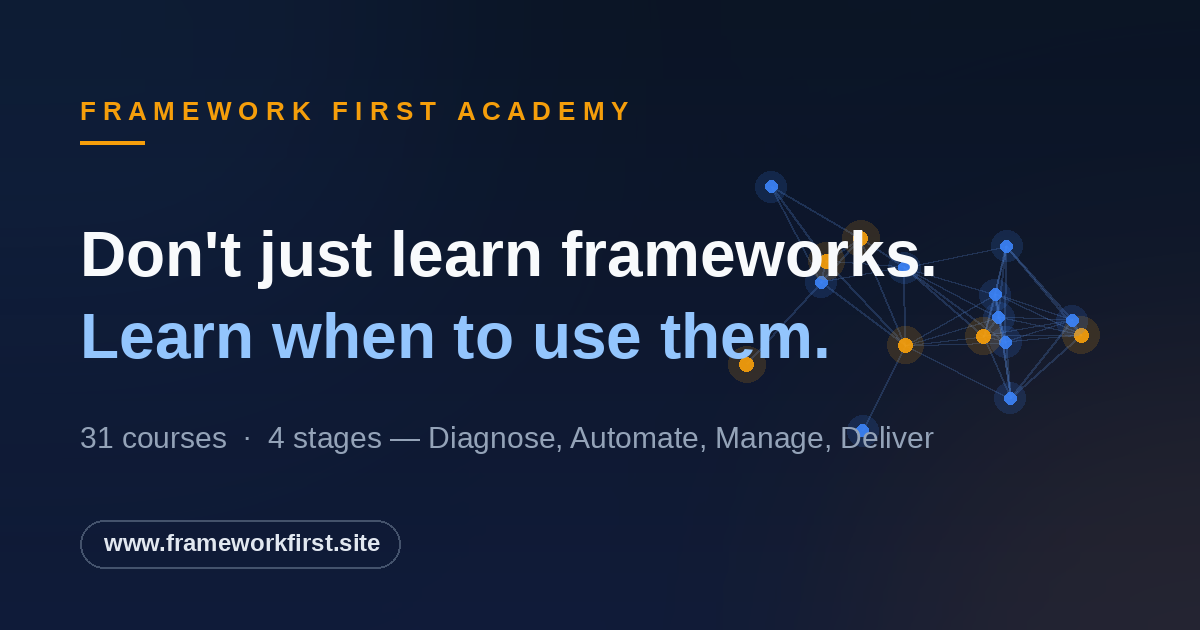
Framework First Academy is a framework-based learning site built around 30 courses in four stages: Diagnose, Automate, Manage, and Deliver. It is designed to help learners choose the right framework for the situation they are facing, instead of starting from framework names alone.
The site frames its core problem as timing: many people know the frameworks, but reach for the wrong one in the wrong context. Its materials start with the trigger situation, then move through practice, quizzes, downloadable resources, and capstone work so learners can apply the framework in real work settings.
The catalog covers problem framing, automation decisions, project and delivery management, cloud and DevOps topics, communication, and applied machine learning. The pricing page shows individual course purchases, an annual all-access option, and team plans, with a free preview path and a free decision map available for exploration.
The catalog is split into four stages: Diagnose, Automate, Manage, and Deliver. Each stage starts with the situation you are in, which helps learners choose a framework by problem context rather than by name alone.
Courses are built around text lessons, exercises, quizzes, assessments, and capstone projects. The site describes the format as text-first and practice-heavy, aimed at working professionals who want to apply the material.
Learners get downloadable artifacts such as templates, worksheets, checklists, decision tables, and code starters. The pages note that these resources are attached to the modules that teach them, so the material is meant to be reused on the job.
Every course includes situational knowledge checks rather than trivia. The site says there are 655+ questions across 195 modules, with explanations for wrong answers.
Completed courses issue a verifiable certificate with a unique code. The pricing page says certificates are included, and the home page says they are auto-issued on completion.
The platform includes progress tracking, streaks, a dashboard, and a referral program. For teams, it adds a team dashboard, role-based learning paths, and onboarding for team leads.
Use the free decision map when you are unsure whether the problem is a root-cause issue, an automation candidate, a delivery problem, or something else. The map groups frameworks by situation and calls out the cognitive trap each stage is meant to prevent.
Use the course catalog when you want structured training across problem solving, cloud, automation, management, communication, or machine learning topics. The catalog starts from the situation and then maps to the framework, which is helpful when you are learning a method for the first time or revisiting one you already know.
Use the applied exercises, quizzes, and capstones when you need more than a definition and want to test judgment on realistic scenarios. The site positions the material for working professionals who need to apply the framework in messy, constraint-filled situations.
Use the team plan when you want a shared framework vocabulary across roles and a way to track progress. The team pages mention role-based paths and onboarding for team leads, which makes the offering suitable for coordinated rollout rather than solo study.
Use single-course or annual access when you want to study a specific framework or work through the broader system over time. The pricing page separates one-off course access from all-access annual enrollment, so learners can match the purchase to their immediate scope.
Framework First Academy is built around one decision-making system with four stages: Diagnose, Automate, Manage, and Deliver. The courses are organized by the situation you are in, so you can start from the problem type rather than the framework name.
The site says courses are text-first and practice-heavy, with short reading lessons, hands-on exercises, situational quizzes, and capstone projects. It also includes downloadable templates, worksheets, checklists, and code starters attached to relevant modules.
Yes. The pricing page says completed courses issue a verifiable certificate with a unique code. The home page also says certificates are automatically issued on completion.
Yes. The pricing page offers a free account with a free preview module in all 30 courses and the Framework Decision Map, with no credit card required.
Yes. The pricing page includes team pricing with a team dashboard, progress tracking, custom learning paths by role, and an onboarding session for team leads.

TubeKit turns public YouTube videos and playlists into AI-powered tools creators can customize and share. Free to try, no signup needed.

BeFreed is a personalized audio learning app that turns books and knowledge sources into narrated listening experiences with interactive audio and learning tools.

AGINE Academy — a gamified online academy for learning Claude in work, creative tasks, and automation. Start with a free lesson and real missions, no dev experience needed.

Padel Chess is a web-based platform for improving padel tactics with puzzle-based practice in realistic court scenarios.

Sidegent is a hands-on platform for building AI agents and apps with browser-based courses and labs. Start free, then unlock the full catalog, live coding machines, and weekly updates with Pro.

NerdSip is an AI microlearning app that creates custom 7-lesson courses on almost any topic, with quizzes, key takeaways and visual summaries.