
Natural live dialogue
The model is designed for fast, fluid voice interaction and is positioned for scalable, cost-efficient voice-agent workloads.

Gemini 3.8 Live and Gemini 3.8 Live Extended Thinking are Google voice models for near-real-time dialogue, visual context, tools, and reasoning.
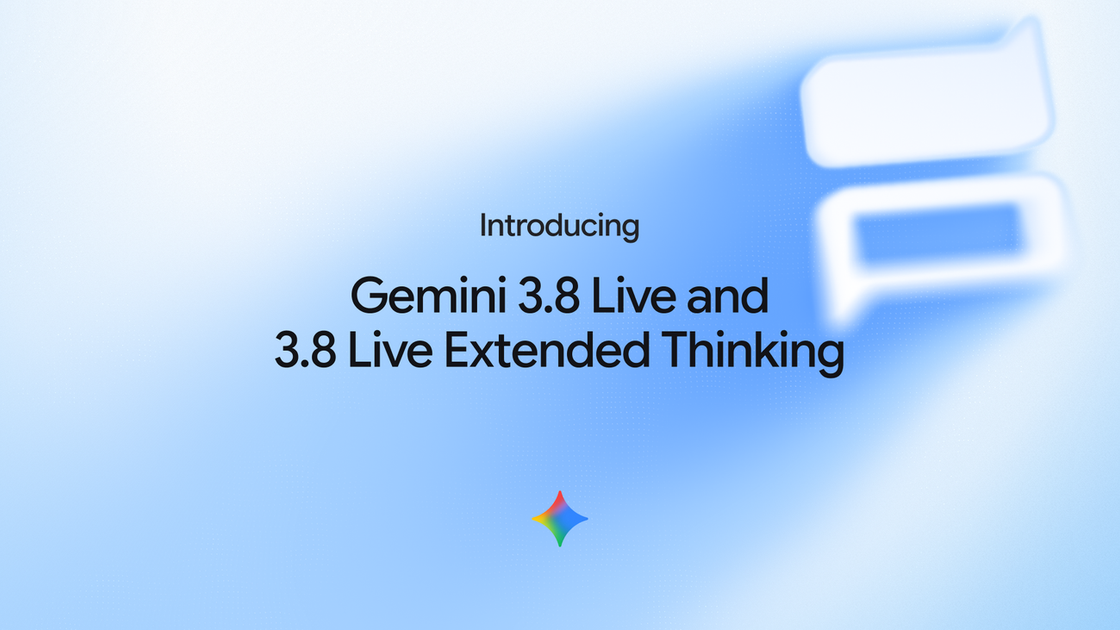
Gemini 3.8 Live and Gemini 3.8 Live Extended Thinking are Google models for near-real-time voice interaction. They combine conversational dialogue with visual grounding, tool use, and reasoning so users can work through tasks by speaking rather than relying only on typed prompts.
The standard Live model is aimed at fluid, scalable voice agents and fast conversational responses. Live Extended Thinking is intended for more demanding workflows that require multi-step reasoning; it can continue speaking while work proceeds and narrate progress as background tasks advance. The models are presented for developer and enterprise voice applications, as well as experiences in the Gemini app, Google Workspace, and Search.
The model is designed for fast, fluid voice interaction and is positioned for scalable, cost-efficient voice-agent workloads.
It accepts visual context in near real time, allowing conversations to incorporate what the model is seeing, such as an onboarding screen or a chessboard.
Gemini 3.8 Live can detect and transition between 97 supported languages during a conversation.
The models can execute tools and API calls in the background while acknowledging requests and continuing the conversation.
The Extended Thinking variant is designed for high-complexity tasks, using multi-step reasoning while speaking and providing early verbal cues and progress narration.
The Gemini Live API supports voice-agent development, while platforms including Agora, Fishjam, LangChain, LiveKit, Pipecat, Vercel, and Vision Agents are cited as enabling development and deployment workflows.
A voice agent can acknowledge a request, call APIs or tools in the background, and keep the user informed without forcing a silent wait. This suits workflows such as bookings and other multi-step service interactions.
Employees can receive live guidance during onboarding or troubleshooting while the model interprets the screen or other visual context in near real time.
Developers can build voice-driven interfaces using the Gemini Live API and supporting real-time media platforms, focusing on the interaction design while those platforms handle streaming infrastructure.
Extended Thinking can work through complex plans, explain progress aloud, and turn spoken instructions into outputs such as functional React components or business planning materials.
Multilingual conversations can move between supported languages without requiring a manual mode change, which is useful for live dialogue involving language changes.
Gemini 3.8 Live is available through the Gemini API and Google AI Studio for developers. The source also says it is rolling out in Gemini Enterprise, with further enterprise availability information incomplete in the supplied text.
Gemini 3.8 Live is intended for fast, fluid dialogue, visual grounding, and scalable voice-agent workloads. Gemini 3.8 Live Extended Thinking is intended for more complex tasks that benefit from multi-step reasoning and deeper task completion.
The models can process visual input in near real time, continue speaking while tools and API calls run in the background, and, in Extended Thinking, provide verbal progress cues during longer tasks.
Gemini 3.8 Live automatically detects and transitions between 97 supported languages during a conversation, according to the launch article.
Audio generated by Google AI products is watermarked with SynthID. The source describes this as an imperceptible watermark intended to help detect AI-generated audio.

Flunkey is a voice-first productivity layer for Windows that turns speech into text, AI outputs, and remembered context without leaving your app.

An All-In-One AI Platform that combines tools for image, video, voice, writing, and chat to enhance creativity and collaboration.
Gemma AI is a phone call reminder app that calls you with scheduled reminders instead of push notifications, with Google Calendar sync and natural voice interaction.

Grok 4.7 is an xAI model for coding and knowledge work, available via Grok Build, Cursor, the Grok API and more, from $2 per million input tokens.

Wallie is an open-source AI streamer that watches your screen, hears chat, and delivers live commentary in a configurable persona. Runs locally with your own keys.

Claude Overlay is a Windows desktop overlay for Claude Code that reads your screen, so you can ask questions, inspect content, and request edits without leaving the app. Uses your existing Claude subscription via Claude CLI.