
AI-assisted code generation and maintenance
Describe the automation you need and Intuned Agent generates production-ready Playwright code, then keeps it updated when the site changes.

Intuned is a code-first browser automation platform for production-ready Playwright scrapers, crawlers, RPA workflows, and AI browser automation.
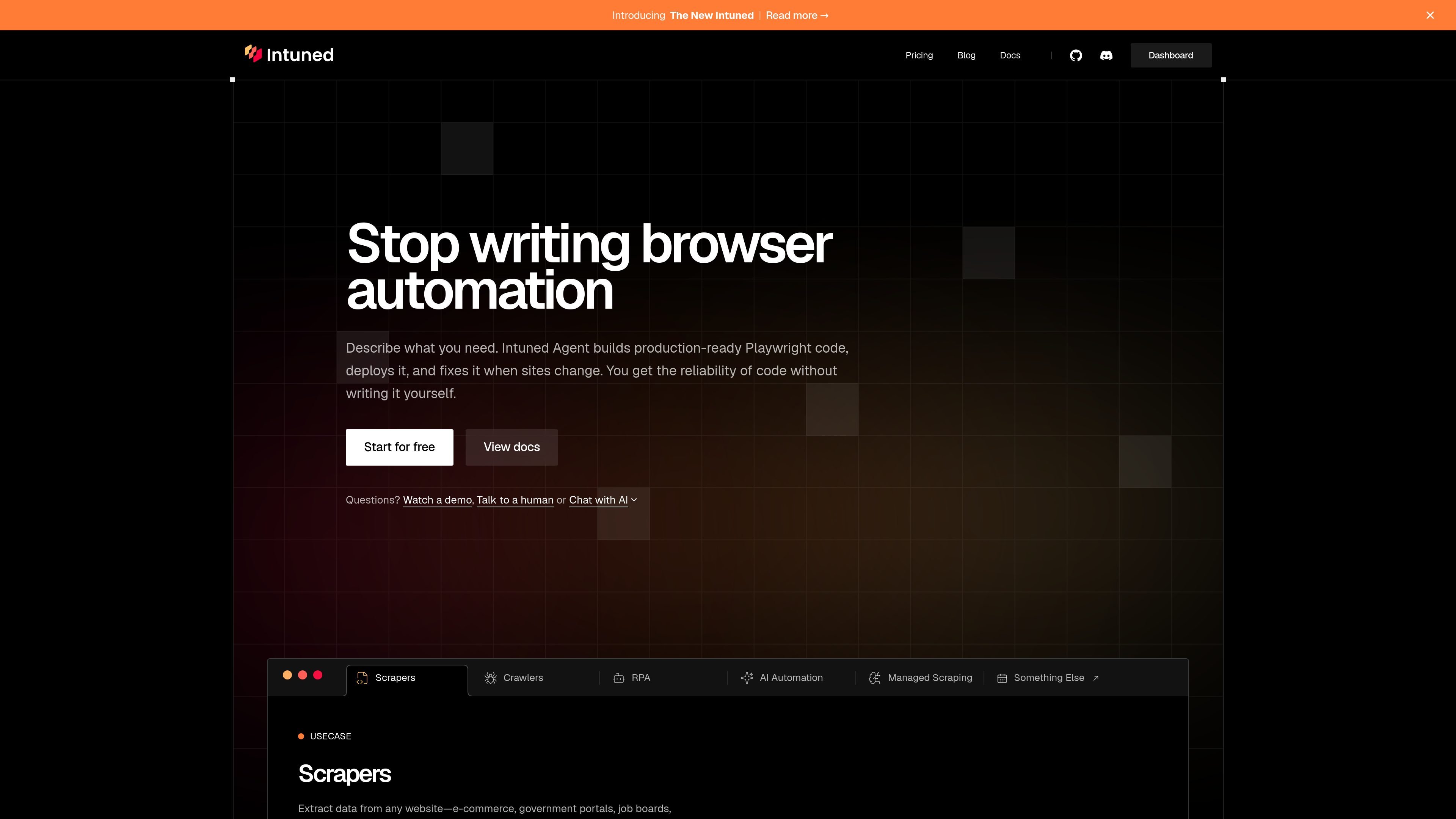
Intuned is a code-first browser automation platform for building, running, and maintaining web automations. Its Agent can generate production-ready Playwright code from a prompt and schema, deploy the automation, and update it when sites change.
The product is aimed at scrapers, crawlers, RPA workflows, and AI automation. The source emphasizes deterministic code, built-in stealth and authentication handling, scheduled runs, monitoring, and infrastructure that can scale from a single machine to larger workloads.
Describe the automation you need and Intuned Agent generates production-ready Playwright code, then keeps it updated when the site changes.
Deploy automations with built-in stealth, auth handling, scheduling, monitoring, and scaling so the infrastructure does not have to be managed separately.
Write automations in TypeScript or Python with Playwright, or use compatible libraries and frameworks for crawling and browser automation.
For RPA and other API-style workflows, Intuned can expose automations as endpoints and queue work with parallel limits.
The platform supports session lifecycle handling through create/check patterns for authenticated workflows, including validation, reuse, and recreation as needed.
Plans include varying compute hours, API machine limits, job runs, AI credits, data retention, and access to larger machines, with enterprise options for custom limits and controls.
Generate scrapers for e-commerce sites, job boards, government portals, and similar targets, then deploy them with stealth, auth handling, scheduling, and monitoring.
Build crawlers that follow links, parse sitemaps, and index content across many pages while keeping runs scheduled and scalable.
Automate form submissions, data entry, account actions, and other user-facing tasks for products that need browser-based workflows without public APIs.
Create AI-powered browser automations that combine deterministic Playwright logic with AI-driven steps, including workflows that use external browser-use tools or computer-use APIs.
Use the managed service for large scraping programs where a team wants delivered code and ongoing maintenance rather than self-managed builds.
Intuned is a code-first browser automation platform. From the source, it supports building automations in Playwright and also references TypeScript and Python workflows, with the platform deploying and maintaining the code for you.
The free plan includes 3 compute hours, 5 API machines total, 10 job runs, a $10 trial AI credit, advanced stealth mode, and 7-day data retention. It is positioned for individuals exploring web automation.
The pricing page says overages are billed per compute hour and per job run on Developer and Startup plans, while AI credit is included monthly on paid plans. Enterprise uses custom limits and volume pricing, so exact overage terms are set through sales.
Yes. The pricing page lists an Enterprise plan with SSO/SAML, advanced access controls, custom retention, regions, compliance setup, and priority escalation paths.
The source does not list a public self-serve integration catalog. It does show support for Playwright, Python, TypeScript, Crawl4AI, and several AI browser tools or APIs, so the exact fit depends on the workflow you want to automate.

CreateOS Sandbox is an isolated compute environment for running code and agent workloads in Firecracker micro-VMs with private networking and SDK, CLI, or MCP control.

Codex Plugins bundle reusable skills, app integrations, and MCP servers into workflows you can install in the Codex app or use from Codex CLI.

Wallie is an open-source AI streamer that watches your screen, hears chat, and delivers live commentary in a configurable persona. Runs locally with your own keys.

ClawTick is an AI agent automation platform for scheduling jobs from the CLI, dashboard, or REST API. Built for developers and teams using LangChain, CrewAI, webhooks, or custom workflows with monitoring, alerts, and logs.

Falconer is an AI-powered company brain that keeps internal docs accurate, searchable, and up to date by syncing with GitHub, Slack, and Linear.
OpenFlags is an open-source, self-hosted feature flag platform for JavaScript teams, with local evaluation, targeted rollouts, and controlled launches.