

Manus AI
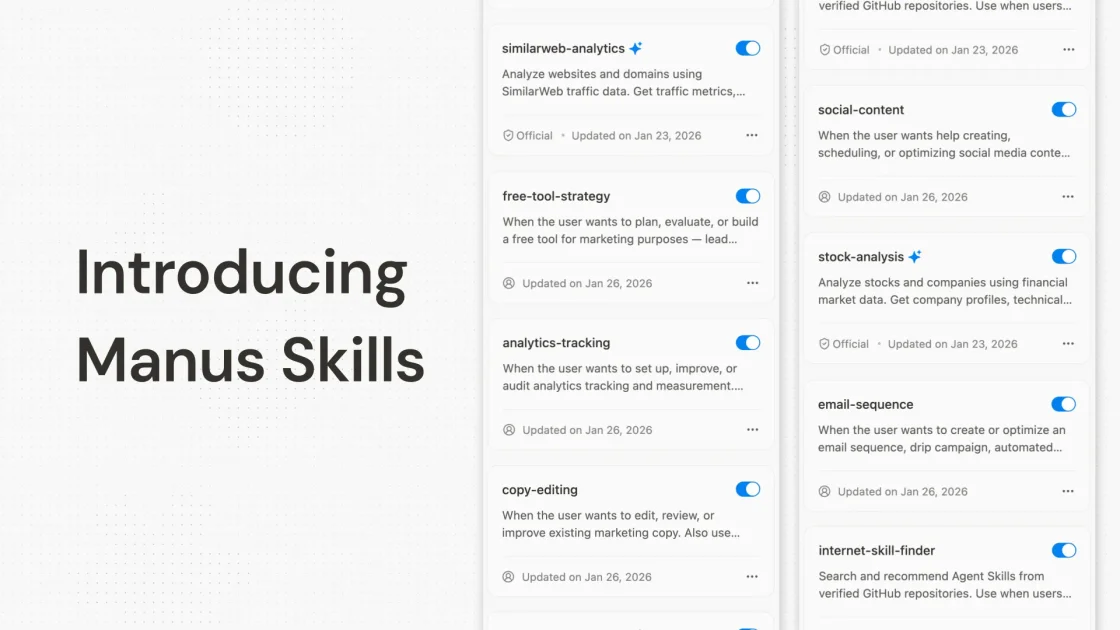
Manus Skills integrates Anthropic’s Agent Skills open standard into Manus AI, packaging workflows as reusable resources loaded on demand.
What is Manus AI?
Manus AI is a general-purpose AI agent from Manus AI that supports business workflows and agent tools. In the context of this page, Manus Skills refers to Manus AI’s integration with Anthropic’s open standard “Agent Skills,” allowing agent capabilities to be packaged into reusable resources.
The core purpose of Manus Skills is to let users capture domain know-how and workflows (e.g., best practices and structured procedures) and have the AI agent load that material on demand—turning a generalist agent into a more specialized assistant for recurring tasks.
Key Features
- Agent Skills open standard integration: Enables Manus AI to work with Agent Skills resources packaged as modular, reusable capability files.
- File-system-based Skill resources: Skills are described as “file-system-based resources,” including a SKILL.md file for instructions and additional referenced materials.
- On-demand loading: Skills are designed to be discovered and loaded by the agent when triggered, rather than relying on one-off, long conversational instructions.
- Progressive Disclosure context strategy: Each Skill is split into levels that load only when needed—reducing unnecessary context usage:
- Level 1 metadata (name/description) loaded at startup (extremely low token cost)
- Level 2 instructions loaded when triggered (moderate token cost)
- Level 3 resources/scripts/files loaded on demand only when referenced
- Reusability and composability: Skills can be created once and reused across conversations/projects, and multiple independent Skills can be combined to support complex, multi-step workflows.
- Manus AI sandbox execution compatibility: Manus AI runs in a fully isolated sandbox virtual machine environment with Ubuntu file system access and shell execution, which supports reading the Skill directory, parsing SKILL.md, and executing Python or Bash scripts contained in Skills.
How to Use Manus AI
- Create or capture a best-practice workflow as a Skill: Turn a successful interaction or repeatable process into a Skill resource (including metadata and a SKILL.md instruction file).
- Trigger the Skill when you need it: When the agent encounters a task that matches the Skill, it loads the Skill content at the appropriate level (metadata, then instructions, then resources as referenced).
- Reuse the Skill across work: Apply the same Skill to similar tasks later without re-writing the full instructions each time.
- (For teams) share validated Skills: The page describes an upcoming “Team Skill Library” concept where team members can share personal Skills with others.
Use Cases
- Specialized task workflows (domain expertise): Use Skills to support recurring expert tasks such as legal review, financial analysis, or branded content creation by packaging procedures and best practices into reusable resources.
- Personal productivity for repeat tasks: Capture a workflow that reliably completes a complex task, then invoke the same Skill later to reduce repetitive thinking and trial-and-error.
- Team onboarding and reuse of expertise: Share validated Skills so newer or less experienced team members can apply expert workflows without recreating the process from scratch.
- Multi-step automation with supporting assets: Build a Skill that includes scripts and reference files, such as a “Market Research” workflow that uses browser actions, processes downloaded data via a script, and generates a report from a preset template.
- Composing multiple Skills for complex jobs: Combine independent Skills to support tasks that require different capabilities (for example, steps involving research, analysis, and report drafting).
FAQ
What are Agent Skills?
Agent Skills are an open standard that packages expertise, workflows, and best practices into modular, reusable resources that an AI agent can load on demand.
What does “Progressive Disclosure” mean for Skills?
Progressive Disclosure divides Skill content into levels that load only when needed: metadata loads at startup, instructions load when the Skill is triggered, and scripts/files load on demand only if referenced.
Can Skills include scripts and files?
Yes. The page describes Skills as including resources such as scripts and reference files/assets, and it explains that Manus AI can execute Python or Bash scripts contained in the Skill resource.
How do Skills help compared with long chat instructions?
The page contrasts Skills with one-off, lengthy conversational instructions by describing Skills as discoverable, loadable resources that can be reused across multiple tasks.
Is there support for teams?
The page mentions an upcoming “Team Skill Library” where team members can share validated personal Skills, lowering the barrier to entry for others. Exact timing and details are not provided.
Alternatives
- Template-based prompting / chat instruction files: A common alternative is saving long prompts or task checklists in documents and reusing them manually. This differs because Skills are described as on-demand, modular resources with progressive disclosure.
- General agent configurations without Skill packaging: Users may rely on the agent’s general capabilities plus ad-hoc guidance per task. Compared to Skills, this typically requires repeating instructions rather than loading structured, reusable resources.
- Other knowledge-base or workflow automation tools: Tools that store SOPs, policies, or playbooks can support repeatable work. Skills differ by being designed to be loaded by an AI agent and to include executable resources (scripts) referenced by the Skill.
- No-code workflow automation for multi-step tasks: When a workflow is strictly procedural, teams may use automation platforms instead of agent-loaded resources. The difference is that Skills are designed to be discoverable/triggered and to integrate with the agent’s tool use.
Alternatives

Codex Plugins
Use Codex Plugins to bundle skills, app integrations, and MCP servers into reusable workflows—extending Codex access to tools like Gmail, Drive, and Slack.

Struere
Struere is an AI-native operational system that replaces spreadsheet workflows with structured software—dashboards, alerts, and automations.

Lasso
Lasso is an AI-first PIM for ecommerce teams that enriches product attributes and descriptions, processes supplier data, and monitors competitors via app or API.

garden-md
Turn meeting transcripts into a structured, linked company wiki with local markdown and an HTML browser view. Sync from supported sources.

Falconer
Falconer is a self-updating knowledge platform for high-speed teams to write, share, and find reliable internal documentation and code context in one place.

OpenFlags
OpenFlags is an open source, self-hosted feature flag system with a control plane and typed SDKs for progressive delivery and safe rollouts.