

MartinLoop
MartinLoop is a governed runtime for AI coding agents, with rules before execution, checks before completion, and records after each run.
What is MartinLoop?
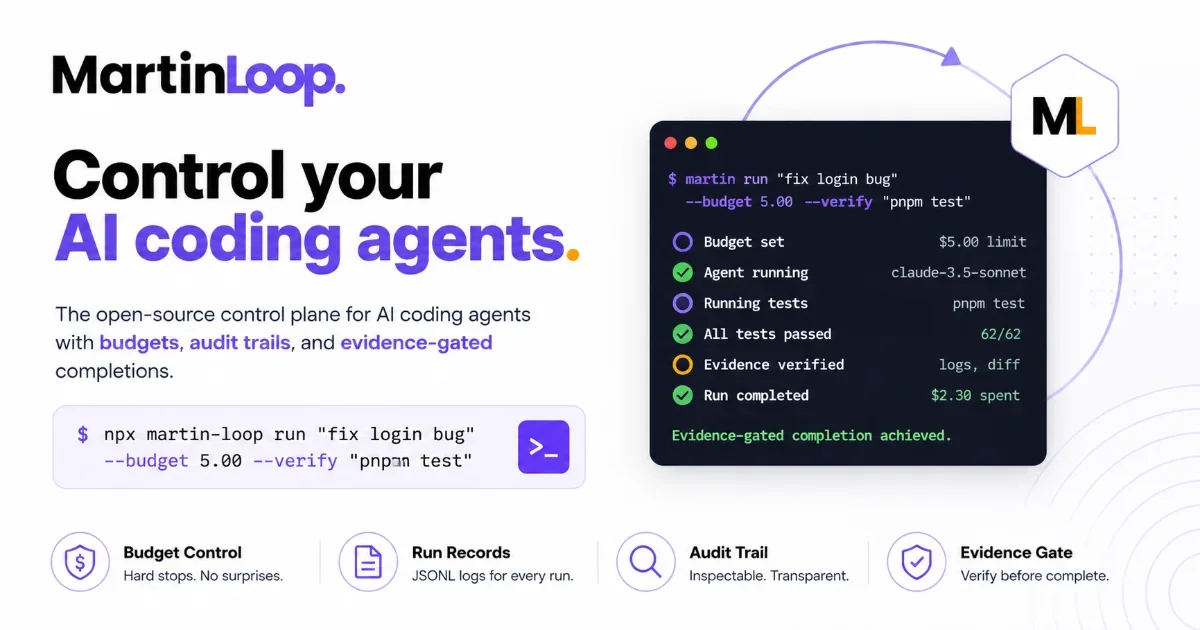
MartinLoop is a governed runtime for AI coding agents. It is designed to sit around agents such as Claude, Codex, or custom models and provide the controls needed to run code-changing tasks with more oversight: rules before execution, checks before completion, and a record after each run.
The product focuses on making agent work easier to manage in team settings. Instead of treating the model as the system, MartinLoop handles retry logic, budget enforcement, run records, and completion checks so teams can review what happened and decide whether the output is ready to merge.
Key Features
- Smarter retries: failed attempts are compressed into structured signals instead of being sent back raw, which helps keep token usage flat across retries.
- Targeted failure handling: MartinLoop groups failures into 12 classes and applies different fixes depending on the problem, such as constraint repairs for syntax errors and grounding checks for hallucinations.
- Hard budget caps: users can set a dollar limit before a run starts, and MartinLoop monitors spend in real time and stops when the cap is reached.
- Smart exits: the system can end a run cleanly when returns diminish or the budget ceiling is approaching, rather than continuing unnecessarily.
- Accurate cost accounting: it counts all tokens involved in the run, including thinking tokens and sub-agent spend, to reduce under-reporting.
- Run records and governed completion: the source mentions JSONL run records and evidence-gated completions, giving teams an audit trail and a way to verify results before a run is considered finished.
How to Use MartinLoop
A typical workflow is to connect MartinLoop around the AI coding agent you already use, define the rules and budget for the run, and start the task. MartinLoop then manages retries, monitors cost, applies failure-specific handling, and records the run outcome.
After the run, teams can review the record and any completion evidence to understand what happened, what was fixed, and whether the result is acceptable to merge or continue working on.
Use Cases
- Production AI coding workflows: engineering teams can run Claude, Codex, or another agent under controlled rules when the output may be merged into a repository.
- Budget-managed agent execution: platform or engineering leaders can set a dollar ceiling for a task so agent spend stays predictable during longer or repeated runs.
- Debugging repeated agent failures: teams can use targeted failure handling to respond differently to syntax errors, hallucinations, and other classes of failure instead of retrying blindly.
- Auditability and review: organizations that need a record of what an agent did can use the JSONL run logs and post-run records to inspect changes and decisions.
- Team governance around agent work: groups that want checks before completion can use MartinLoop to add an approval or evidence step around autonomous code generation.
FAQ
Is MartinLoop another coding agent? No. The source describes MartinLoop as the system around AI coding agents, not the worker that writes the code.
Which agents does it work with? The page explicitly mentions Claude, Codex, and custom agents. Beyond that, the source does not specify other compatible tools.
Is MartinLoop open source? Yes. The core is Apache 2.0 licensed. The hosted dashboard and managed control plane are described as commercial.
Does it include pricing? The open source core is listed as free. Paid plans are marked as coming soon and early access, but the page does not provide specific prices.
Who is it for? The FAQ and page copy point to engineering teams, platform teams, and CTOs running AI coding agents in production who need control, auditability, and records.
Alternatives
- Using an AI coding agent directly: tools like Claude or Codex can generate and edit code, but they do not provide the surrounding governance layer MartinLoop is designed to add.
- General CI/CD or code review workflows: traditional pipelines can validate code after the fact, but they are not built to manage an autonomous agent during the run.
- Agent orchestration frameworks: broader orchestration tools can coordinate tasks across models and tools, but they may not focus on budget caps, failure-class handling, and run records for coding agents specifically.
- Custom internal wrappers: teams can build their own controls around agents, but MartinLoop packages the runtime, logging, budget management, and completion checks into one system.
Alternatives

AakarDev AI
AakarDev AI is a powerful platform that simplifies the development of AI applications with seamless vector database integration, enabling rapid deployment and scalability.

Arduino VENTUNO Q
Arduino VENTUNO Q is an edge AI computer for robotics, combining AI inference hardware and a microcontroller for deterministic control. Arduino App Lab-ready.

Devin
Devin is an AI coding agent that helps software teams complete code migrations and large refactoring by running subtasks in parallel.

MakerLoft
MakerLoft is an AI app builder for non-developers that connects to your GitHub repo to generate working apps with auth, payments, files, jobs.

open-codex-computer-use
open-codex-computer-use is an open-source “Computer Use” MCP server that lets AI agents run desktop GUI actions on macOS, Linux, and Windows.

Codex Plugins
Use Codex Plugins to bundle skills, app integrations, and MCP servers into reusable workflows—extending Codex access to tools like Gmail, Drive, and Slack.