

Moryflow
Moryflow is a local-first AI agent workspace to run autonomous agents on your notes and files, keep adaptive memory, and publish outputs to the web.
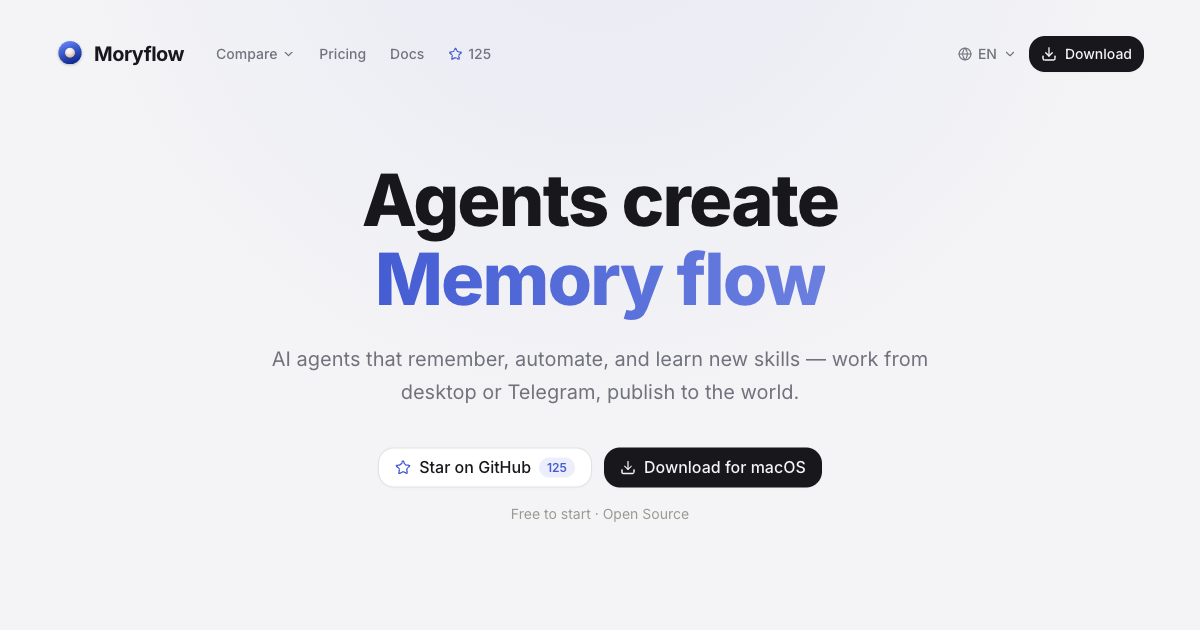
What is Moryflow?
Moryflow is a local-first AI agent workspace that helps you run autonomous agents on your own notes and files, remember context across sessions, and publish results to the web. The core purpose is to keep your knowledge locally while still enabling agents to perform work and turn outputs into shareable pages.
It combines autonomous agent tasks, a local-first knowledge base, and one-click publishing in a single open workspace. You can work from a desktop or connect agents through Telegram while keeping the same underlying context.
Key Features
- Autonomous AI agents for note-and-file workflows: Assign tasks so agents can research, write, organize, and act on your existing notes and files.
- Adaptive memory across sessions: Agents remember preferences, projects, and context as you use the workspace more.
- Trigger-based automations and scheduled tasks: Set up workflows that send messages to Telegram, run agents on a schedule, or react to events.
- Skills for extending agent capabilities: Add reusable, community-built or custom skills so you can expand what agents can do without changing the core.
- Remote Agent via Telegram: Start from Telegram while maintaining the same context and memory as your desktop workspace.
- One-click publishing from notes: Turn a note into a live website (e.g., “digital gardens” or portfolios) without needing a separate CMS.
- Local-first storage and optional sync: Notes and knowledge stay on your device; sync is only done when you choose.
- Bring your own key (BYOK) for AI providers: Support for 24+ AI providers using your own API keys, without a middleman markup on AI costs.
- Open source and self-hostable: MIT-licensed, fully transparent codebase that you can inspect, modify, and self-host.
How to Use Moryflow
- Download and install Moryflow: Public downloads are available for macOS (Apple Silicon and Intel).
- Start with a local-first workspace: Keep your notes and knowledge on your device as you begin running agent tasks.
- Assign tasks to autonomous agents: Provide a goal and let the agent work with your notes and files to produce outputs.
- Add automations if you want hands-free runs: Create trigger-based workflows and scheduled tasks, including Telegram messaging.
- Publish results directly from notes: Use one-click publishing to turn a note into a live website.
- Extend and reuse capabilities: If needed, add skills (community-built or custom) to expand agent behavior.
Use Cases
- Digital garden publishing: Write or refine notes locally with agent assistance, then publish them as live pages using one-click publishing.
- Portfolio site from knowledge: Organize project notes and have agents help draft or structure content, then publish directly to the web without a separate CMS.
- Scheduled research and drafting: Set scheduled tasks so agents periodically research and draft content based on your existing notes, keeping outputs as part of your durable knowledge.
- Telegram-based agent workflow: Use Telegram to initiate work while relying on the same context and adaptive memory maintained by your workspace.
- Reusable workflow automation: Build trigger-based automations that react to events (including sending messages to Telegram) to keep routine tasks running without manual initiation.
FAQ
-
Is Moryflow local-first? Yes. The site states that notes and knowledge stay on your device, with sync only when you choose.
-
Can I use my own AI provider keys? Yes. Moryflow supports 24+ AI providers and uses your own API keys (BYOK), with no middleman.
-
Where can I run or access agents? You can work from a desktop workspace and also use a Remote Agent via Telegram with the same context and memory.
-
How does publishing work? The product includes one-click publishing to turn a note into a live website (for example, a digital garden or portfolio).
-
Is the software open source? Yes. Moryflow is MIT licensed, and the codebase can be inspected, modified, and self-hosted.
Alternatives
- Desktop note-taking + automation with local agents: Use a local-first notes app paired with an automation layer to run AI tasks on your documents, but publishing may require a separate website/CMS setup.
- Agent platforms that depend on hosted knowledge: Platforms that centralize data in the cloud can be easier to start with, but they typically don’t match the local-first storage and “sync only when you choose” model.
- Static site generators for note-to-web publishing: Tools that publish content from files can provide control over websites, but you’d still need to add your own agent layer for autonomous writing and memory.
- Other open-source AI workspace/self-hosted setups: Open-source alternatives may let you self-host and bring your own keys, but they may separate agent execution, memory management, and publishing into different components.
Alternatives

Lasso
Lasso is an AI-first PIM for ecommerce teams that enriches product attributes and descriptions, processes supplier data, and monitors competitors via app or API.

Codex Plugins
Use Codex Plugins to bundle skills, app integrations, and MCP servers into reusable workflows—extending Codex access to tools like Gmail, Drive, and Slack.

Struere
Struere is an AI-native operational system that replaces spreadsheet workflows with structured software—dashboards, alerts, and automations.

garden-md
Turn meeting transcripts into a structured, linked company wiki with local markdown and an HTML browser view. Sync from supported sources.

Tavus
Tavus builds AI systems for real-time, face-to-face interactions that can see, hear, and respond, with APIs for video agents, twins & companions.

Falconer
Falconer is a self-updating knowledge platform for high-speed teams to write, share, and find reliable internal documentation and code context in one place.