
Persistent project memory
PMB records decisions, lessons, facts, files, and entities into a single local memory store so the agent can reuse them later.

PMB is a local-first memory layer for AI coding agents, storing decisions, lessons, and facts in a SQLite file on your disk. Works with Claude Code, Cursor, Codex, and Zed.
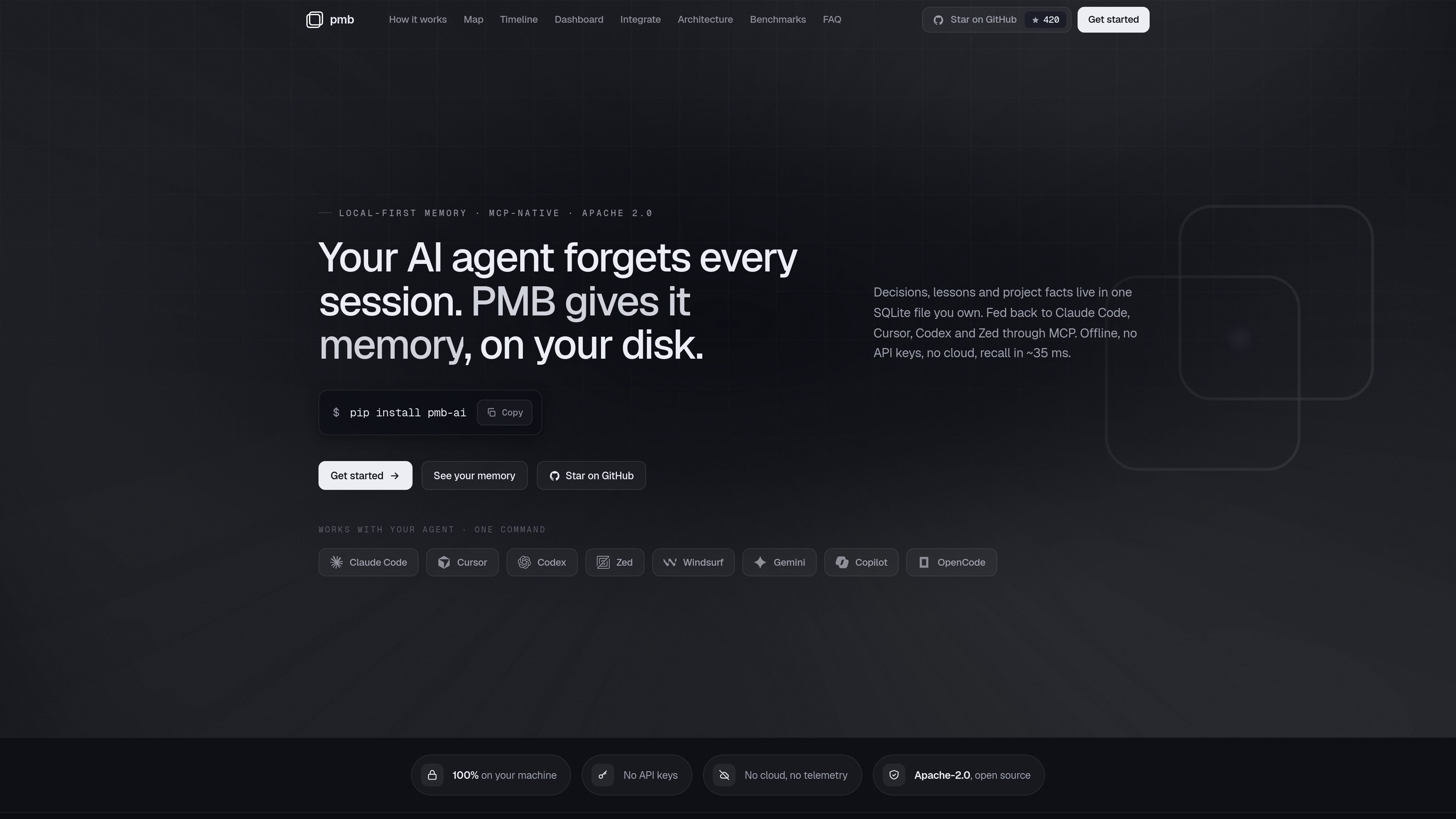
PMB is a local-first memory layer for AI coding agents. It gives tools such as Claude Code, Cursor, Codex, and Zed a shared place to store decisions, lessons, facts, and project context in one SQLite file on your disk.
The product is designed to inject relevant memory before an agent answers and to write new information after the turn, so context persists across sessions without API keys, cloud services, or telemetry. The source also describes a dashboard for exploring the memory graph and timeline, plus support for running optional summarization and extraction locally.
PMB records decisions, lessons, facts, files, and entities into a single local memory store so the agent can reuse them later.
Hooks inject relevant memory before the model answers, and PMB journals the agent’s work afterward, so recall does not depend on the agent remembering to ask for it.
The source says recall combines BM25, dense vectors, an entity graph, and optional reranking, then fuses the results with reciprocal-rank fusion.
Writes are asynchronous and the tool returns immediately; the write path is described as sub-millisecond while indexing continues in the background.
PMB surfaces a live map and timeline for exploring memory by entity, kind, cluster, and event order.
The product integrates over MCP using stdio, with the server running as a child process of the agent and no network port or token required.
Use PMB to keep project conventions, decisions, and bug history available across sessions so a fresh chat does not start from zero.
Use one shared workspace memory when switching between Claude Code, Cursor, Codex, or Zed so context follows the project instead of the editor.
Let PMB capture lessons and rules during day-to-day coding, then revisit the dashboard to see which memories are being followed and which ones should be pruned.
Use the local dashboard’s map and timeline to inspect what was recorded, how items connect, and what happened most recently in a project’s history.
Run PMB with local models for summarization or graph extraction when you want the memory pipeline to stay offline end to end.
PMB runs as a local SQLite-backed memory store on your machine. The source says there are no network calls on the read path, no account, and no telemetry, and that it still works offline.
The source describes PMB as using hybrid recall: BM25, dense vectors, an entity graph, and optional reranking, fused with reciprocal-rank fusion. It is presented as a memory layer rather than a plain vector database.
PMB supports Claude Code, Cursor, Codex, and Zed according to the homepage. It connects over MCP/stdio and can be wired into an agent from the terminal.
Yes. The homepage says you can bring your own model or run the optional summarize and graph-extract passes on a local model such as Ollama.
The source says PMB is useful for project memory, decisions, lessons, facts, and keeping agent context across sessions and tools. It is aimed at coding workflows where the same project context should persist.

ByteAsk is a terminal-first AI coding agent for C and C++ that edits repos and verifies changes with compilers, debuggers, sanitizers, and tests.

Ghost is a terminal-based AI assistant for chatting, code generation, and CLI tasks. Includes free models, supports Linux, macOS, Windows, and is open source.

Goldfish is an AI memory app for macOS that helps you reply, write, summarize, and continue with context already on your Mac. It stores memory locally and writes in your tone.

Lasso is an ecommerce product data platform for enriching catalog records, processing supplier files, generating product content, and tracking competitors. It includes a web app, REST API, SDK, and MCP server.

CreateOS Sandbox is an isolated compute environment for running code and agent workloads in Firecracker micro-VMs with private networking and SDK, CLI, or MCP control.

Struere turns spreadsheet data into structured operational software with dashboards, alerts, and automations for teams replacing manual spreadsheet workflows.