
Sourced use-case directory
Browse a large collection of real things people have built or done with Meta Muse, including personal-agent tasks, software projects, and model experiments.

shipwithmuse is an independent, hand-sorted directory of Meta Muse use cases, projects, and workflows for researching agent errands, coding, connectors, creative builds, and local models.
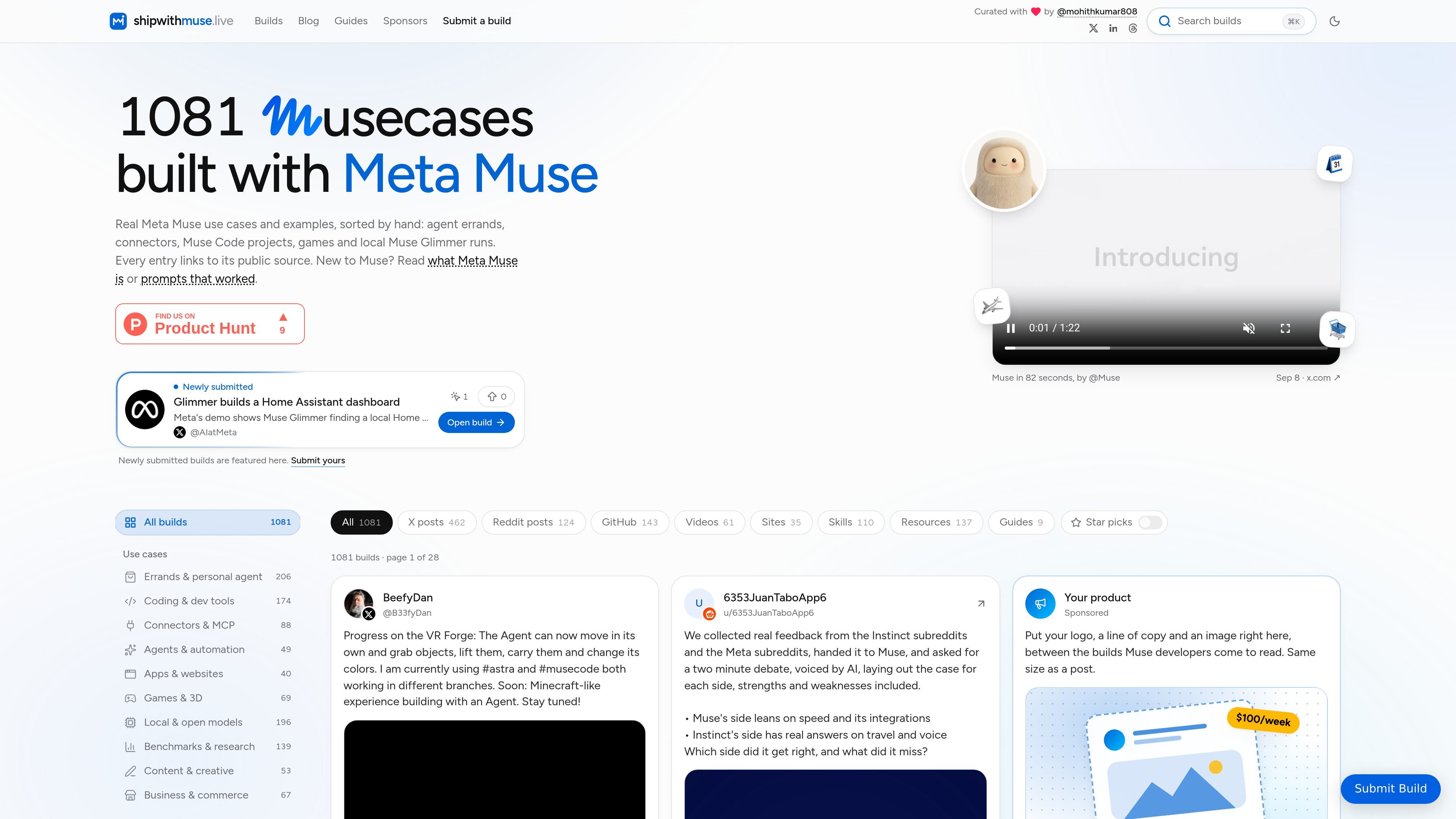
shipwithmuse is an independent directory of real Meta Muse use cases and projects. It collects publicly sourced examples of people using Muse for errands, scheduling, browsing, purchases, coding, connector-based workflows, creative work, games, and local model runs.
The catalog is designed as a research and discovery reference: readers can browse examples by category and source type, then follow the original post, repository, video, or site for context. Its accompanying guides explain the Meta Muse ecosystem and beginner workflow, while noting that reported numbers and capabilities come from their authors and that shipwithmuse is not affiliated with Meta.
Browse a large collection of real things people have built or done with Meta Muse, including personal-agent tasks, software projects, and model experiments.
Entries are grouped into practical categories such as Errands & personal agent, Coding & dev tools, Connectors & MCP, Apps & websites, Games & 3D, and Local & open models.
Review examples from multiple source formats, including X posts, Reddit posts, GitHub projects, videos, sites, skills, resources, and guides.
Find examples spanning Meta Muse’s wider ecosystem, including the personal agent, connectors, Muse Code, Muse Glimmer, and related agent workflows.
Use the site’s guides to understand Meta Muse, beginner setup, Muse prompts, Muse Engineering, pricing topics, and using Muse outside the US.
Review examples of scheduling, form filling, travel planning, purchases, phone calls, file work, and other agent errands to identify tasks that may fit a personal-agent workflow.
Study connector and MCP examples to understand how agents can interact with services and where a structured integration may be relevant to a project.
Look through coding, app, and Muse Code projects for implementation ideas, technical patterns, and examples of agents working with software or a cloud computer.
Compare Games & 3D, Content & creative, and Apps & websites examples when evaluating whether Muse can support a creative or interactive build.
Read Local & open models and Benchmarks & research entries to examine reported Glimmer runs, model performance observations, and self-hosted experimentation.
shipwithmuse is an independent, hand-sorted catalog of real things people have built or done with Meta Muse. Entries are linked to their public source, and the site states that it is not affiliated with Meta.
The catalog covers agent errands, connectors, Muse Code projects, games and 3D work, local Glimmer runs, coding, content creation, business tasks, benchmarks, and related examples. Categories and source types help organize the collection.
The site is useful for people exploring Meta Muse, looking for task ideas, researching agent workflows, or comparing examples of personal-agent, coding, connector, and local-model usage. It is a reference catalog rather than the Meta Muse product itself.
Each catalog entry carries a public source or receipt according to the site’s description. The collection includes posts and examples sourced from platforms such as X, Reddit, GitHub, video pages, and websites.
The catalog reflects a changing ecosystem and reports details from the original authors. Availability, capabilities, regional access, and model behavior should be checked against current Meta documentation before relying on an example.

Lasso is an ecommerce product data platform for enriching catalog records, processing supplier files, generating product content, and tracking competitors. It includes a web app, REST API, SDK, and MCP server.

Botacts is a web directory for finding AI bots and agents you can contact by phone, email, SMS, WhatsApp, Telegram, or Signal.

Tavus is an AI video platform for real-time face-to-face agents, digital twins, and AI companions, with APIs and multilingual workflows for developers.

HiringPartner.ai is an autonomous AI recruiting platform for sourcing, screening, and interviewing candidates 24/7 with ATS-connected workflows and bulk resume uploads.

Macuse is a macOS app that lets AI assistants control native Mac apps through MCP and use Computer Use for any app, with on-device automation.

AgentMail is an email inbox API for AI agents to create, send, receive, and search messages via REST APIs and SDKs. Built for threaded workflows, verification, support, scheduling, and approvals.