
Single transactional memory layer
Stores documents, conversations, entities, attributes, relations, embeddings, and traces in one ACID-transactional database so memory stays inside a single substrate rather than split across multiple stores.

Spectron is a provenance-first memory and knowledge layer for AI agents on SurrealDB. Early preview, waitlist access, managed deployment via SurrealDB Cloud.
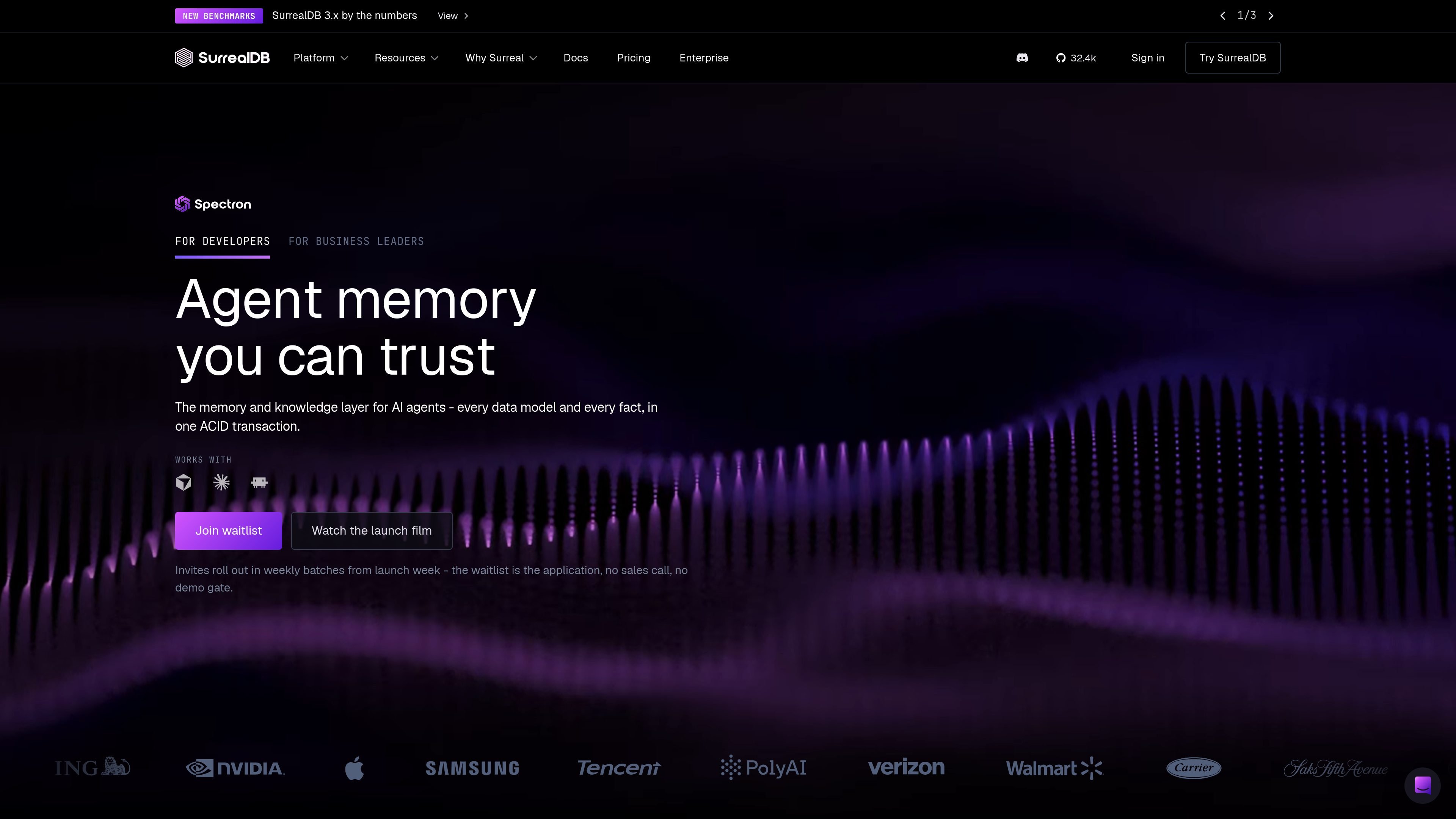
Spectron is a provenance-first, tri-temporal memory and knowledge layer for AI agents built on SurrealDB. It is designed to keep documents, conversations, entities, relations, embeddings, and traces in one ACID transaction so agent memory does not have to be stitched together from separate vector, graph, and row stores.
The product is presented as an early-preview system with a waitlist-based access model. The homepage frames Spectron as the memory layer, while SurrealDB Cloud provides the managed substrate underneath, with options for development, production, and enterprise deployment across the broader SurrealDB platform.
Stores documents, conversations, entities, attributes, relations, embeddings, and traces in one ACID-transactional database so memory stays inside a single substrate rather than split across multiple stores.
Captures provenance on every row and uses supersession instead of overwrite, so older beliefs remain visible and replacement is explicit rather than silent.
Supports ingest of text, code, JSON, CSV, PDFs, images, audio, and video, with originals kept in object storage and structured records indexed in the database.
Extracts typed entities, attributes, and relations from turns and document chunks, alongside embeddings, RAKE keywords, and location attributes.
Uses a four-tier read path of direct lookup, response reuse, hybrid retrieval, and full-context fallback, with each read producing a retrieval trace.
Includes background reflection, elaboration, and consolidation to deepen the graph between interactions and to promote, update, or supersede facts with recorded provenance.
Build agent memory that can distinguish between conflicting facts, preserve superseded beliefs, and show which source supported a given answer.
Index documents, conversations, and multimodal artifacts together so an application can retrieve context without stitching across separate systems.
Support multi-user or multi-instance workflows where memory needs to be shared, scoped, and reconciled without relying on application-layer consistency tricks.
Use the managed SurrealDB Cloud path to evaluate the memory layer without provisioning and operating storage or infrastructure yourself.
Debug agent responses by following the retrieval trace for a read and examining which tier, candidates, and rows were returned.
Spectron is presented as an early-preview memory and knowledge layer for AI agents. The page says the waitlist is the access path, with invites rolling out in weekly batches from launch week.
The page positions Spectron as the memory layer on top of SurrealDB Cloud, while the underlying SurrealDB substrate ships today. The homepage also points to a getting-started flow for Spectron on SurrealDB’s site.
Spectron’s workflow is described as ingest, extract, connect, and query. It ingests conversations and files, extracts typed entities and relations, reconciles beliefs with supersession and uncertainty, and exposes a retrieval trace on reads.
The source pages do not show a public standalone Spectron price. The pricing and cloud pages show SurrealDB Cloud free, scale, and enterprise offerings, and Spectron is described as running on SurrealDB Cloud.
The source highlights managed cloud deployment and a stateless application tier on top of SurrealDB. It does not document a self-hosted Spectron deployment path on the pages provided.

garden-md is an open-source Node.js CLI that turns meeting transcripts into a local company wiki, linking entities and preserving the original text.

Goldfish is an AI memory app for macOS that helps you reply, write, summarize, and continue with context already on your Mac. It stores memory locally and writes in your tone.

Lasso is an ecommerce product data platform for enriching catalog records, processing supplier files, generating product content, and tracking competitors. It includes a web app, REST API, SDK, and MCP server.

CreateOS Sandbox is an isolated compute environment for running code and agent workloads in Firecracker micro-VMs with private networking and SDK, CLI, or MCP control.

Codex Plugins bundle reusable skills, app integrations, and MCP servers into workflows you can install in the Codex app or use from Codex CLI.

Struere turns spreadsheet data into structured operational software with dashboards, alerts, and automations for teams replacing manual spreadsheet workflows.