
Customizable sound environments
TiniAid lets users choose a sound balance that fits their current energy level and return to familiar environments when needed.

TiniAid is a focus support app for iPhone, iPad, and web that uses structured, techno-inspired sound to help neurodivergent users manage stimulation and attention.
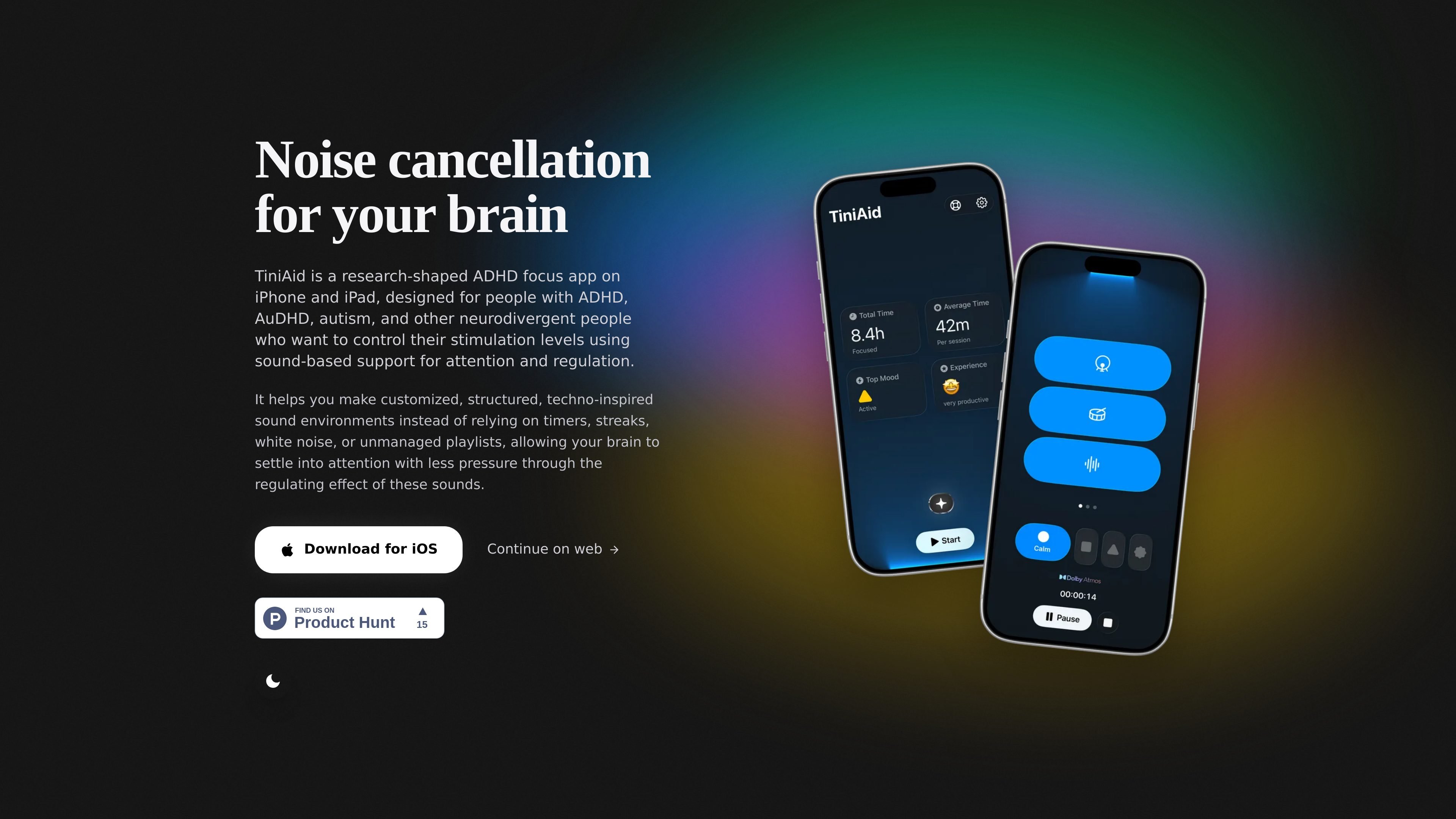
TiniAid is a focus support app for people with ADHD, AuDHD, autism, and other neurodivergent experiences. It uses structured, techno-inspired sound environments to help users control stimulation and settle into attention without relying on timers, streaks, or generic background audio.
The product is positioned as a sound-based accessibility tool rather than a productivity tracker. Across the site, TiniAid emphasizes customizable audio environments, open-ended sessions, and research-informed sound design as a gentler alternative to white noise, playlists, and timer-first focus apps.
TiniAid lets users choose a sound balance that fits their current energy level and return to familiar environments when needed.
The app uses structured, techno-inspired audio rather than flat white noise or unstructured playlists, aiming to provide a predictable background anchor.
The product avoids rigid timers, streaks, and gamified pressure, so focus sessions stay open-ended and user-directed.
The site says the audio is designed around sound, attention, and neurodivergent focus research, including repetitive beats and amplitude modulation.
TiniAid is available on iPhone and iPad, with a web option also referenced on the landing page.
Use TiniAid when silence feels distracting or mentally noisy and you want a steady sound backdrop to help you begin work.
Use it for reading, writing, studying, or other solo tasks where predictable audio helps you stay with the task longer.
Use the app when you want stimulation control without a timer, checklist, or streak-based system pushing the session.
Use TiniAid as a familiar sound environment you can return to whenever you need to re-enter work after a break or transition.
Use the iOS or web access points when you want a focus-support tool across devices rather than a single-device workflow.
TiniAid is a focus support app that uses structured, techno-inspired sound environments instead of timers or white noise to help neurodivergent users settle into attention.
The site says it is designed for people with ADHD, AuDHD, autism, and other neurodivergent experiences, as well as anyone who wants gentler sound-based support for focus and regulation.
TiniAid is presented as research-shaped and backed by public research on repetitive beats, structured rhythms, and amplitude modulation, along with self-experimentation and early user testing.
It is not a timer-first productivity app or a generic playlist. The product uses customizable, structured sound environments intended to support focus and controlled stimulation without productivity-pressure mechanics.
No. The terms state that TiniAid is a focus support app and not a medical treatment, diagnosis tool, or cure.

Goldfish is an AI memory app for macOS that helps you reply, write, summarize, and continue with context already on your Mac. It stores memory locally and writes in your tone.

ArtDeck is a visual reference board app for iPhone, iPad, and Mac. Collect mixed references on one canvas and study them with ToolBox lenses. Offline, optional iCloud sync, one-time purchase.

Biji is a versatile platform designed to enhance productivity through innovative tools and features.

Malyatko is a baby tracker for feeding, sleep, growth, teething, and milestones. Use it on iPhone, Apple Watch, and widgets offline, with iCloud sharing.

Redline is a budgeting tool for Claude Code that paces sessions by time, tokens, cost, or plan percentage, helping them end with a usable result.

Claude Overlay is a Windows desktop overlay for Claude Code that reads your screen, so you can ask questions, inspect content, and request edits without leaving the app. Uses your existing Claude subscription via Claude CLI.