
Live solar-system map
The home page presents an animated pixel-art map of the solar system with each body placed at its real current position.

AstraPixels is a browser-based solar-system map and catalog with live positions, object pages, upcoming sky events, and searchable claimed-body ownership pages.
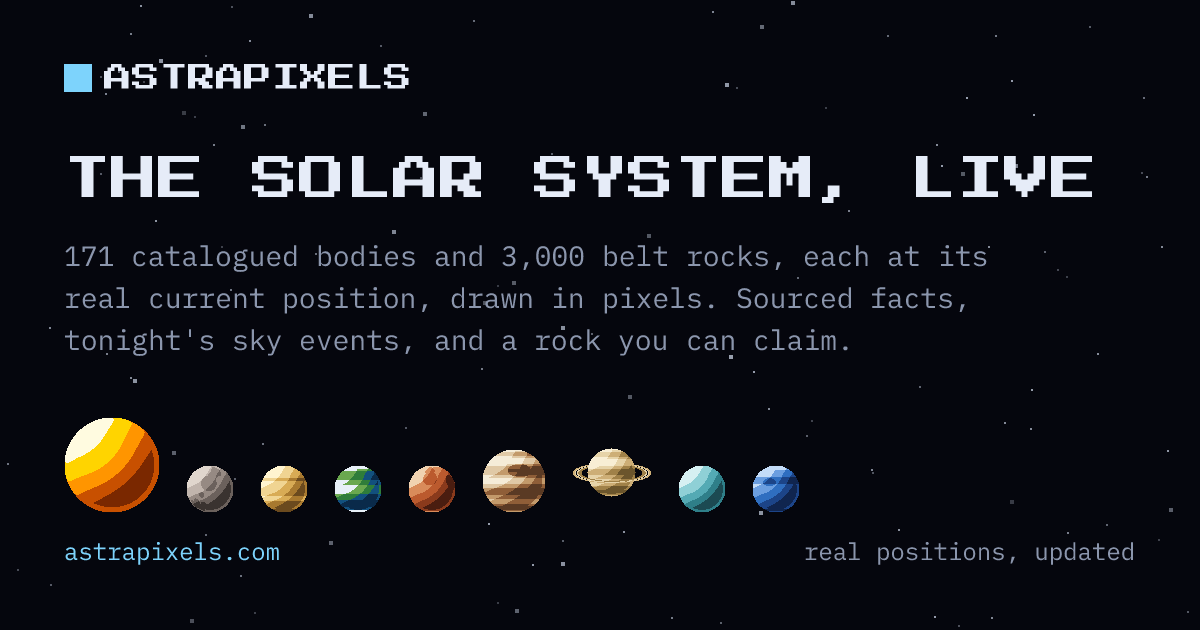
AstraPixels is a browser-based solar-system map and catalog that presents the Sun, planets, moons, minor bodies, and selected stars as live pixel-art objects in their current positions. It combines a visual map with a browsable object index so visitors can inspect individual bodies, their orbital data, and their status on the site.
The product also surfaces sky events and ownership information. The events page lists upcoming conjunctions, oppositions, meteor showers, and eclipses computed from astronomy-engine, while the claimed-objects view shows which bodies or orbital slots have been bought and what owner-chosen names they carry on the site.
The home page presents an animated pixel-art map of the solar system with each body placed at its real current position.
The browse view is a plain-text index of 171 catalogued bodies, grouped by what they orbit, with a page for each object and its sourced facts and orbital elements.
The events page lists upcoming conjunctions, oppositions, meteor showers, and eclipses for the next 180 days, and explains how each event is computed.
The claimed objects page shows which bodies and orbital slots have been claimed, supports search, and records the chosen owner name shown on the site.
The browse index is designed to work in a screen reader, a text browser, and with JavaScript switched off, making the catalog accessible outside the animated map.
The site notes that some body pages may no longer resolve if a claim was recycled or if a slug is spelled differently, and points users back to browse and search entry points.
Use the animated map to see where familiar bodies are in the solar system right now, instead of looking at a static diagram or table.
Open the browse index when you want sourced facts, orbital elements, or a text-first way to move through the catalog.
Visit the events page to see upcoming conjunctions, oppositions, meteor showers, and eclipses for planning stargazing or outreach content.
Use the claimed-objects page to see which bodies are already owned, what names owners selected, and which categories are still available.
Start from the text index if you are using a screen reader, a text browser, or have JavaScript disabled and still need the catalog to work.
AstraPixels is a browser-based solar-system map that shows bodies at their current positions and lets you browse individual object pages. The map itself is presented as a canvas, while the plain-text browse index works without JavaScript and is usable in a screen reader or text browser.
The browse index describes 171 hand-authored catalogued bodies, grouped by what they orbit. It includes the Sun, planets, dwarf planets, moons, minor bodies, comets, and nearby stars, while the main-belt page covers an additional set of procedurally generated rocks that are not listed individually.
The claimed-objects page says bodies are bought once and kept, with one disclosed exception: a link that stops resolving can eventually mark a claim derelict. It also notes that names shown in quotes are owner-chosen names that appear on astrapixels.com, not IAU designations.
The events page shows astronomy events for the next 180 days and says they are computed from astronomy-engine rather than copied from a list. It includes conjunctions, oppositions, the eight annual meteor showers, and lunar and solar eclipses, with times given in UTC.
The source does not show a working pricing page. The referenced /pricing URL returned a "Nothing at this address" message and directed visitors to browse, the main asteroid belt, sky events, or the map instead.

garden-md is an open-source Node.js CLI that turns meeting transcripts into a local company wiki, linking entities and preserving the original text.

PixelForge turns a single photo into a game-ready 2D character sprite pack with a 4×4 sheet, transparent frames, direction strips, and looping walk GIFs for Godot, Unity, Phaser, GameMaker, and web games.

Scite is an AI research platform for finding papers, checking citation context, and getting answers grounded in scholarly literature and patents.

DrDroid is an AI SRE agent for incident investigation that connects cloud, code and telemetry to build a stack-wide knowledge graph for faster root-cause analysis.

NodeDB is a universal database engine combining relational, vector, graph, document, columnar and scientific array data in one Rust binary with PostgreSQL client compatibility.

Mixels.ai is a browser-based AI pixel art generator for 8-bit characters, sprites, avatars, and photo-to-pixel conversions—no software install needed.