
Unified source library
Alexandria brings together the live web, official APIs, registries, licensed publishers, specialized indexes, and site-specific connectors through one library.

Firecrawl Alexandria is a data library for AI agents, combining the live web, APIs, licensed providers, indexes, and structured tools for research, coding, and analysis.
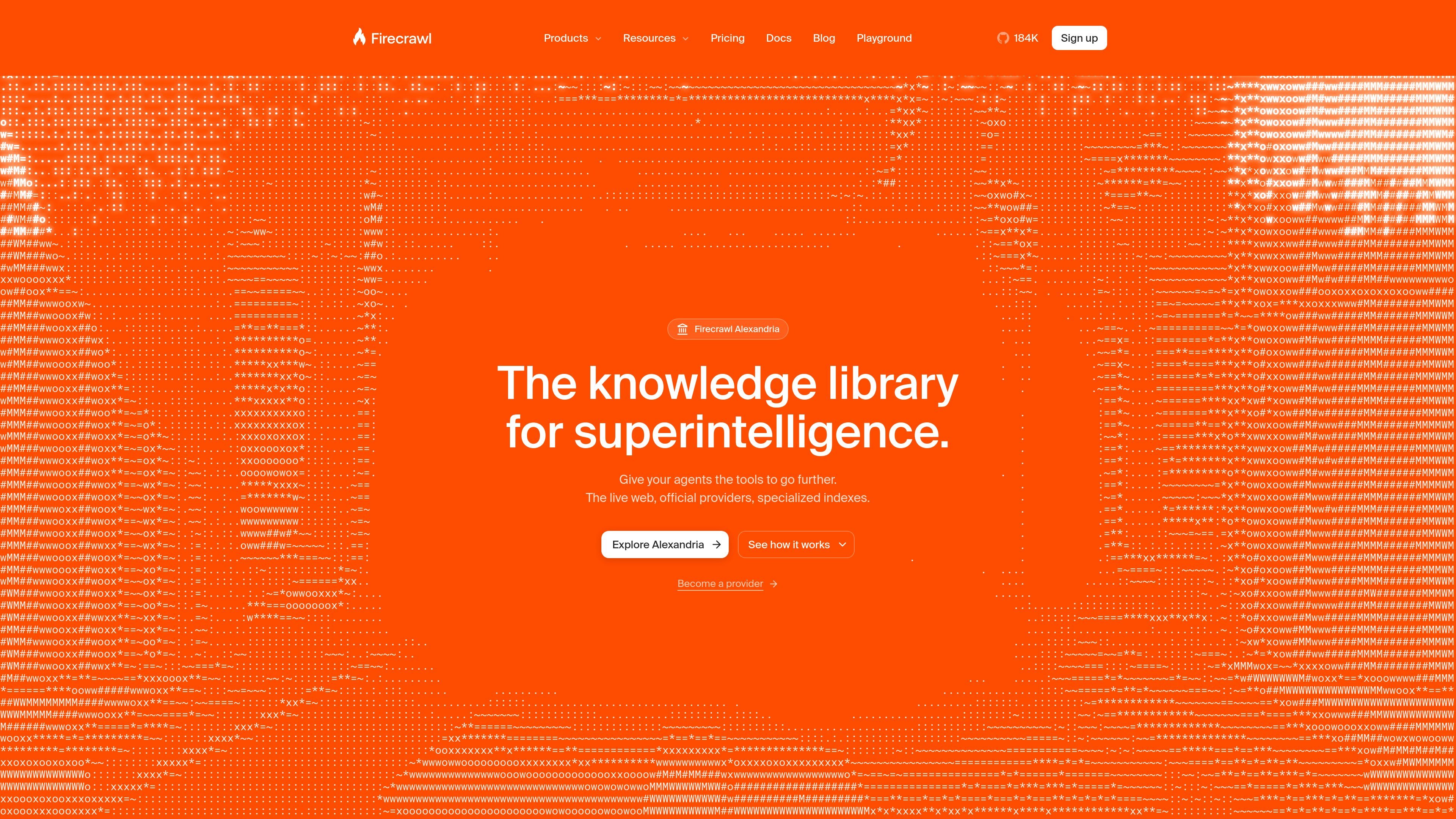
Firecrawl Alexandria is a data library for AI agents that combines the live web with official providers, specialized indexes, and other structured sources. It gives agents a single way to discover and access information spanning research, coding, finance, companies, government, shopping, news, real estate, jobs, health, travel, and people-related data.
The product is intended to improve agent workflows that need more than general web search. Agents can select a source or capability, retrieve direct or structured data, and use focused results for tasks such as research, developer assistance, company analysis, or economic-data queries. Alexandria is available through MCP, the Firecrawl CLI, and Firecrawl API and SDK tooling.
Alexandria brings together the live web, official APIs, registries, licensed publishers, specialized indexes, and site-specific connectors through one library.
Agents can reach data directly from sources that ordinary web search may miss, including company data, product catalogs, government contracts, and code and documentation.
The library is built around richer, structured data that agents can process, with capabilities exposing defined inputs, outputs, and pricing.
Specialized indexes support focused retrieval: the Research Index covers research abstracts and citation-linked passages, while the Developer Index covers READMEs, issues, pull requests, and documentation.
Alexandria can be used through MCP and the CLI, or incorporated into applications through Firecrawl's API and SDKs.
A source-selection flow helps agents discover available providers, choose relevant tools, and retrieve only the data needed for a task.
Use the Research Index to search research abstracts, read relevant passages, and follow citations when an agent needs evidence beyond broad web results.
Connect an engineering assistant to the Developer Index for READMEs, issues, pull requests, and documentation while it investigates libraries or helps resolve implementation questions.
Use provider and index data for company research, financial analysis, earnings information, market calendars, or economic indicators from sources such as Fiscal.ai, Benzinga, and FRED.
Retrieve laws, tax forms, permits, contracts, and other government information from the Government Index and official government sources.
Build an agent or application that combines web search with Alexandria sources, allowing one workflow to compare general web pages with provider-specific or structured data.
Alexandria can be connected to an AI agent through MCP or the Firecrawl CLI. The site also shows API and SDK access for building the library into an application, including a Node.js search example that requests both web and Alexandria sources.
The library combines the live web with official APIs, registries, licensed publishers, specialized indexes, and site-specific connectors. Examples shown on the site include FRED, World Bank, Fiscal.ai, Particle, Benzinga, and Firecrawl's Research, Developer, and Government indexes.
Alexandria is designed to return source-level data and richer structured data that an agent can reason over. Capabilities have defined inputs, outputs, and pricing, and the displayed examples include search, reading passages, following citations, and access to company or economic datasets.
The site describes a workflow of discovering sources, choosing relevant tools, and getting the data. Alexandria is intended to give an agent focused access to selected sources rather than presenting the entire library as undifferentiated options.
Alexandria is presented as part of Firecrawl's platform access model. Firecrawl offers a free plan and paid plans for its web-data platform, but the supplied product page does not specify a separate Alexandria price or Alexandria-specific usage allowance.

CreateOS Sandbox is an isolated compute environment for running code and agent workloads in Firecracker micro-VMs with private networking and SDK, CLI, or MCP control.

GitBot is a local browser workspace for reusable coding bots powered by Claude Code, Codex, or OpenCode, with persistent threads and configurable permissions.

Codex Plugins bundle reusable skills, app integrations, and MCP servers into workflows you can install in the Codex app or use from Codex CLI.

Wallie is an open-source AI streamer that watches your screen, hears chat, and delivers live commentary in a configurable persona. Runs locally with your own keys.

ClayHog is an AI search visibility platform for tracking brand presence in ChatGPT, Gemini, Perplexity, Claude, and Google AI Overviews from one dashboard.

Grok is a free AI assistant developed by xAI, engineered to prioritize truth and objectivity while offering advanced capabilities like real-time information access and image generation.