
Deterministic relationship resolution
Parses code with Tree-sitter and resolves imports, call chains, field types, and return types so the graph reflects concrete code relationships rather than text similarity.

GitNexus by Akon Labs turns repositories into a resolved knowledge graph for agent context, impact analysis, and multi-repo reasoning. Free OSS tier; Enterprise SaaS or self-hosted.
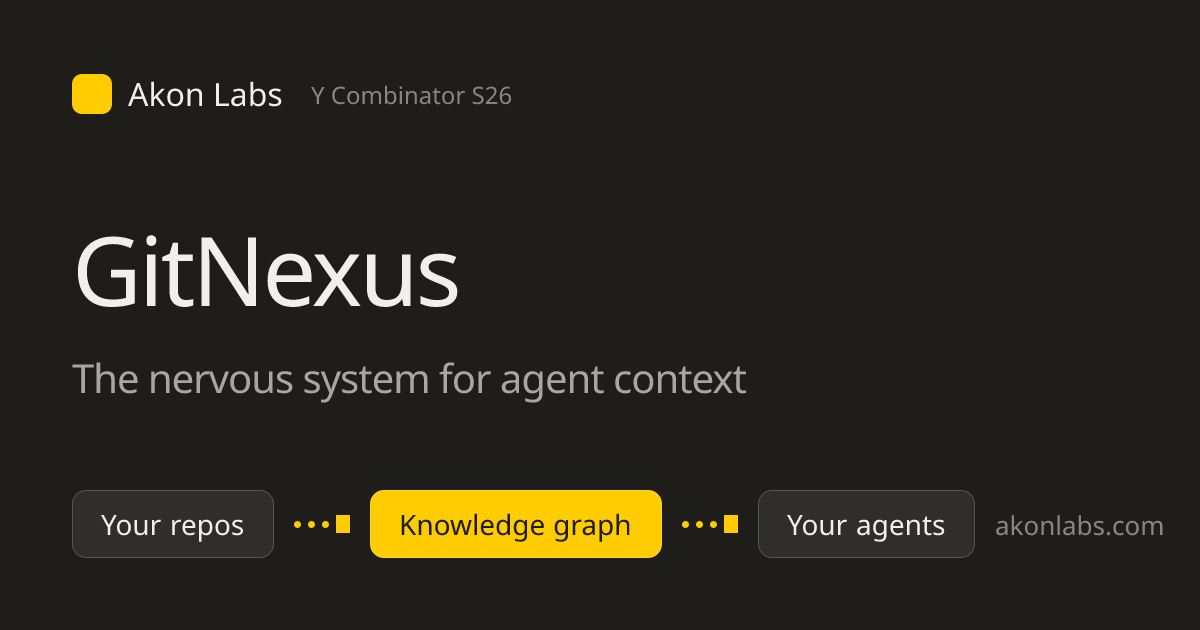
GitNexus is Akon Labs’ code intelligence system for turning repositories into a resolved knowledge graph. It indexes dependencies, call chains, clusters, and execution flows so agents can reason about code structure instead of searching file by file.
The product is built for developer workflows where understanding what a change touches matters as much as the edit itself. It supports local, private indexing and query workflows, while Enterprise adds managed SaaS or self-hosted deployment, automated PR review, auto-updating wikis, and multi-repo graphs.
Parses code with Tree-sitter and resolves imports, call chains, field types, and return types so the graph reflects concrete code relationships rather than text similarity.
Builds a knowledge graph once and reuses it for queries, which lets agents ask for compact, grounded answers instead of re-reading large file sets.
Clusters symbols with Leiden community detection to surface functional modules such as auth, billing, and ingestion, along with cohesion scores.
Traces downstream callers and affected symbols from a proposed change, grouping blast radius by depth and confidence before the edit is merged.
Connects repositories into one graph with cross-repo edges so teams can query multiple services together and see how changes propagate across boundaries.
Exposes the graph through MCP tools and a terminal/web workflow, with integrations for Claude Code, Cursor, Codex, Windsurf, OpenCode, and Antigravity.
Use GitNexus when an AI coding agent needs reliable context about callers, callees, imports, and execution flow before making edits. The graph reduces file-by-file searching and gives the agent grounded structural answers.
Use the blast-radius view to see what a proposed change may affect before merging. The product traces downstream callers by depth and confidence so reviewers can understand likely breakage earlier.
Use the unified graph to reason across service boundaries when a system is split across several repositories. Cross-repo edges connect contracts, symbols, and flows so dependent services can be inspected together.
Use the clustering view to identify functional modules and architecture boundaries in a large repository. Leiden clusters help surface cohesive areas such as auth, billing, or ingestion.
Use GitNexus in a terminal-first or browser-based agent loop when teams want graph context attached to planning, editing, and verification rather than as a separate search step.
GitNexus is the open-source code intelligence engine that indexes a codebase into a resolved knowledge graph. It can answer questions about callers, callees, imports, execution flows, and impact analysis through MCP tools and supported editors or agents.
Yes. The pricing page says GitNexus OSS is free for individual developers and available as open source. It also says Enterprise is available as managed SaaS or self-hosted.
The site says GitNexus works with Claude Code, Cursor, Codex, Windsurf, OpenCode, and Antigravity, and that the graph can also be used through a terminal-first CLI workflow and a browser web UI.
The site says GitNexus supports 13 languages via Tree-sitter. The benchmark page mentions Python, Go, TypeScript, and Rust as languages represented in the DeepSWE benchmark corpus.
The source says GitNexus uses compiler-grade static analysis and a precomputed graph to answer structure questions exactly, while the benchmark page notes that DeepSWE measures one narrow slice and does not cover all product capabilities such as multi-repo graph queries or taint tracking.

ByteAsk is a terminal-first AI coding agent for C and C++ that edits repos and verifies changes with compilers, debuggers, sanitizers, and tests.

Ghost is a terminal-based AI assistant for chatting, code generation, and CLI tasks. Includes free models, supports Linux, macOS, Windows, and is open source.

Vi3ecode is a maintained development environment for AI coding agents, keeping project context, terminal, Git, memory, flows and review connected.

Lucid Train is a local-first AI coding harness that turns repo code into architecture diagrams for coding agents. Desktop app and Rust CLI, local models or API keys.

Devin is an AI coding agent and software engineer for planning and executing complex software tasks, with desktop, cloud, JetBrains, and CLI access.

CreateOS Sandbox is an isolated compute environment for running code and agent workloads in Firecracker micro-VMs with private networking and SDK, CLI, or MCP control.