
Scout developers by search
Search and browse developer profiles using queries such as a username, role, language, or country-specific request.

Gitwork is a web app for scouting and contacting developers from public GitHub activity, with ranked profiles by country, role, or language.
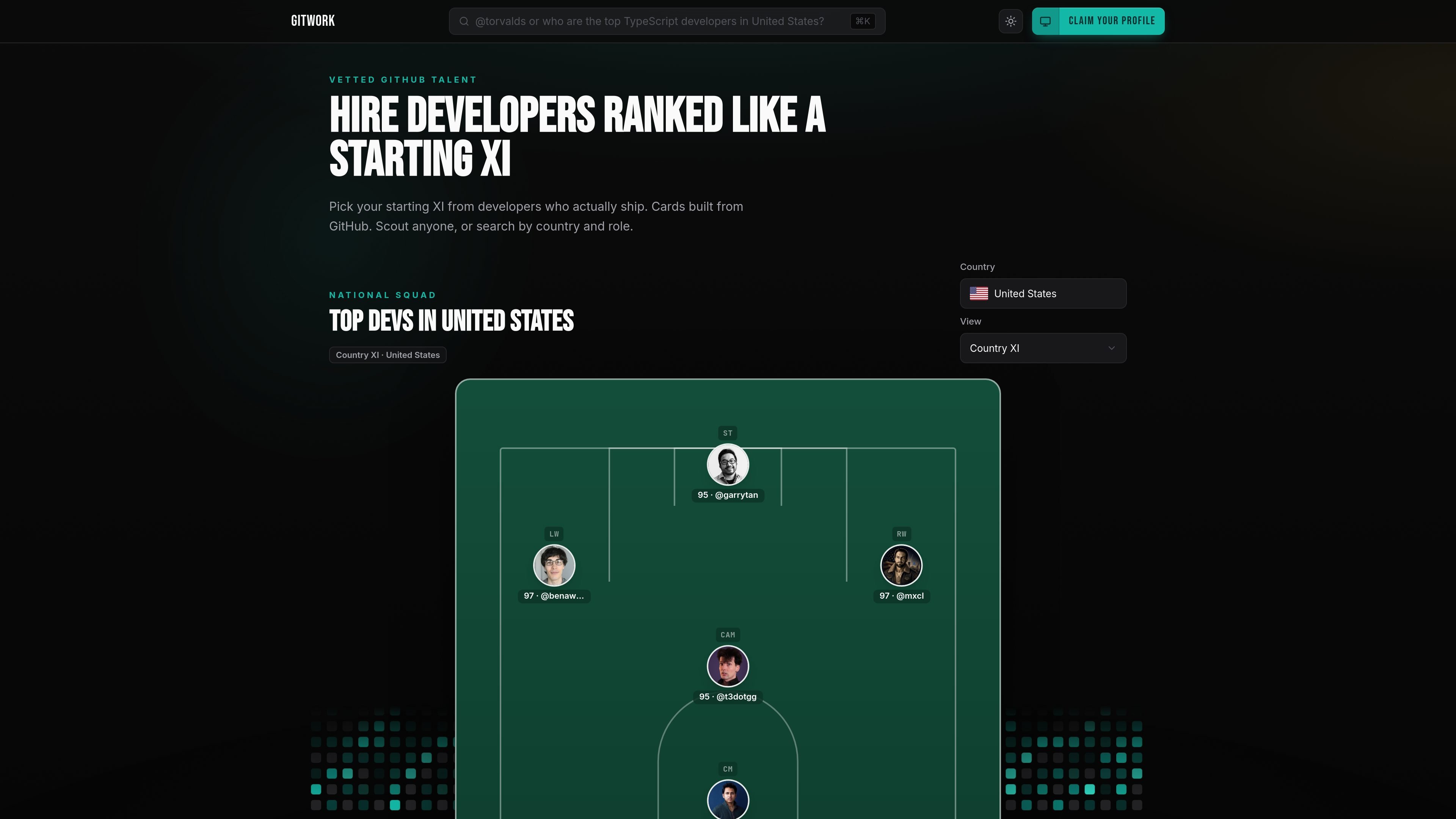
Gitwork is a developer discovery and hiring platform that ranks GitHub profiles by public output. It presents developers as player-style cards and lineups, making it possible to scout talent by country, role, language, or direct username search.
The product is designed for both sides of the hiring flow: clients can search for developers, post requests, and message claimed profiles, while developers can verify ownership of a profile and publish the contact details they want to share. The underlying scoring uses public GitHub activity such as repositories, contributions, stars, reviews, and languages.
Search and browse developer profiles using queries such as a username, role, language, or country-specific request.
Build country-based lineups and role-based rankings from GitHub activity, including a national squad view and a starting XI layout.
Convert public GitHub signals into a player-style card with overall score, role, family, stat breakdown, country, and top language.
Let developers verify ownership through GitHub OAuth so they can publish availability, rates, contact details, and a short bio.
Support client-to-developer hiring threads, including requests, inboxes, and replies from the claimed developer account.
Provide a scoped API for scripted discovery, profile lookup, match/discover flows, and claim or inbox operations.
Use a role-and-country query to find developers for a specific market, then compare the ranked cards in the lineup view before reaching out.
Search by language or role when you already know the technical need, such as TypeScript or a specific position in the lineup.
Claim a profile after GitHub OAuth verification, then publish only the availability and contact details you want clients to see.
Open a hiring request and message a claimed developer through the inbox/thread workflow instead of handling outreach manually.
Automate scouting or profile operations from another system using the documented API and scoped keys.
Gitwork is built for discovering developers from public GitHub activity and then contacting claimed profiles. The browsing experience supports country squads, role-based rankings, and search-style scouting queries.
Developers can sign in with GitHub OAuth, claim their profile, and add availability, rates, a contact email or URL, and a short bio. Claimed profiles can then receive messages from clients.
Gitwork’s docs show a Bearer-token API under /api/v1 with scoped keys. Public website routes like /api/lineup do not require a key, but agent access is intended for /api/v1 endpoints.
The privacy policy says rankings and cards are built from public GitHub activity only. It explicitly states that Gitwork does not access private repositories.
The source material does not show plan tiers or published prices. The pricing page appears to focus on product access and scouting rather than listing concrete paid plans.

HiringPartner.ai is an autonomous AI recruiting platform for sourcing, screening, and interviewing candidates 24/7 with ATS-connected workflows and bulk resume uploads.

Elvixs is an AI job outreach tool for freshers and students that finds hiring contacts, writes personalized cold emails, sends from Gmail, and tracks opens and replies.

Badge turns anonymous peer reviews into a Trust Score, helping job seekers, freelancers and candidates show proof of work to recruiters.

Nova Recruiter is an AI-assisted talent sourcing platform to search 800M+ public profiles, rank candidates by merit, and automate outreach with ATS integration.

topple.lol is a public pay-to-rank leaderboard where listings start at $1 and bid balance decays over time and clicks for short-term visibility.

Podium is an AI lead generation and lead management platform for local businesses. Centralize conversations, follow-up, reviews, payments, and booking with a 24/7 AI Employee add-on.