
AI network search
Search across the accounts you connect and the people in your network, then surface relevant contacts, mutuals, and groups based on a natural-language prompt.

Happenstance is an AI-powered network search tool to find people, mutual connections, and warm introductions across connected accounts, with API, MCP, Slack, and team integrations.
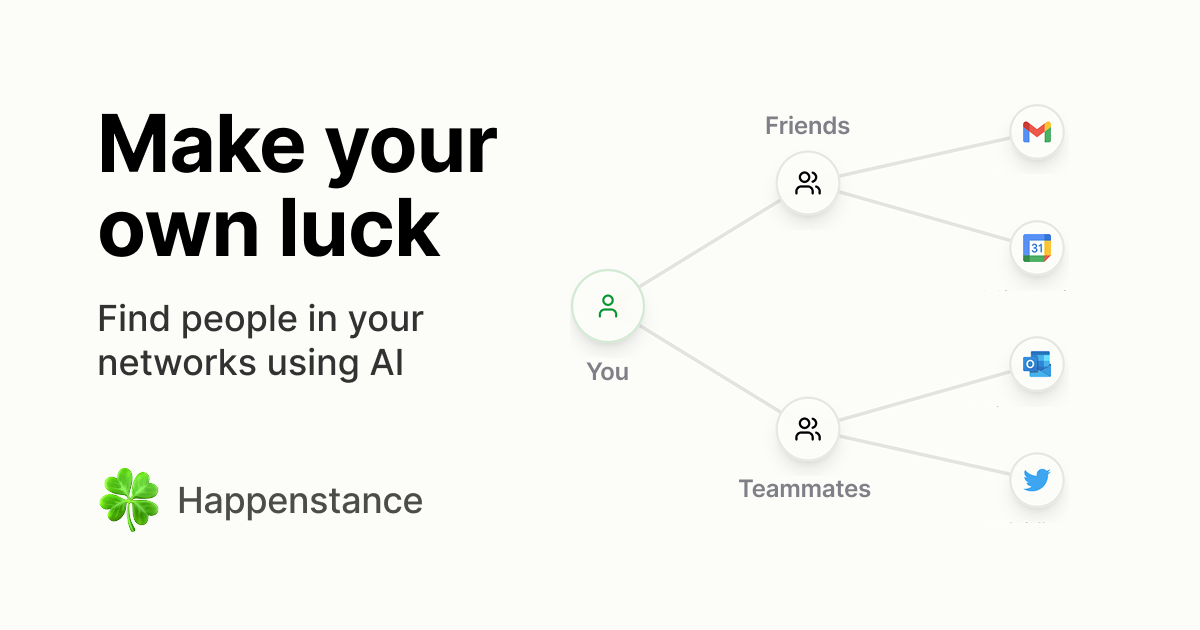
Happenstance is an AI-powered network search product that helps people search across their personal and professional connections instead of starting from an empty contact list. The site positions it for sales, recruiting, fundraising, job searching, and other relationship-driven work.
Users can connect accounts such as Gmail, Calendar, Contacts, LinkedIn, Instagram, Twitter, and Outlook, then ask Happenstance to find people, mutual connections, and possible warm introductions. The product also supports team groups, an API, MCP, Slack, and other integrations for people who want to use the same network search workflow in different tools.
Search across the accounts you connect and the people in your network, then surface relevant contacts, mutuals, and groups based on a natural-language prompt.
Use the product to find warm introductions and mutual connections when you need a path to someone specific, rather than a cold outreach list.
Create a shared group for a company or community so multiple people can search pooled connections in one place.
Use the developer API to create a search, fetch results, and continue the search for additional output when needed.
Connect with AI tools and workplace surfaces such as ChatGPT, Claude, Claude Code, Slack, MCP-compatible clients, and a terminal CLI.
Upgrade for unlimited web searches, CSV export, and early access to new features on the Pro plan.
Search for candidates or hiring targets by role, location, background, and other natural-language criteria, then inspect whether anyone in your network can provide a warm introduction.
Look for potential customers, decision-makers, or adjacent contacts and use connected networks to identify a stronger path to outreach than a cold message.
Find founders, investors, or operators who fit a thesis or event brief and quickly see who in your network is connected to them.
Use the product to locate relevant people in your existing network when you are looking for a job, an advisor, or a second opinion on a career move.
Pool multiple teammates’ or community members’ connections into a shared group so everyone searches the same collective network instead of working alone.
Happenstance connects your accounts and lets you search across the people and groups you already know. The site shows support for Gmail, Calendar, Contacts, LinkedIn, Instagram, Twitter, and Outlook, plus group searches and API/MCP access.
The pricing page shows a Free plan, a Pro plan, and a Team plan. Free includes search, connected accounts, friends, groups, and Slack integration; Pro adds unlimited web searches, CSV export, and early access features; Team adds shared billing, seat assignment, and API credit tracking.
The integrations page lists ChatGPT, Claude, Claude Code, Slack, CLI, MCP, and developer API options. The API page shows a quickstart for creating an API key, submitting a search, checking results, and optionally continuing the search.
The site describes Happenstance as useful for sales, recruiting, fundraising, finding a job, and related research tasks. Example searches on the homepage include finding engineering leaders and AI founders with specific background filters.
The pricing page states that Happenstance never shares, sells, or uses your data to train AI models. The public pages also emphasize connected-account search and team groups rather than a consumer social feed.

Mindcase is a web data API and console for extracting structured data from websites and major platforms, with prompt or API access and prepaid per-record billing.

Mailercloud Email Verifier checks email addresses in bulk, one by one, or via API to reduce bounces and improve deliverability.

topple.lol is a public pay-to-rank leaderboard where listings start at $1 and bid balance decays over time and clicks for short-term visibility.

Podium is an AI lead generation and lead management platform for local businesses. Centralize conversations, follow-up, reviews, payments, and booking with a 24/7 AI Employee add-on.

Octen is a search infrastructure for AI apps needing live web context, structured answers, and retrieval tools via API, SDKs, Skills, MCP, and CLI.

Blinked is a free Chrome extension for LinkedIn outreach to research leads, draft personalized messages, and manage follow-ups locally in your browser.