

Invofox
Invofox is a Document Parsing API that extracts invoices, payslips, and utility bills into clean, validated JSON via webhook for developers.
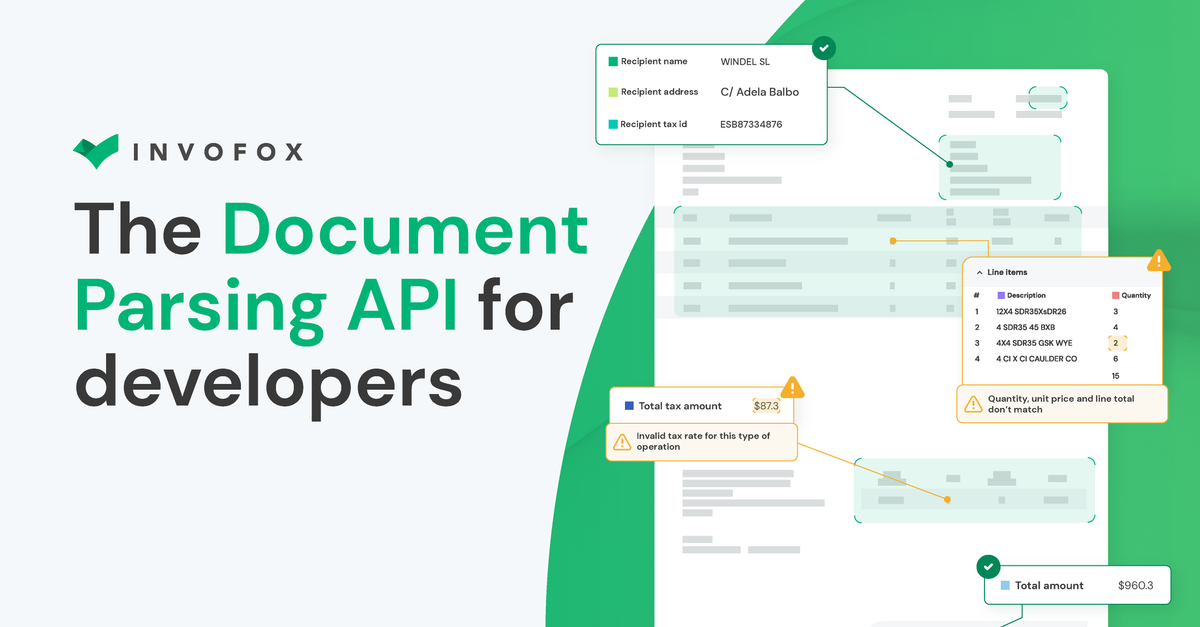
What is Invofox?
Invofox is a Document Parsing API for developers that extracts structured data from documents such as invoices, payslips, and utility bills. It goes beyond OCR by turning unstructured document content into clean, predictable JSON designed for downstream processing.
The core purpose is to help teams reduce manual data entry and data-cleaning work by validating extracted fields, autocompleting missing or uncertain values, and delivering the results as structured output via a webhook.
Key Features
- AI-driven document parsing into JSON: Converts messy, unstructured documents into clean and predictable JSON for easier integration into applications.
- OCR-style extraction with added verification: Combines AI models and proprietary algorithms to validate fields rather than outputting raw text only.
- Autocompletion of extracted data: Helps fill in values that may be incomplete or unclear, improving the usefulness of the extracted result.
- Field validation to catch costly errors: Checks extracted fields to reduce the risk of propagating incorrect data into business workflows.
- Webhook delivery for extracted results: Sends parsed output to your system via webhook so you can automate follow-up steps.
How to Use Invofox
- Identify the document types you need to parse (for example, invoices, payslips, or utility bills).
- Send documents to the Invofox Document Parsing API so it can extract and structure the fields.
- Receive the result as JSON via webhook and map it to your application’s data model.
- Use validated and autocompleted fields to drive downstream processes such as record creation and reconciliation.
If you need to evaluate fit for your workflow, the site also indicates that you can book a demo.
Use Cases
- Invoice processing for accounts payable: Parse invoice documents into structured JSON, then use validated fields and autocompleted values to reduce manual entry when creating or updating payment records.
- Payslip extraction for payroll workflows: Convert payslip content into structured output so payroll systems can ingest consistent fields without relying on OCR text scraping alone.
- Utility bill data capture: Extract details from utility bills and deliver them as JSON for billing reconciliation or customer account updates.
- Handling large and complex document sets: Use document classification and separation concepts to support extraction when documents have varied layouts and multiple pages.
- Reducing latency and operational overhead: Automate parsing instead of manual review of extracted text, aiming to improve operational efficiency when document volumes are high.
FAQ
-
What formats or document types does Invofox support? The provided information explicitly mentions invoices, payslips, and utility bills, and describes document parsing in general.
-
Does Invofox only do OCR? No. The site positions Invofox as going beyond OCR by validating fields, autocompleting data, and outputting clean JSON.
-
What does the API return? It returns structured, predictable JSON delivered via webhook.
-
How does field validation help? Validation is described as a way to catch costly errors that could occur when extracted values are incorrect or incomplete.
-
How do I integrate it into my system? The typical approach described is to send documents to the API and receive the parsed JSON results through a webhook.
Alternatives
- Standalone OCR services: These extract text but typically don’t provide the same combination of field validation and structured JSON aimed at direct workflow ingestion.
- Document processing platforms: Tools that manage document classification and data capture can serve a similar purpose, but may focus more on end-to-end workflows than providing a developer-first parsing API.
- Custom extraction pipelines (OCR + rules/LLMs): Teams can build their own pipeline using OCR and post-processing. This may offer flexibility, but requires more engineering to implement validation, autocompletion, and reliable JSON structuring.
- ETL + templated parsing approaches: If document layouts are highly consistent, templated extraction can work. It often performs less reliably across varied formats and language/locale differences than an AI parsing approach.
Alternatives

Extend
Extend is a document processing platform for parsing, extracting, and splitting complex documents into structured data for production workflows.

Codex Plugins
Use Codex Plugins to bundle skills, app integrations, and MCP servers into reusable workflows—extending Codex access to tools like Gmail, Drive, and Slack.

Nolain OCR
Nolain OCR is an advanced Optical Character Recognition solution designed to accurately extract text and data from various document formats, streamlining document processing workflows.

Snapmark for VS Code
Snapmark for VS Code helps you annotate screenshots before pasting into AI chat tools—blur sensitive areas, add numbered steps, auto-compress large images.

open-codex-computer-use
open-codex-computer-use is an open-source “Computer Use” MCP server that lets AI agents run desktop GUI actions on macOS, Linux, and Windows.

DataSieve: Text to Data
DataSieve: Text to Data extracts emails, dates, URLs, and structured info from text and many file types—offline on iPhone, iPad, and Mac.