
Production-ready delivery
Assets are positioned as production-ready and reviewed to match a team’s art style, technical specifications, and production standards.

Kaedim is an AI-powered 3D asset production service for studios and brands that need production-ready models at scale. It helps teams speed up 3D creation while matching art styles, technical specs, and existing production workflows.
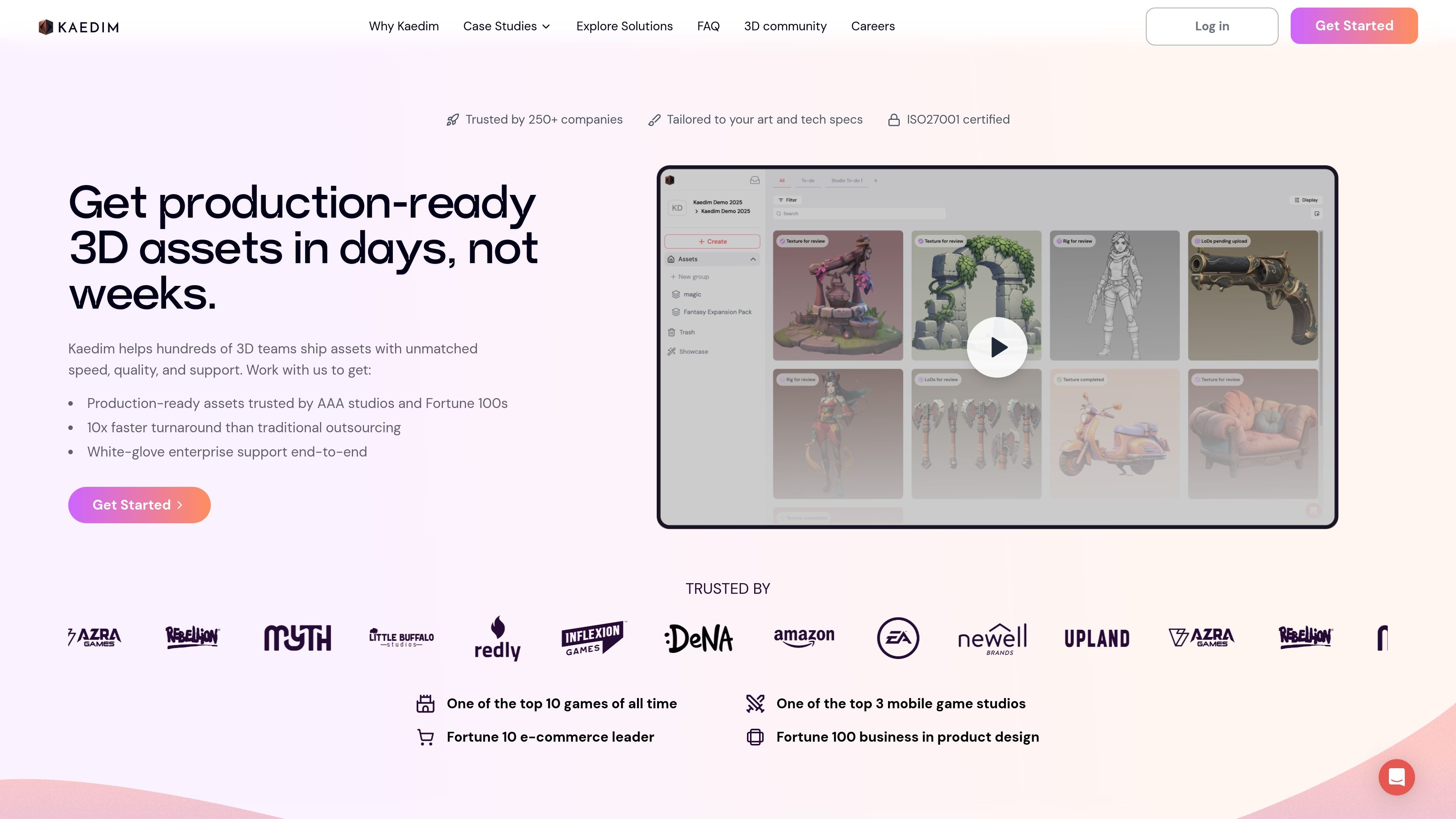
Kaedim is an AI-powered 3D asset production service for studios and brands that need production-ready models at scale. The site positions it as a way to generate 3D assets faster than traditional outsourcing while keeping outputs aligned to a team’s art style and technical requirements.
The product is built around a guided service workflow rather than a simple self-serve generator. Teams book a demo, define asset scope and quality standards, go through onboarding, and then scale production with custom styles, review steps, and support tailored to their pipeline.
Assets are positioned as production-ready and reviewed to match a team’s art style, technical specifications, and production standards.
The company says it can deliver assets up to 10x faster than traditional outsourcing, with days-not-weeks turnaround called out on the homepage.
Kaedim describes a workflow that spans high poly modeling, texturing, rigging, and LODs during trial setup.
Custom Styles are used to align topology, UVs, materials, and format requirements with a team’s existing standards.
Teams get dedicated onboarding and ongoing support, including a communications channel for 24/7 support during setup.
The site says teams can define how to brief, review, organize, and deliver assets, and work with Kaedim on custom features and integrations.
Create production-ready game assets faster when internal artist bandwidth or outsourcing timelines are slowing down delivery.
Prototype and iterate physical products or packaging with 3D assets that support review and approval cycles.
Build scalable 3D catalogs, digital twins, and marketing visuals for retail and e-commerce teams.
Scale content for live-service, mobile, or AAA projects where teams need consistent assets across launches and updates.
Support teams with strict style guides or technical constraints by adapting the pipeline to existing workflows and review standards.
Kaedim uses a guided onboarding and trial process. The team first learns your pipeline, styles, and requirements, then sets up a pilot or trial with agreed asset scope, quality standards, milestones, and delivery dates.
The source describes Kaedim as a fit for studios and brands that need production-ready 3D assets at scale, including games, product design, and e-commerce workflows. It emphasizes matching art style, technical specifications, and production standards.
Kaedim’s workflow is described as production-ready asset creation with review and approval at each stage. The FAQ states that outputs are validated by an expert artist team and returned in engine-ready file formats and structure.
Kaedim says it can align outputs to style guides and technical constraints, including topology, UVs, materials, and format requirements. Its Custom Styles feature is used to adapt the pipeline to a team’s visual and production standards.
The source does not publish self-serve pricing details. The pricing page instead focuses on case studies, savings estimates, and a calculator, while the site encourages teams to book a demo.

AakarDev AI helps teams manage AI provider access, project-level setups, logs, and analytics from one dashboard. It supports BYOK workflows and lists providers including OpenAI, Google Gemini, Anthropic, Groq, Mistral AI, and Perplexity AI.

BookAI allows you to chat with your books using AI by simply providing the title and author.

DeepMotion is a web-based AI motion capture and 3D animation platform with Animate 3D for video-to-animation and SayMotion for text-to-animation. It helps creators and teams generate motion in a browser and export results in common production formats.

Skills Janitor is a GitHub-hosted set of slash commands for auditing, tracking, and managing Claude Code and OpenAI Codex skills. It helps users find duplicates, broken links, and unused skills, then clean them up with self-contained commands.

FeelFish is a PC client for AI-assisted novel writing, designed to help fiction writers plan characters and settings, draft and revise long-form content, and manage story context. It includes a free tier and paid plans, with support for multiple large-model providers.

Benchspan is an AI agent security platform that discovers agents, blocks prompt injection and data exfiltration in real time, and supports pre-launch red teaming. It is aimed at teams running agents in production and includes Python and TypeScript SDKs.